Norse mythology · Gods & goddesses
Heimdall, guardian of Asgard and herald of Ragnarök
In brief
Heimdall, Norse god who guards the Bifröst bridge: his birth from nine mothers, superhuman senses, the Gjallarhorn, his rivalry with Loki, and mutual death at Ragnarök.
- vigilance
- guarding the Bifröst bridge
- the boundary between worlds
- superhuman senses
- +3
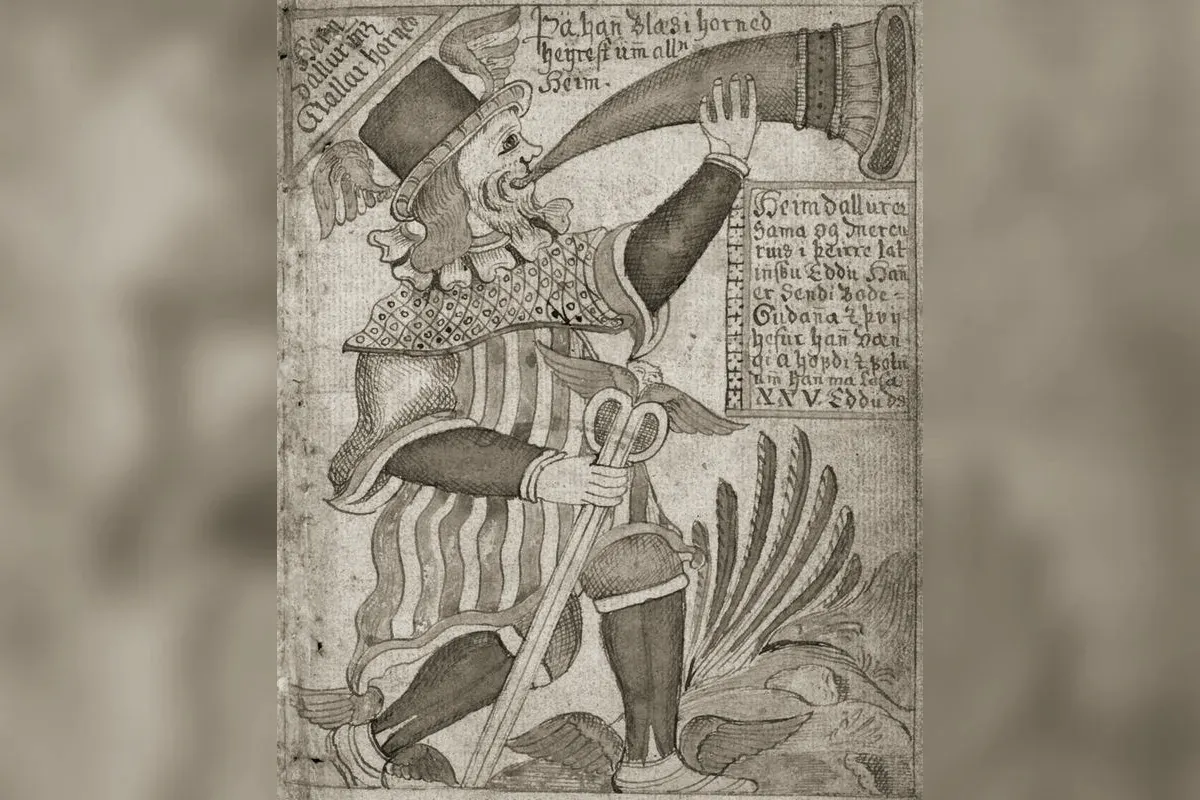
Who is Heimdall?
Heimdall is the Norse god who guards Asgard, standing permanent watch at the entrance to the Bifröst, the burning rainbow bridge linking the world of the gods to that of humans. Gifted with superhuman senses and unfailing vigilance, he is the one on whom the ultimate warning depends: it is his horn that will sound the start of Ragnarök, the final battle of the Norse cosmos.
Role, nature, and superhuman senses
Snorri Sturluson’s Gylfaginning describes Heimdall as needing less sleep than a bird, able to see a hundred leagues by day or night, and able to literally hear grass growing on the earth and wool growing on sheep. This heightened sensory acuity makes him the ideal guardian: nothing can approach Asgard without his noticing. He is called “the White God” (Hvítastr Ása), an epithet underscoring his ritual purity and protective role.
A unique birth: nine mothers
Heimdall’s genealogy is among the most singular in Norse mythology. According to the Húsdrápa and the Hyndluljóð, he was born of the nine daughters of the sea giant Ægir — the nine waves personified — who conceived and nursed him together at the edge of the world. This multiple birth, unmatched among the other Æsir, ties him as much to the primordial forces of the sea as to the society of Asgard’s gods he serves.
The guardian of the Bifröst
Heimdall resides near the Bifröst, the rainbow bridge connecting Asgard to Midgard, the world of humans. His dwelling, Himinbjörg (“heaven’s cliffs”), overlooks the bridge’s approach. No giant, no hostile creature can hope to cross this boundary without alerting his sight or hearing. This position of perpetual watch makes him the keystone of Asgard’s security.
The Gjallarhorn and the alarm of Ragnarök
Heimdall’s most famous attribute is the Gjallarhorn (“resounding horn”), which he carries at his side at all times. This horn must stay silent as long as cosmic peace lasts. But when the omens of Ragnarök appear — Fenrir breaking his bonds, the Bifröst collapsing under Surtr’s army — Heimdall finally sounds the Gjallarhorn with a blast that crosses the nine worlds, waking the gods and the warriors of Valhalla for the final battle.
Rivalry with Loki and the fight over Freya’s necklace
An old tradition, recorded in the Húsdrápa of the Icelandic poet Úlfr Uggason (10th century), tells how Heimdall and Loki both transform into seals and fight off a rock to recover the Brísingamen, Freya’s stolen necklace. Heimdall triumphs and returns the jewel to its owner. This episode establishes a rivalry between the two gods that will find its final resolution at Ragnarök.
Mutual death at Ragnarök
At Ragnarök, Heimdall and Loki, longtime adversaries, face each other in single combat and kill one another — according to the account in the Gylfaginning. This symmetrical death symbolically closes the opposition between the vigilant order Heimdall represents and the perpetual disorder Loki embodies: the two principles cancel each other out at the precise moment the entire cosmos collapses.
A figure tied to Yggdrasil?
Some modern scholars, drawing on etymological connections and an enigmatic poem sometimes attributed to Heimdall (the Heimdallargaldr, now lost except for a few lines quoted by Snorri), propose a symbolic link between Heimdall and Yggdrasil, the world tree — the guardian and the tree he guards forming a single cosmic boundary. This reading remains an interpretive hypothesis rather than a claim directly attested in the complete Old Norse sources.
What ancient sources say
The Völuspá (Poetic Edda) mentions Heimdall’s horn and his role at Ragnarök. The Húsdrápa of Úlfr Uggason (10th century) is the oldest source for the episode of his fight against Loki as seals over the Brísingamen. The Gylfaginning of Snorri Sturluson (c. 1220) provides the fullest description of his superhuman senses, his dwelling, and his death at Ragnarök. The Hyndluljóð (Poetic Edda) records his birth from Ægir’s nine daughters.
Further reading
For the burning rainbow bridge he watches over from Himinbjörg, read the page on Bifröst. For the final battle where Heimdall sounds the alarm and confronts Loki, read the myth of Ragnarök. For the rival god whose death is bound to his own, see the page on Loki. For the goddess whose stolen necklace Heimdall recovers, see the page on Freya. For the king of the Æsir he serves as supreme guardian, see the page on Odin.
See also
Stories featuring this entity
Frequently asked questions
Why was Heimdall born of nine mothers?
According to the Húsdrápa and the Hyndluljóð, Heimdall is the son of the nine daughters of the sea giant Ægir — the nine waves personified. This multiple birth, unique in Norse mythology, underscores his singular nature: born of the sea itself, at the boundary between elements, foreshadowing his role as a guardian posted at the edges of the gods' world.
What is the Gjallarhorn and what is it for?
The Gjallarhorn ('resounding horn') is the horn Heimdall carries at all times. It must stay silent as long as peace holds, but at the first sign of Ragnarök, Heimdall sounds it with a blast that echoes through the nine worlds, waking the gods and the warriors of Valhalla for the final battle. It is the very instrument of cosmic alarm.
How does Heimdall die at Ragnarök?
According to Snorri Sturluson's Gylfaginning, Heimdall and Loki, lifelong adversaries, face each other at Ragnarök and kill one another. This symmetrical death closes an ancient rivalry: the guardian of order and the perpetual agent of disorder cancel each other out at the very moment the cosmos collapses.