Norse mythology · Mythical places
Bifröst, the rainbow bridge of the Norse gods
In brief
Bifröst in Norse mythology: the burning rainbow bridge linking Asgard to Midgard, guarded by Heimdall, that shatters beneath the fire-giants riding to Ragnarök.
What is Bifröst?
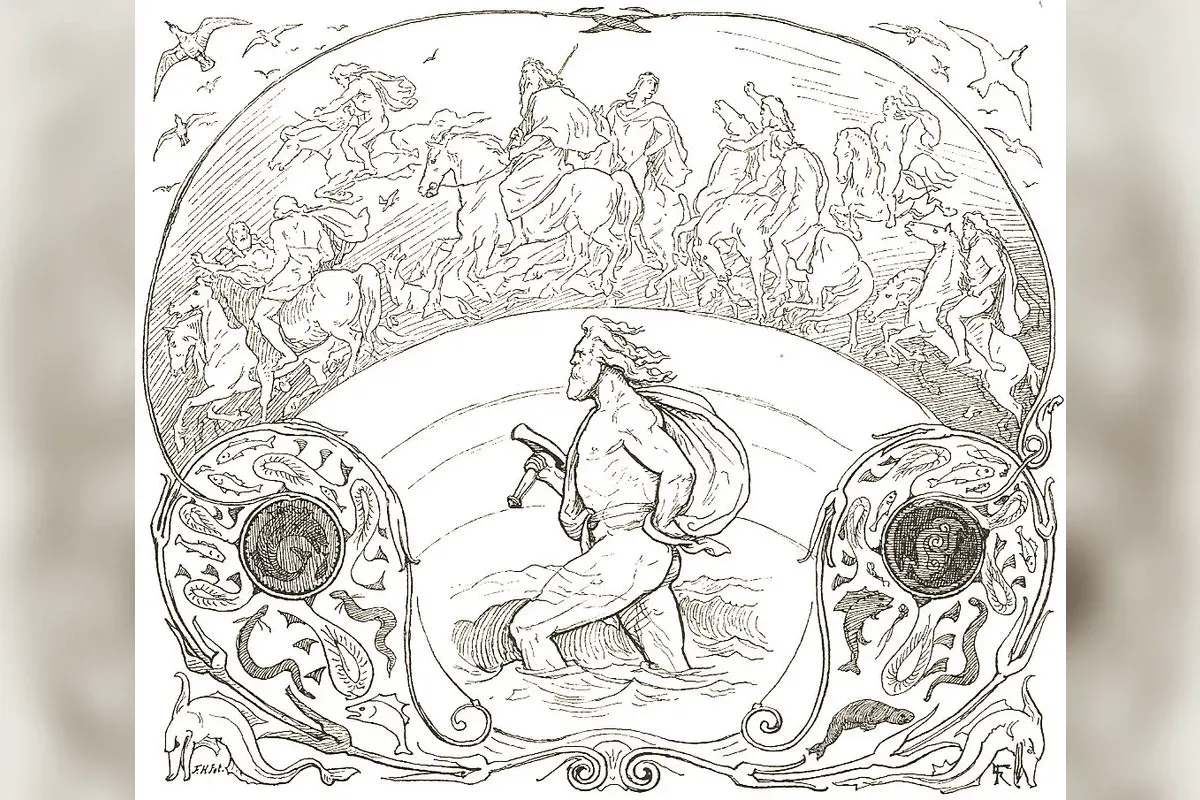
Bifröst is the rainbow bridge of Norse mythology — the shimmering, fire-laced span that joins Asgard, the fortress of the gods, to Midgard, the world of humans. To mortal eyes it is a rainbow arching across the sky; to the gods it is a road, the one passage between the divine heights and the middle-earth below. It is the most beautiful of all built things, says the tradition, and also one of the most fragile: for all its splendour, it is doomed to break when the world ends.
A bridge of fire and colour
Snorri Sturluson describes Bifröst as a bridge of three colours, immensely strong and made with more craft and cunning than any other structure. But its beauty conceals a weapon. The red band of the rainbow is a living fire, built into the span to stop the frost-giants and mountain-giants from storming up into Asgard. What appears to humans as the gentle arc of a rainbow is, to the enemies of the gods, a barrier of flame. The bridge is thus both a link and a defence — the single road into the world of the gods, and the burning line that keeps chaos on its own side.
Within the structure of the nine worlds hung from the world-tree Yggdrasil, Bifröst is the vertical axis of communication: the gods ride down it and up it, and each day they cross it to hold their council beneath the tree — all except Thor, who (in Snorri’s account) wades through the rivers on foot rather than trust his enormous weight to the bridge.
Heimdall, the watchman of the bridge
Bifröst has a guardian, and no post in Norse myth is more constant. Heimdall, the white god born of nine mothers, dwells at Himinbjörg (“heaven-mountain”) at the very top of the bridge, where it meets the sky. He needs less sleep than a bird; he can see for a hundred leagues by day or night; he hears the grass grow on the earth and the wool grow on sheep. His whole existence is a vigil over Bifröst, watching for the day the giants come. At his side hangs the Gjallarhorn, the horn whose blast will be heard through all the worlds — the alarm that announces the end.
The breaking of Bifröst at Ragnarök
The bridge exists under a sentence of doom. At Ragnarök, the sons of Muspell — the fire-giants led by Surtr with his blazing sword — ride out of the south to make war on the gods. As their host thunders across Bifröst, the bridge breaks apart beneath them. Its collapse is one of the great images of the Norse apocalypse: the road between gods and men, heaven and earth, is severed forever, and Heimdall sounds the Gjallarhorn to summon the gods to their last battle on the plain of Vígríðr. The very fragility of the bridge is part of its meaning. As Snorri’s Hár remarks, no thing, however strongly made, can be trusted absolutely — not even the finest work of the gods.
Variants and interpretation
The two names of the bridge — Bifröst and the older Bilröst — both stress instability and fleeting radiance, a fitting image for a rainbow. Some scholars have read Bifröst as a mythic explanation of the rainbow itself, others as a reflex of the Milky Way seen as a road across the night sky; the sources do not settle the question. What is certain is the bridge’s structural role: it is the threshold of Norse cosmology, the guarded frontier between order and chaos, and its destruction is the precise moment the boundary fails and the old world ends.
What the ancient sources say
The fullest description comes from the Gylfaginning of Snorri Sturluson’s Prose Edda (c. 1220), which names the bridge’s three colours, explains its defensive fire, and places Heimdall’s hall Himinbjörg at its summit. The Poetic Edda attests the bridge under the form Bilröst: the Grímnismál mentions the gods riding it daily and warns that it will “burn with flame”, while the Fáfnismál foretells that “Bilröst will break” when the hosts of the dead cross it. Together the sources present a single coherent picture — a radiant, burning, guarded bridge, made to last as long as the gods and no longer.
Further reading
For the ever-watchful god who guards the bridge and will sound the Gjallarhorn, read the page on Heimdall. For the fortress-city the bridge leads up to, see the page on Asgard. For the world-tree whose nine worlds the bridge helps bind together, consult the page on Yggdrasil. For the sovereign of the Aesir whose gods ride down Bifröst each day, read the page on Odin. Finally, for the battle in which the bridge shatters beneath the fire-giants, see the tale of Ragnarök.
See also
Stories featuring this entity
Frequently asked questions
What is Bifröst in Norse mythology?
Bifröst is the rainbow bridge that links Asgard, the world of the gods, to Midgard, the world of humans. Built by the gods with great skill, it burns with fire — the red band of the rainbow — to keep the giants from crossing. It is guarded day and night by Heimdall from his hall Himinbjörg, and it will shatter at Ragnarök.
Why does the Bifröst bridge burn?
According to Snorri Sturluson, the red in the rainbow is a blazing fire built into the bridge to stop the frost-giants and mountain-giants from climbing up into Asgard. The bridge is strong and beautifully made, but its fire is a defensive barrier: what looks like a rainbow to humans is, to the giants, a wall of flame.
What happens to Bifröst at Ragnarök?
At Ragnarök, the sons of Muspell — the fire-giants led by Surtr — ride out to attack the gods, and as their host gallops across Bifröst the bridge breaks beneath them. Its destruction marks the collapse of the ordered cosmos: the road between gods and men is severed, and the final battle begins on the plain of Vígríðr.