Egyptian mythology · Gods & goddesses
Seth, god of chaos and the desert in Egyptian mythology
In brief
Seth, Egyptian god of chaos and the desert: killer of Osiris, rival of Horus for Egypt's throne, and guardian of Ra against the serpent Apophis.
- chaos
- desert
- storms
- war
- +6
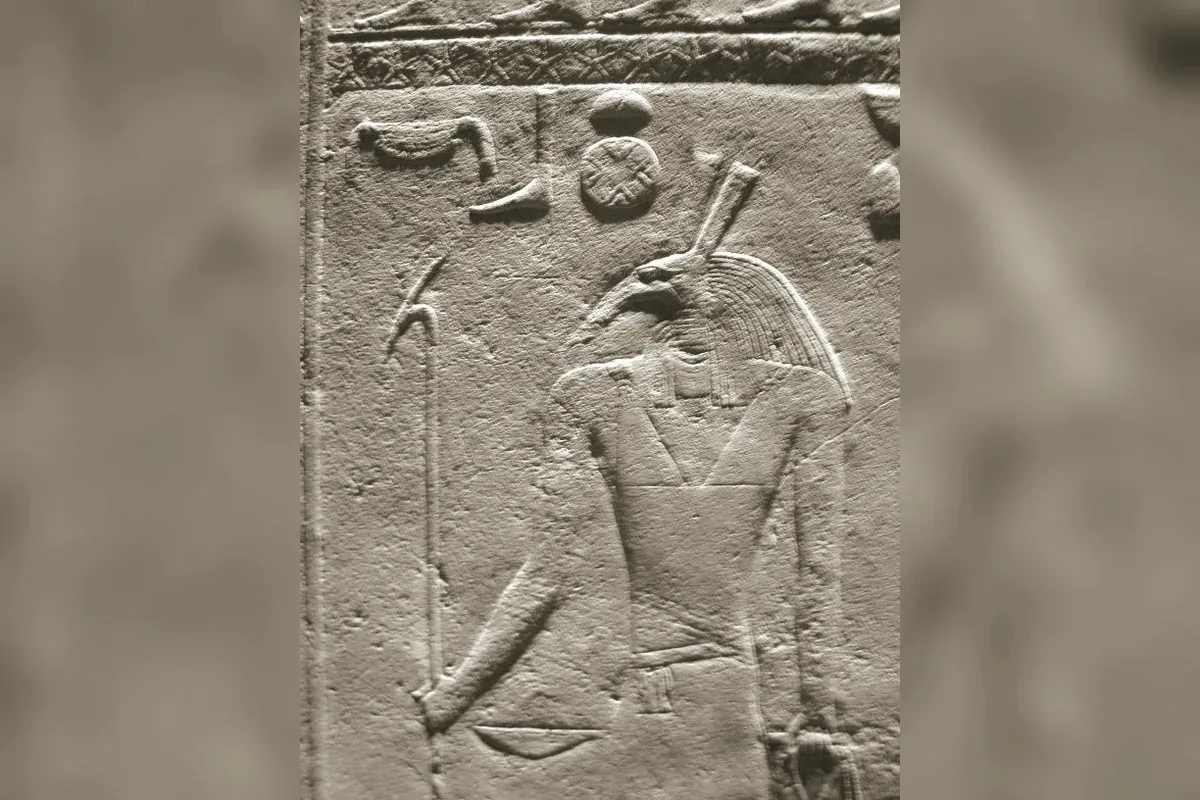
Who is Seth?
Seth is one of the most complex and ambivalent deities in the Egyptian pantheon. Son of Geb (god of the earth) and Nut (goddess of the sky), brother of Osiris, Isis, and Horus, he embodies the forces of chaos, the desert, and storms — destructive forces, yet necessary to cosmic balance. His story oscillates between the darkest betrayal and the most indispensable heroism.
Role, nature, and domains
Seth is the master of Isfet, the cosmic chaos opposed to Maat (order and justice). His primary domain is the desert — the red arid lands bordering the fertile Nile Valley — together with storms, desert thunder, and turbulent waters. By extension, he governs foreign lands: Hyksos, Libyans, and other invaders from the desert are associated with him.
His iconography is immediately distinctive: the head of a composite animal with squared upright ears, a long curved snout, and a forked tail — a creature that egyptologists have never identified with certainty in real fauna, which reinforces his status as an entity apart in the Egyptian cosmos. His skin and hair are often red or reddish — the colour of the desert, the colour of danger.
Genealogy and place in the Ennead
Seth belongs to the Great Ennead of Heliopolis, the ninefold divine structure that organises Heliopolitan cosmology. He is:
- brother of Osiris, king of the dead
- brother of Isis, goddess of magic
- brother of Nephthys, whom he takes as a wife in several traditions
- brother of Horus the Elder in some theological variants
Classical Heliopolitan tradition assigns Nephthys as his consort, though their union is sterile — texts stressing that Seth cannot consummate the marriage, while Nephthys secretly unites with Osiris to conceive Anubis (in certain versions).
The murder of Osiris
Seth’s most fundamental crime in Egyptian mythology is the assassination of his brother Osiris. According to the most complete account, transmitted by Plutarch (De Iside et Osiride, 1st–2nd century CE) from much older Egyptian sources:
- Seth, jealous of Osiris’s royal prestige, has a chest crafted to fit his brother’s exact measurements.
- At a banquet, he offers the chest as a gift to whoever fits inside it perfectly.
- Osiris lies down — and fits exactly. Seth seals the lid and throws it into the Nile.
- Isis recovers the chest and brings the body back. Seth discovers it and dismembers the body into fourteen pieces (seventeen in some variants), scattering them across Egypt.
This dismemberment triggers Isis’s quest, the reassembly of the body, the provisional resurrection of Osiris, and the birth of Horus, who will later avenge his father.
The contest with Horus
After Osiris’s death, Seth usurps the throne of Egypt. Horus, the posthumous son of Osiris, claims the throne as the legitimate heir. What follows is a series of eighty years of conflicts (in the symbolic narrative), judged by the tribunal of the gods.
The battles are physical, metamorphic, and legal: hippopotamuses clashing, shape-shifting contests, stratagems and counter-stratagems. Seth tears out Horus’s left eye — which, once restored by Thoth, becomes the protective wedjat; Horus mutilates Seth in return. Finally, the tribunal — under pressure from Osiris from the Duat — rules in Horus’s favour.
But Seth is not destroyed. In several versions, he is integrated into Ra’s solar barque as guardian and warrior: his brute strength and hostility to chaotic forces make him an indispensable protector of the sun god against the serpent Apophis each night.
Guardian of Ra against Apophis
This role as protector is one of Seth’s most significant dimensions. Each night, Ra traverses the Duat on his solar barque. At the deepest hour of night, the cosmic serpent Apophis — the embodiment of absolute annihilation — attempts to destroy the barque and prevent the sun from rising.
Seth, standing at the prow, transfixes Apophis with his spear and drives it back. Without Seth, the sun would not rise, and the world would cease to exist. This cosmic guardian role explains why, despite his status as Osiris’s murderer, Seth is never simply the “god of evil” in classical Egyptian thought: the chaos he embodies is also the chaos only he can master.
Variants and evolution of the cult
At the Old Kingdom and Middle Kingdom, Seth is a respected and even venerated deity, especially in regions such as Ombos (Nubt) in Upper Egypt. Some pharaohs bear his name proudly: Seti I (“He of Seth”), father of Ramesses II, and Seti II.
The Hyksos, Asian invaders of the seventeenth century BCE, adopted Seth as their tutelary god under the name Sutekh — assimilating their own storm deity to this figure of the desert and the foreign. This association reinforced Seth’s ambivalence in Egyptian memory: simultaneously an ancestral deity and a “foreign” power.
From the New Kingdom onward, and especially in the first millennium BCE, with the rise of the Osirian cult, Seth became progressively a dark and threatening figure. Coffin Texts and the Book of the Dead often present him as an adversary of virtuous souls. In the Ptolemaic period, the Greeks identified him with Typhon, the chaos-monster defeated by Zeus — completing his marginalisation in the Greco-Egyptian composite tradition.
What the ancient sources say
The Pyramid Texts (c. 2400 BCE) mention Seth as god of the northern sky, competitor of Horus for celestial kingship. The Coffin Texts (c. 2000 BCE) elaborate the narrative of his rivalry with Horus. Papyrus Chester Beatty I (Ramesside, c. 1180 BCE), the “Contendings of Horus and Seth,” is the fullest narrative account of the conflict, blending theological gravity with humour: Seth attempts grotesque and humiliating tricks. Plutarch’s De Iside et Osiride offers the most narrative version of Seth’s murder of Osiris, though Hellenised and morally weighted.
Further reading
For the victim of Seth whose murder founds Egyptian funerary theology, read the page on Osiris. For the son of Osiris who confronts Seth and recovers the throne, see the page on Horus. For the goddess whose magic counters Seth’s plans, read the page on Isis. For the solar deity whom Seth protects each night, read the page on Ra. For a comparison of war gods across multiple mythologies, see Gods of war in world mythologies. For a full overview of the Egyptian pantheon, see the Egyptian mythology hub.
See also
Related entries
Stories featuring this entity
Comparisons
Frequently asked questions
Is Seth an evil god in Egyptian mythology?
Not in any absolute sense. Seth embodies Isfet — cosmic chaos, the opposite of Maat — but this chaos is not pure 'evil': it is a necessary force in the cosmos. Seth plays a vital role each night, defending Ra's solar barque against the serpent Apophis. Egyptian tradition is ambivalent about him: reviled as Osiris's murderer, yet venerated as a solar guardian. Only from the first millennium BCE onward, as the Osirian cult grew and foreign influences intensified, did Seth become predominantly a malevolent figure.
What animal is the Seth animal?
The Seth animal is an unidentified composite creature: long curved snout, squared upright ears, forked tail. Egyptologists have proposed the oryx, wild ass, okapi, or an invented animal — no real species matches precisely. This iconographic strangeness reinforces Seth's status as an uncategorisable being, the embodiment of what lies beyond the ordered world.
Why does Seth kill Osiris?
Egyptian sources, relayed and enriched by Plutarch, portray Seth driven by jealousy: Osiris is the legitimate king, beloved, associated with fertility and justice. Seth, confined to the desert margins, covets that power. The murder is not gratuitous but cosmological: it inaugurates the cycle of death and resurrection that underpins all of Egyptian funerary theology.