Egyptian mythology · Gods & goddesses
Shu, Egyptian god of air who separates sky from earth
In brief
Shu, Egyptian god of air and light: son of Atum, brother and husband of Tefnut, he lifts Nut away from Geb and holds open the space in which creation breathes.
- air and atmosphere
- light and space
- wind and the breath of life
- separation of sky and earth
- +3
Who is Shu?
Shu is the Egyptian god of air, light and atmospheric space. He is the first being to issue from the demiurge Atum, and his role is genuinely architectural: by coming between earth and sky, he opens the volume in which creation can breathe. Without Shu, the world would remain a compact block, sky and earth crushed against one another. He is therefore less a god of stories than a cosmic principle: the vital interval, the breath that holds things apart.
Role, nature and domains
Shu is breath in the most concrete sense. He is the air we breathe, the wind, the diffuse light that fills the space between the ground and the vault. Egyptian theology conceives him as a couple of opposites with his sister Tefnut: he the dry, warm air, she the moisture. Together they form the complete atmosphere, the first polarity of matter after the surging forth of Atum.
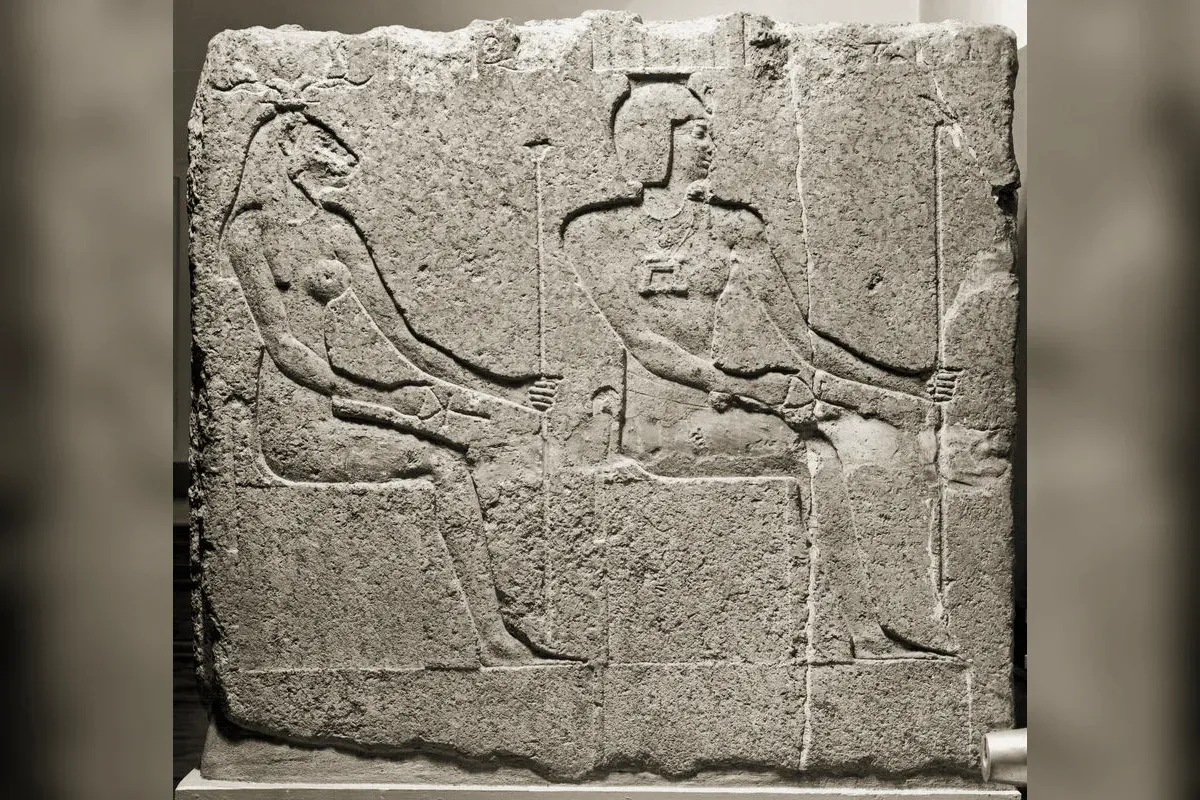
In iconography, Shu appears as a man crowned with an ostrich feather — the very hieroglyph of his name — often shown kneeling, arms raised, supporting with his hands the arched body of Nut. This image, one of the most famous in Egyptian art, sums up his function alone: Shu is the column of air that keeps the sky from falling back onto the earth.
Genealogy and place in the Ennead
Shu is the son of Atum, begotten without a mother at the beginning of creation. In Utterance 600 of the Pyramid Texts, Atum brings Shu and Tefnut forth from his body; the passage uses wordplay between their names and bodily verbs. Brother and husband of Tefnut, Shu begets with her the second divine couple, Geb, the earth, and Nut, the sky. He thus occupies the second generation of the Great Ennead, the hinge between the solitary creator and the peopled world that will spring from his grandchildren — Osiris, Isis, Seth and Nephthys.
The founding gesture: separating Geb and Nut
Shu’s central myth is that of the separation of sky and earth. In the beginning, Geb and Nut are so tightly entwined that no space remains between them, and Nut cannot give birth to her children. Shu, the air, inserts himself between the two and lifts Nut above Geb, holding her at arm’s length like a starry vault. This gesture parts the lovers but creates the world: the space so opened becomes the domain of light, wind and life.
This cosmological image carries a philosophical weight. It affirms that the habitable world is born of a sustained tension, not of rest: it is Shu’s constant, never-slackening effort that guarantees the sky does not collapse. Some texts even evoke the dread of a final collapse, when a weary Shu might let Nut fall back — an Egyptian echo of the idea of the end of the world.
Shu the warrior and defender of Ra
Alongside his cosmic function, Shu develops a more martial face, notably through his assimilation to Onuris (Anhur), the hunter god of This. In the form Shu-Onuris he becomes a defender of the solar order, often shown with a lion’s head. An important tradition also makes him a divine king: after the reign of Ra and Atum upon the earth, Shu is said to have held kingship before passing it to Geb. He then fights the enemies of the sun, foremost among them the serpent Apophis, the embodiment of chaos that the luminous air holds at bay.
What the ancient sources say
Shu is attested from the Pyramid Texts, which describe his birth from Atum and his role as separator. The Coffin Texts contain long spells spoken ‘in the first person of Shu’, in which the god presents himself as the breath of life that animates the deceased. The Book of the Dead and the mythological papyri of the New Kingdom fix his iconography as bearer of the sky. Finally, the late myths preserved in the Greco-Roman period develop his warrior face and his earthly kingship. Across these sources, Shu remains above all what he was from the beginning: the air that holds the world open.
Further reading
For the creator of whom Shu is the firstborn, read the page on Atum. For his sister and wife, the moisture that completes the air, see the page on Tefnut. For the two children he separates and supports, consult Geb and Nut. For the enemy the luminous god drives back, read the page on the serpent Apophis.
See also
Frequently asked questions
Who is Shu in Egyptian mythology?
Shu is the Egyptian god of air, light and atmospheric space. The first son of Atum, brother and husband of Tefnut, he begets Geb (earth) and Nut (sky), then separates them by lifting Nut above Geb to create the space of the world.
Why does Shu lift up the sky?
In the Heliopolitan cosmogony, Geb and Nut — earth and sky — are at first locked in a tight embrace. Shu, the air, comes between them and lifts Nut on his arms: this gesture opens the habitable space through which light, wind and life can move.
What is the relationship between Shu and Tefnut?
Shu and Tefnut form the first couple of creation, both born of Atum without a mother. Shu is the dry, luminous air, Tefnut the moisture; together they embody the two complementary principles of the atmosphere and beget Geb and Nut.