Egyptian mythology · Gods & goddesses
Atum, the creator god of Heliopolis in Egyptian mythology
In brief
Atum, creator god of Heliopolis: the self-created demiurge who rose from Nun, begot Shu and Tefnut, founded the Ennead and embodies the setting sun, father of the gods.
- creation and the origin of the world
- totality and completeness
- the setting sun
- primordial divine kingship
- +3
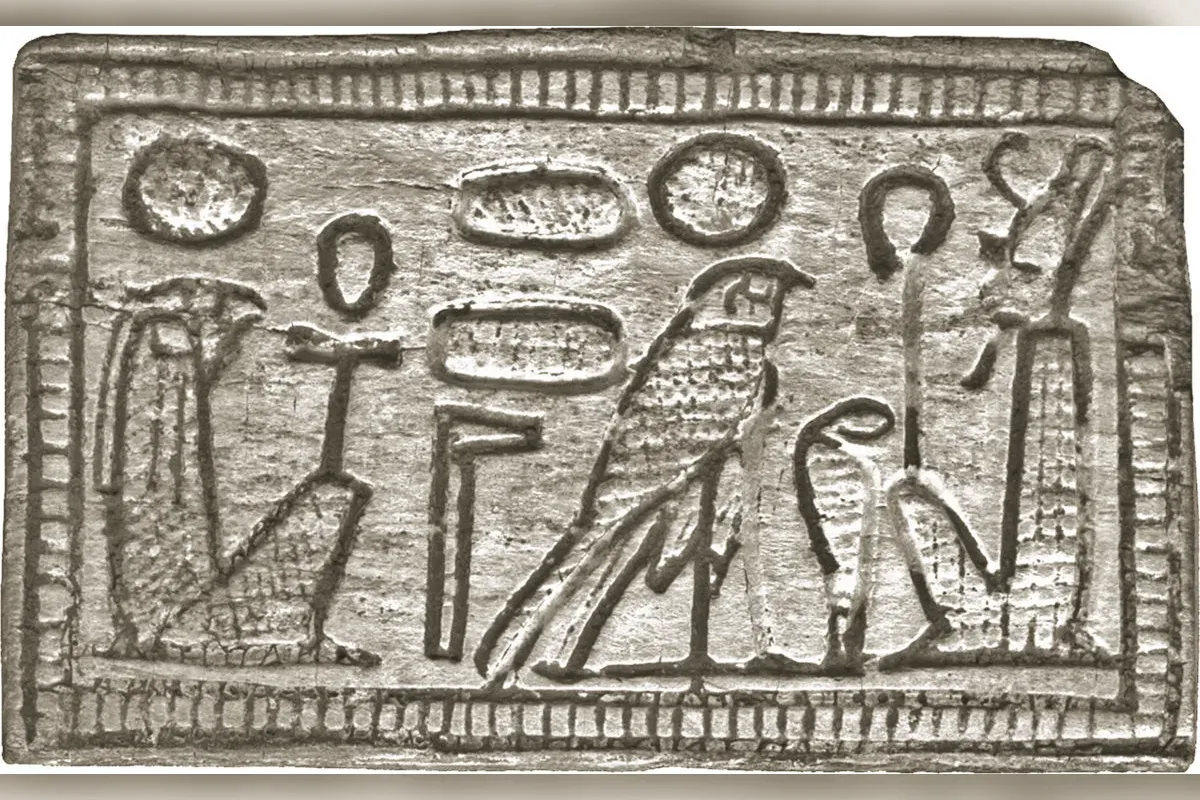
Who is Atum?
Atum is the creator god of the Heliopolitan cosmogony, the most influential of ancient Egypt’s theologies. His name, drawn from the root tem, says everything about his nature: he is the ‘Completed One’ and, at the same time, ‘the one not yet in being’ — the total, undivided being who precedes the world and contains it as a promise. Before Atum there is only Nun, the primordial ocean, inert and boundless. Atum is the first to exist, and from that single existence flows everything that follows: the gods, the sky, the earth and the order of the world.
Role: the self-created demiurge
What defines Atum is self-creation. He is born of no parent: he ‘comes into being of himself’ upon the primordial mound, the first hillock of dry earth to emerge from the waters of Nun. This original solitude lies at the heart of Heliopolitan theology: creation is not the result of a battle or a pre-existing couple, but of the surging forth of a single being who must divide himself in order to fill the void.
Atum is therefore the god of completeness and origin. He is also the distant guarantor of kingship: crowned with the pschent, the double crown of Upper and Lower Egypt, he is the first king of the world, whose reign every pharaoh prolongs. His form is not animal but that of a mature man, which sets him apart from most Egyptian deities and underscores his standing as a paternal and sovereign figure.
Creation: from Nun to the Ennead
The creation account is already fixed in the Pyramid Texts (c. 2350 BC). Alone on the mound, Atum begets the first divine couple without a partner. The texts use a striking image: he brings forth Shu, the air, and Tefnut, moisture, from his own body. Utterance 600 uses wordplay between their names and Egyptian verbs commonly translated as “expectorate” and “spit”. Other versions, such as the Bremner-Rhind Papyrus, describe a self-fertilisation: Atum produces the seed from which his children are born, his hand playing the role of the female principle.
From Shu and Tefnut are born Geb, the earth, and Nut, the sky. From this second couple descend at last Osiris, Isis, Seth and Nephthys. Together with Atum himself, these eight deities form the Great Ennead — literally ‘the Nine’ — the founding genealogy that structures the order of the world and gives Heliopolis its theological authority.
Atum and Ra: the evening sun
From an early date Atum is identified with Ra, the great solar god, in the composite form Atum-Ra or Ra-Atum. This fusion distributes the roles across the daily cycle: Khepri is the morning sun, Ra the noonday sun, and Atum the evening sun, the declining star that, in the guise of an old man, sinks into the Duat to accomplish his nightly regeneration. Atum is thus the god of dusk and of the return to origin: each evening the world flows back toward the primal unity from which it came, before being reborn at dawn.
This cyclical reading is not incidental. It makes Atum not only the beginning but also the end toward which all things tend. Some funerary texts even credit him with announcing a final return to Nun, when the whole of creation will dissolve back into the undifferentiated ocean — Atum and Osiris remaining alone, in the form of two serpents, in the primordial water.
Cult at Heliopolis and iconography
Atum is the great deity of Heliopolis (Iunu, in the modern northern suburbs of Cairo), cradle of solar theology. There he is worshipped alongside Ra, and the benben, a sacred stone in the shape of a pyramidion, materialises the primordial mound on which he created himself. In iconography, Atum most often appears as a man wearing the pschent, sometimes ageing to signal the setting sun. His animal forms of regeneration — the serpent that sheds its skin and the scarab — recall his power to be reborn of himself.
What the ancient sources say
Atum is one of the earliest attested deities. The Pyramid Texts, notably Utterance 600, name him ‘Atum-Khepri’ and describe the production of Shu and Tefnut. The Coffin Texts and the Book of the Dead develop his role as creator and his funerary dimension. The Bremner-Rhind Papyrus (c. 310 BC) preserves a detailed creation account in which Atum begets the world from his own substance. These sources, spread over more than two millennia, reveal a remarkably stable theology: everywhere, Atum remains the solitary starting point of all that exists.
Further reading
For the solar god with whom Atum is identified in his evening course, read the page on Ra. For his two first children, born of him alone, see the pages on Shu and Tefnut. For the following generation, earth and sky, consult Geb and Nut. For his great-grandchildren, at the heart of the great Egyptian drama, read Osiris and Isis. For the full account of the birth of the world and the Ennead, read the Egyptian creation myth.
See also
Related entries
Stories featuring this entity
Frequently asked questions
Who is Atum in Egyptian mythology?
Atum is the creator god of Heliopolis, the self-created demiurge who rose alone from Nun, the primordial ocean. From him were born Shu (air) and Tefnut (moisture), and then the whole Ennead. He also embodies the setting sun, the evening face of Ra.
What is the difference between Atum and Ra?
Ra is the great solar god, while Atum is particularly associated with the setting sun. Heliopolitan theology links them as Ra-Atum or Atum-Ra without erasing all their distinct roles.
How did Atum create the world?
According to the Pyramid Texts, Atum creates himself on the primordial mound risen from Nun, then begets the first divine couple alone: he brings forth Shu and Tefnut from his own body—through expectoration or his seed, depending on the text and translation. Creation thus begins with a single, complete being who divides in two.