Egyptian mythology · Gods & goddesses
Sobek, crocodile god of the Nile and the Faiyum
In brief
Sobek is the Egyptian crocodile-headed god, son of Neith and lord of the Faiyum and Kom Ombo. He embodies both the fertilising force of the Nile and the danger hidden in it: Egyptians worshipped him to win protection against the very animal whose head he wears.
- waters of the Nile and the inundation
- fertility of irrigated land
- the pharaoh's military power
- protection against the dangers of the river
- +4
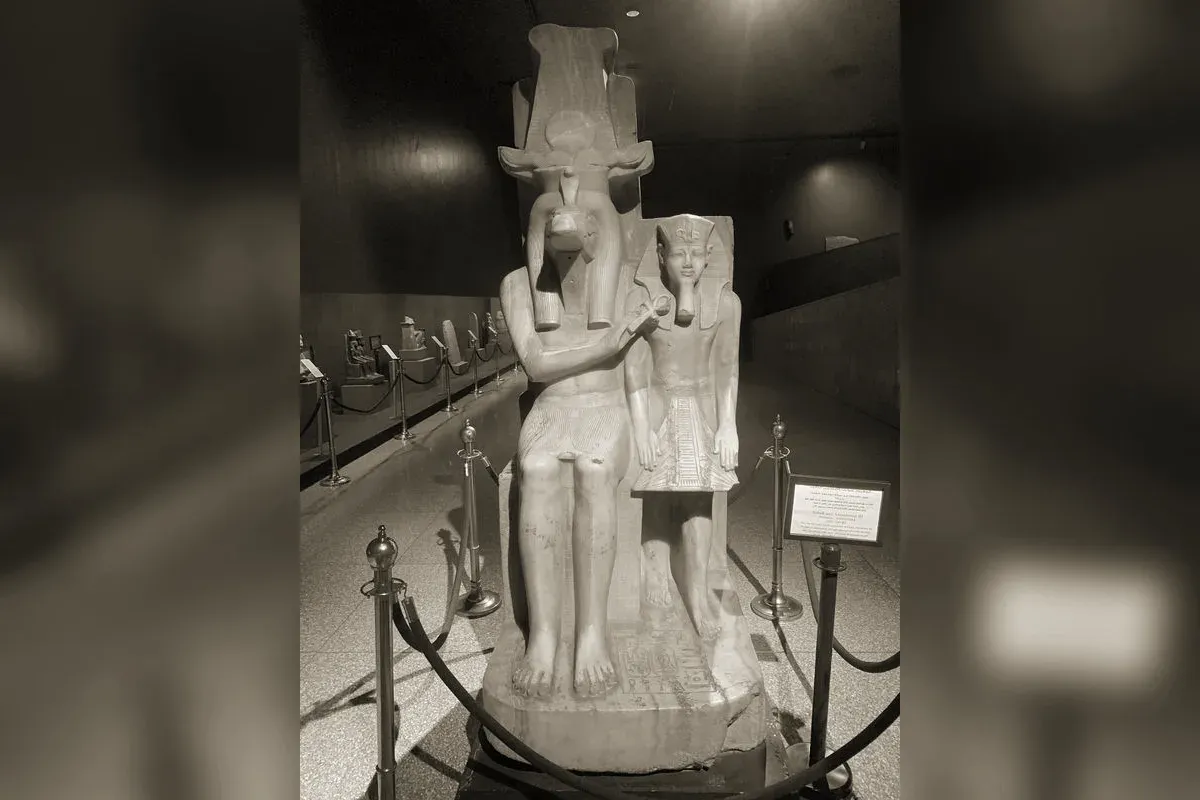
Who is Sobek?
Sobek is the Egyptian crocodile-headed god, master of the Nile waters and of the fertility they leave on the banks. Son of the goddess Neith, he rules the Faiyum, the irrigated depression where crocodiles teemed, and shares the double temple of Kom Ombo with Horus the Elder. His figure rests on an openly accepted paradox: the Egyptians deified the animal that killed them. Sobek is the power of the river in both its fertilising and its lethal aspect — he is not prayed to because he is kind, but so that his force protects instead of devouring.
God of the waters and the inundation
Egypt lived by an annual flood, and Sobek is one of the gods who personify it: texts say the Nile came forth from him, or that his sweat forms the river. His epithet “green of plume” points to the vegetation that returns to the banks once the waters withdraw, and green stays attached to him in the iconography.
That link explains the geography of his cult. The Faiyum is not a valley but a basin fed by a Nile branch, the Bahr Yussef, which supplies Lake Moeris. Marshes, reed beds, standing water: the ideal landscape for crocodiles, and therefore for their god. The Twelfth Dynasty pharaohs, who undertook major hydraulic works in the region, promoted his cult as they reclaimed farmland from the marsh.
Son of Neith, a god without a family
Sobek’s genealogy is short and old: he is the son of Neith, the warlike creator goddess of Sais and one of the most archaic figures of the Egyptian pantheon. That descent, already present in the Pyramid Texts, gives him a first-rank mother without enrolling him in the Heliopolitan Ennead — Sobek remains a provincial god, powerful at home and attached late to the wider system.
It is by fusion that he acquires national rank. From the Middle Kingdom and above all in Ptolemaic times, Sobek-Ra appears: the crocodile becomes a form of the sun, crowned with the disk and associated with the daytime voyage of the barque. The device is the same as for Amun-Ra, but here it produces a startling image — the predator of the waters turned into a heavenly body.
Royal favour shows in the names. The Thirteenth Dynasty counts a run of kings called Sobekhotep, “Sobek is content,” and the Middle Kingdom closes with Sobekneferu, “the beauty of Sobek,” the first woman for whom a complete royal titulary is attested.
Kom Ombo: one temple for two gods
The temple of Kom Ombo, built in Ptolemaic times on the Nile bank, is an architectural oddity: it is entirely double, with two entrances, two parallel hypostyle halls and two sanctuaries. The southern half belongs to Sobek, with Hathor and Khonsu; the northern half to Haroeris, Horus the Elder, with Tasenetnofret and Panebtawy.
The layout states the essentials of local Egyptian theology: two antagonistic powers — crocodile and falcon, murky water and clear sky — housed under one roof in strictly equal shares, with neither prevailing. The site has yielded hundreds of mummified crocodiles, now displayed in a nearby museum, including hatchlings deposited as offerings.
A god both feared and invoked
Sobek’s ambivalence is documented by the texts themselves. The Book of the Dead devotes several spells — chapters 31 and 32 — to repelling crocodiles that come to steal the deceased’s magic in the Duat. The same animal is thus, depending on context, a protecting god and a threat to be conjured away.
Spell 317 of the Pyramid Texts shows the aggressive side of that power: the dead king identifies himself with Sobek, “green of plume,” and proclaims that he seizes and carries off what he wants, women included. This is not a gentle text; it is a claim to unrestrained vital force, exactly what a dead sovereign wants to take with him.
A later tradition, developed above all in the religious literature of the Faiyum, casts Sobek instead as a helper: the crocodile is the one who dives and retrieves from the water what has been thrown into it and scattered, in the service of the gods — a motif often compared with Isis searching for the dismembered Osiris. The god who takes from the water becomes the one who gives back what the water took.
What the ancient sources say
Herodotus gives the crocodile a detailed treatment (Histories, II, 68-70). He notes that the animal is sacred in some regions and hunted in others: around Thebes and Lake Moeris one crocodile is reared, fitted with earrings of glass and gold and bracelets on its forefeet, fed a prescribed diet and mummified at death; at Elephantine, by contrast, crocodiles are eaten. The observation matters: it describes a cult whose geography varies, which archaeology confirms.
Strabo completes the picture two centuries later (Geography, XVII, 1, 38). Visiting Arsinoe, he describes the sacred crocodile Suchos, tame, lying beside its pool; the priests prise its jaws open and place inside the cake, meat and wine brought by visitors. The scene, told by a faintly amused Greek, is one of the rare direct accounts of how an Egyptian animal cult worked day to day.
The Book of the Faiyum papyri, in the Graeco-Roman period, go further still: they map the lake as the body of the god himself and turn the whole region into sacred geography. Sobek’s cult was then, alongside that of Isis, among the most vigorous in an already Hellenised Egypt.
Further reading
For the goddess who likewise embodies a dangerous force turned into protection, read the page on Sekhmet. For the falcon who shares the Kom Ombo temple with Sobek, see the page on Horus. For the underworld where crocodiles threaten the deceased, see the Duat and the judgment of the dead. For the other great reptile of Egyptian myth, enemy of the sun rather than its ally, read the page on Apophis. For the goddess of Sais whose son he is, see the page on Neith.
Ancient sources
- Pyramid Texts, spell 317
- Coffin Texts
- Book of the Faiyum (Graeco-Roman papyri)
- Herodotus, Histories, II, 68-70
- Strabo, Geography, XVII, 1, 38
See also
Related entries
Frequently asked questions
What is Sobek the god of?
Sobek is the god of the Nile waters, of the inundation and the fertility it brings, and of raw power in its royal and military form. His animal, the crocodile, was the most feared predator of the river: by raising it to divinity, Egyptians turned a daily threat into a protection — the same religious logic that governs Sekhmet, goddess of plague and of healing alike.
Where was Sobek worshipped in Egypt?
His great centre is the Faiyum, around Shedet — the Greeks' Crocodilopolis, later Arsinoe — where a sacred crocodile was kept by the priests. His other major sanctuary is the double temple of Kom Ombo in Upper Egypt, shared between Sobek in the southern half and Haroeris, Horus the Elder, in the northern one. Further cults are attested at Sumenu and Gebelein.
Was Sobek a benevolent god or a dangerous one?
Both, and the ambivalence is the heart of the figure. The same Egyptians who built him temples recited Book of the Dead spells to drive crocodiles away in the afterlife. Sobek is not a pacified god: he is the violence of the river, honoured precisely so that it turns against the king's enemies rather than against the living.