Egyptian mythology · Gods & goddesses
Neith, goddess of Sais, of the bow and of the loom
In brief
Neith is the goddess of Sais in the western Delta: an archer crowned with the Red Crown, patron of weavers, mother of Sobek and one of the four goddesses who guard the viscera of the dead. Late texts at Esna make her a creator who rose alone from the primeval waters.
- bow, arrows and hunting
- weaving and mummy bandages
- primeval creation (Esna theology)
- protection of the dead and of the viscera
- +4
Who is Neith?
Neith is the goddess of Sais, in the western Delta, and one of the earliest attested deities of Egypt. Her emblem — a shield crossed by two arrows — appears on monuments from the first dynasties, before divine iconography had settled into its classic forms. She is at once an archer, a weaver, the mother of Sobek and, in the temples of the Late Period, a creator of the world. The accumulation is not confusion: it measures the length of a cult that ran for three thousand years, gathering functions as it went.
A goddess older than the myths
Neith comes before almost everything else. The names of two First Dynasty women — Neithhotep and Merneith, the latter probably regent for her son — already contain hers, which implies a fully formed cult around 3000 BC. Her standard, mounted on a pole, stands among the oldest nome emblems.
That seniority explains an oddity: Neith belongs to none of the great theological systems. She is not in the Heliopolitan Ennead with Atum, nor in the Memphite triad of Ptah, nor in the Theban triad of Amun. She arrived before them and never needed attaching.
The bow and the shuttle
Two objects define Neith, and at first sight they do not belong together.
The first is the weapon. Her emblem consists of two crossed arrows over an object variously read as a case, an animal skin or a stylised shield. She is sometimes shown holding a bow, and texts call her the one who opens the way for armies. Egyptians put her name on arrows and harpoons; in the Late Period the soldiers of Sais were explicitly hers. That places her, within the Egyptian pantheon, in a position that other traditions divide among several war gods: Neith arms without being a deity of slaughter, unlike Sekhmet.
The second is the loom. Neith patronises weavers, and older Egyptology in fact read her emblem as a shuttle before reinterpreting it as a shield. Weaving here is no domestic ornament: it is the industry that produces mummy bandages. A goddess who gives linen also gives what wraps the dead, which partly explains her funerary role.
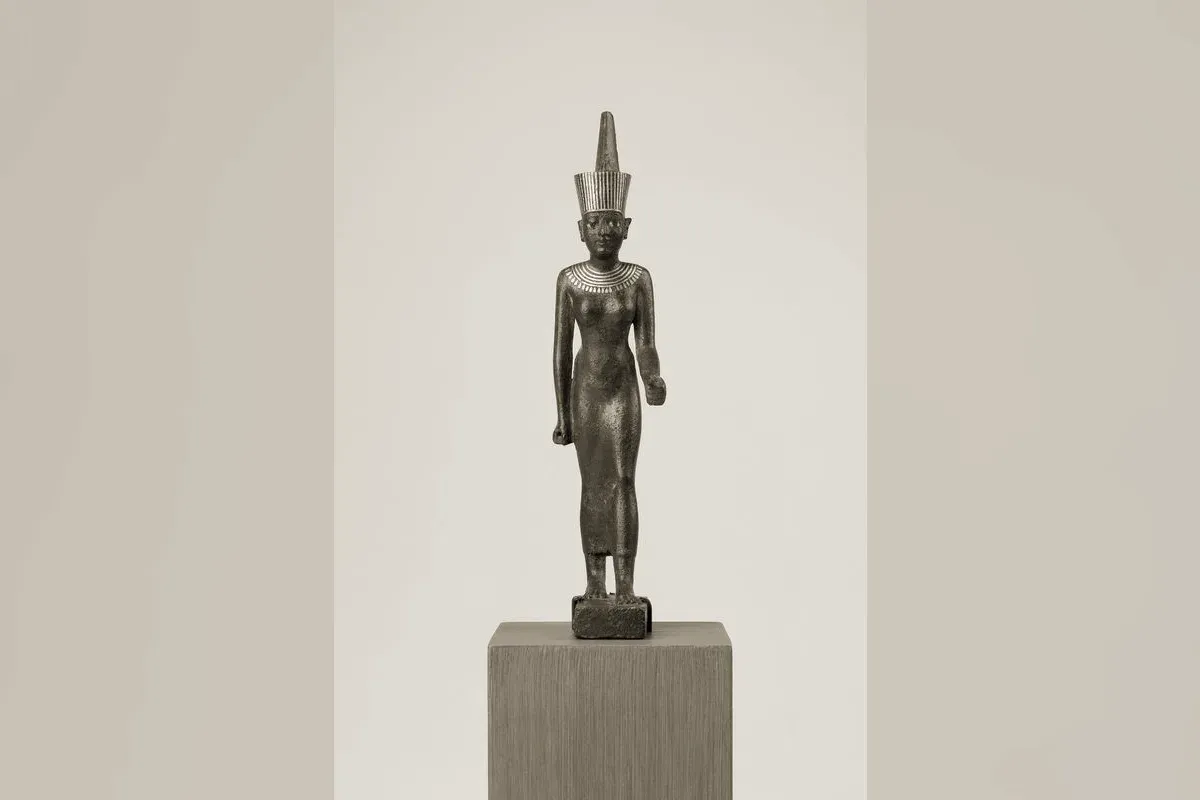
Neith often wears the Red Crown (deshret) of Lower Egypt, marking her connection with the Delta. This royal headdress is distinct from her own emblem, whose identification remains debated: two crossed arrows over what may be a case, an animal skin or a stylised shield.
Mother of Sobek
Neith’s genealogy fits in a single line, but that line is very old: she is the mother of Sobek, the crocodile god. Spell 317 of the Pyramid Texts, in which the dead king identifies himself as “Sobek, green of plume, son of Neith”, attests it as early as the Old Kingdom.
The pairing has a geographical logic. Neith rules the marshes of the Delta, Sobek those of the Fayum. These are Egypt’s two zones of standing water, and the crocodile is at home in both. A goddess of reeds and arrows, a god of murky water — mother and son share one landscape.
She has, by contrast, no settled husband and no other clearly established offspring. The Esna texts go further still: they insist that she begot without a partner, which places her outside the ordinary family system of Egyptian gods.
Arbiter in the contendings of Horus and Seth
Papyrus Chester Beatty I, copied under the Twentieth Dynasty, tells the long lawsuit that sets Horus against Seth over the succession of Osiris. The tribunal of the gods stalls; unable to decide, it writes to Neith for her opinion.
Her answer is a model of statecraft. She rules without hesitation: the office should go to Horus, the legitimate heir. But she immediately attaches compensation for the loser — Seth’s property is to be doubled and he is to be given Anat and Astarte, two warrior goddesses of Levantine origin, as wives. And she closes with a threat aimed at the court itself: if her opinion is ignored, the sky will fall.
The scene reveals her standing. Neith is not a party to the Osirian conflict; she has neither son nor stake in it, and that is precisely why she is consulted. The story casts her as an outside authority beyond challenge — the one who was there before the quarrel began.
What the theology of Esna says
In the Greco-Roman period, the temple of Esna in Upper Egypt carved on its walls a cosmogony in which Neith takes the leading role. The text is late, but it systematises older Delta traditions.
There she rises alone from the waters of Nun, in the form of a cow. She creates by speech, shapes the place where she stands — Esna, then Sais — and then produces light and the gods. One passage calls her “father of fathers and mother of mothers”: she is not a mother goddess in the ordinary sense but a principle older than the distinction of sexes, able to beget as either.
The same corpus credits her with a formidable offspring: from her spittle, cast into the primeval waters, is born Apophis, the serpent of chaos who will attack the barque of Ra every night. The detail is theologically bold: the creator also produces what threatens creation, and the enemy of the sun is not an intruder from outside but a by-product of the creative act itself.
One of the four guardians of the dead
Neith’s funerary role is the most visible archaeologically. From the New Kingdom onward, four goddesses watch over the canopic jars holding the viscera of the dead, each paired with one of the four Sons of Horus: Isis with Imsety, Nephthys with Hapy, Neith with Duamutef — the jackal, who guards the stomach — and Serqet with Qebehsenuef.
The most famous witness is the canopic chest of Tutankhamun: an alabaster shrine guarded by four goddess statues with outstretched arms, facing outward, Neith among them. The gesture says everything about the role — they do not look at the dead man, they watch whatever might approach him.
The patronage makes better sense once you remember that she also gives linen. The goddess who weaves the bandages is logically the one who protects the body they wrap, all the way into the Duat.
What the ancient sources say
Herodotus never names Neith: he calls her Athena, following the Greek habit of translating foreign gods. His testimony is valuable all the same. At Sais he describes the Festival of Lamps (Histories, II, 62): for one whole night the inhabitants burn, in front of their houses, flat lamps filled with oil and salt, and those who cannot come to Sais do the same at home, so that the whole of Egypt is lit. He adds that he was given a religious explanation for that night of lights, but declines to repeat it.
He also places (II, 169-170) the tomb of Osiris within the precinct at Sais, behind the temple, beside a round stone-lined lake where “mysteries” were performed at night that he says he must pass over in silence. The great sanctuary of Neith therefore housed, in the capital of the Twenty-Sixth Dynasty, one of the claimed tombs of Osiris.
Plato, in the Timaeus (21e), gives the equivalence outright: the tutelary goddess of Sais is called Neith in Egyptian and Athena in Greek. It is in that city, from the priests of Neith, that Solon is supposed to have received the story of Atlantis. The identification was not arbitrary: Athena too arms and weaves.
Further reading
For the crocodile god she mothers and who rules the Fayum, read the page on Sobek. For the serpent of chaos born of her spittle at Esna, see Apophis. For the lawsuit she arbitrates, see the pages on Horus and Seth, and the Osiris myth. For the pantheon’s other great dangerous goddess, see Sekhmet. To place her martial side among world traditions, read the comparison of war gods.
Ancient sources
- Pyramid Texts, spell 317 (Sobek son of Neith)
- Coffin Texts
- Papyrus Chester Beatty I (Contendings of Horus and Seth)
- Cosmogonic texts of the temple of Esna
- Herodotus, Histories, II, 62; 169-170
- Plato, Timaeus, 21e
See also
Related entries
Comparisons
Frequently asked questions
What is Neith the goddess of?
Neith holds together domains that look incompatible: the bow and arrow, which make her a goddess of war and hunting; the loom, which places her at the origin of cloth and therefore of mummy bandages; and, in the late theology of Esna, the creation of the entire world. The three faces share one idea — Neith is the one who produces, whether a weapon, a fabric or a cosmos.
Why did the Greeks identify Neith with Athena?
Because both goddesses combine warfare with the working of wool, an unusual pairing. Plato states the equivalence outright in the *Timaeus*: the patron deity of Sais is called Neith in Egyptian and Athena in Greek. Herodotus likewise calls the great sanctuary of Sais the 'temple of Athena', and it is behind that temple that he places the tomb of Osiris.
Is Neith really the mother of Sobek?
Yes, and the descent is among the oldest attested in the pantheon. The Pyramid Texts, around 2400 BC, already call Sobek 'son of Neith'. She does not, however, draw him into any wider divine family: Neith stays outside the Heliopolitan Ennead, with her own line and her own sanctuary in the Delta.