Greek mythology · Gods & goddesses
Asteria, Titaness of stars and mother of Hecate in Greek mythology
In brief
Asteria, Titaness of stars: the goddess who escaped Zeus by becoming the island of Delos, mother of Hecate, and sister to Leto.
- falling stars
- prophetic dreams
- nocturnal divination
- star
- +2
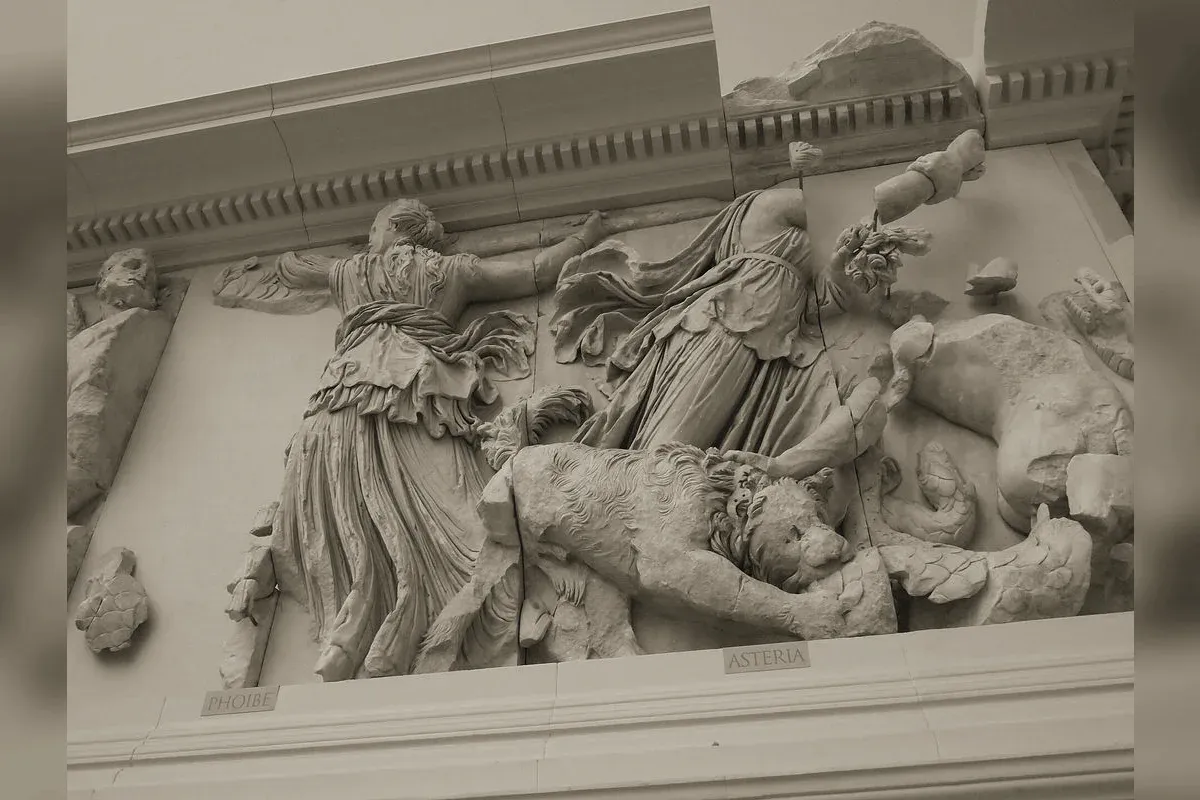
Asteria is the Titaness of stars and night prophecy, daughter of Coeus and Phoebe, and the only figure in Greek myth who escapes Zeus permanently. She does it by ceasing to be a person: she turns into a quail, then into a rock in the sea — and that rock becomes Delos, the most sacred island in the Aegean.
The flight
Zeus pursues her. Asteria refuses, changes into a quail — ortyx in Greek — and throws herself from the sky into the Aegean rather than be caught.
Where she falls, an island appears. It is called Ortygia, Quail Island, and it drifts unanchored, floating from place to place with no fixed position on any map. She is not rescued, transformed as a reward, or compensated. She stops being a goddess and becomes a piece of geography, which is the only exit available.
The point is sharpened by what happens to her sister. Leto, also pursued by Zeus, does not refuse, and is left pregnant and driven across the world by Hera’s anger, unable to find anywhere willing to let her give birth.
Her sister gives birth on her body
Every land refuses Leto, fearing Hera. The only place that will take her is the floating island — her own sister, in her new form.
Delos accepts, on terms: Callimachus has the island negotiate, asking what it will get from this and extracting the promise of a sanctuary. Four pillars rise from the sea floor to fix it in place, and it stops drifting for good. There, holding a palm tree, Leto bears Artemis and then Apollo.
The island is renamed Delos, “the visible” or “the manifest”, because it appeared and because what happened on it was made plain. Asteria’s refusal thus produces the birthplace of the god of prophecy, and the barren rock that no one wanted becomes the site of one of the richest sanctuaries in the Greek world.
Mother of Hecate
Before any of this, Asteria marries the Titan Perses and bears Hecate — and Hesiod’s treatment of that daughter is extraordinary.
The Theogony devotes about forty lines to Hecate, far more than to most Olympians, insisting that Zeus honoured her above all others, left her the privileges she held under the Titans, and gave her a share of earth, sea and sky. Scholars have argued for a century about why: a personal devotion of Hesiod’s, a local Boeotian cult, an interpolation. Whatever the cause, Asteria’s line is the one Titan branch that gains rather than loses under the new regime.
Her family is consistently nocturnal. Phoebe her mother, Leto her sister, Hecate her daughter, and Asteria herself: night, stars, the moon’s neighbourhood, dream-divination and crossroads.
Reading the escape
Asteria’s story is short and it is the clearest statement Greek myth makes about the cost of refusal.
Daphne becomes a laurel, Syrinx becomes reeds, Asteria becomes an island. In each case the escape is real and the price is the self. What distinguishes Asteria is scale and consequence: her transformation is not a private tragedy but a permanent addition to the map, and the god she fled ends up needing her sanctuary for his own children.
Ancient sources
- Hesiod, Theogony, 404-452
- Apollodorus, Library, 1.2.2, 1.4.1
- Callimachus, Hymn to Delos
- Homeric Hymn to Apollo, 25-88
- Pindar, fragment 33
See also
Related entries
Stories featuring this entity
Frequently asked questions
Why was no one allowed to be born or die on Delos?
Because the island was ritually purified. Thucydides records the purification of 426 BCE, when the Athenians removed every tomb and decreed that the dying and women about to give birth be carried to neighbouring Rheneia. The place where myth locates the most famous birth in Greek religion is precisely the place where giving birth became forbidden.
Why is Asteria's line the only Titan family that gains?
Because of her daughter. Hecate, born to her and Perses, receives an astonishing forty-line hymn in the middle of the Theogony, in which Hesiod insists that Zeus honoured her above all others, took nothing from her, and confirmed her share of earth, sea and starry sky. Every other Titan family is punished, chained or reduced. This one keeps its privileges intact under the new administration.