Greek mythology · Creation myths
The Greek Creation Myth: from Chaos to the Olympians
In brief
The Greek creation myth in Hesiod's Theogony: from primordial Chaos to Gaia, from the Titans to the Olympians, the ordered birth of the cosmos.
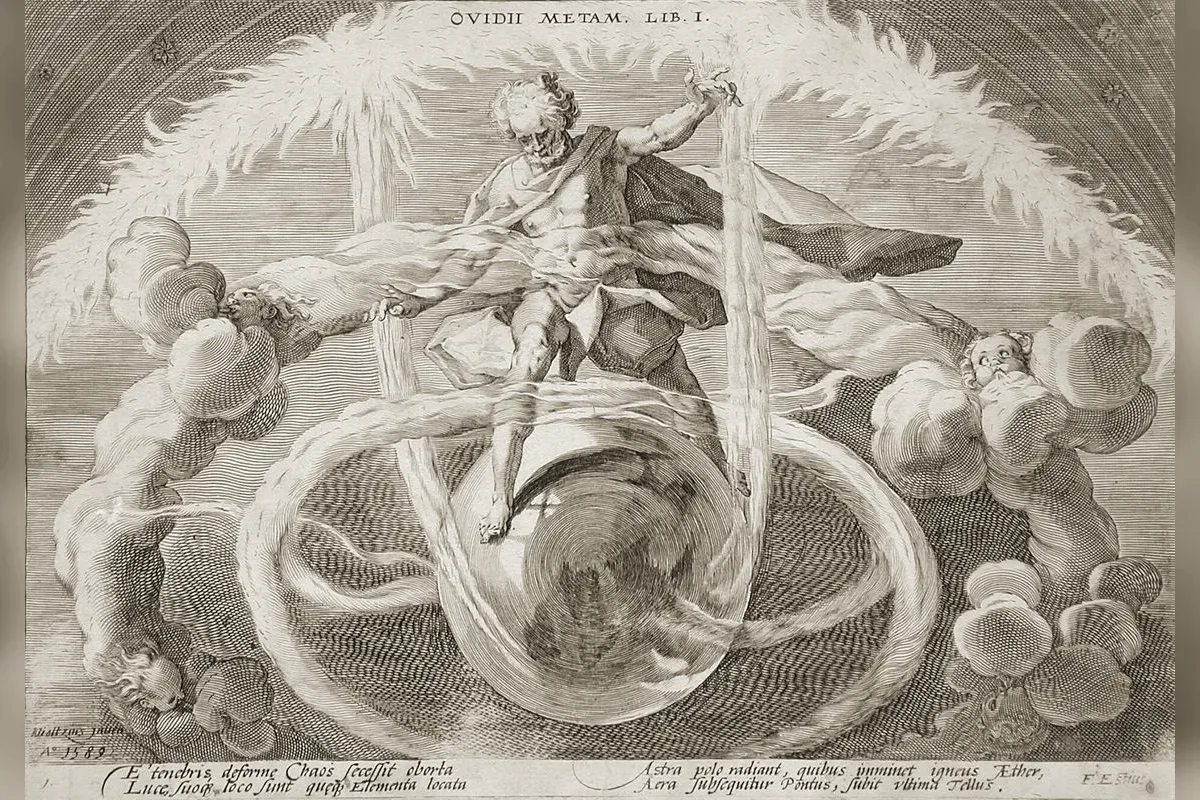
Greek mythology does not begin with a creator god who shapes the world in a single gesture. It begins with a chasm. In Hesiod’s Theogony, our principal source, the story of creation is first of all a genealogy: a long chain of births, separations, and wars that carry the universe from an undivided state to a stable order guaranteed by the justice of Zeus. To understand this cosmogony is to grasp the very logic of Greek myth, in which each divine generation overthrows the last until the world at last finds its balance.
Primordial Chaos: a chasm, not disorder
“First of all,” writes Hesiod, “Chaos came to be.” The Greek word khaos does not mean disorder in the modern sense but a chasm, an open abyss, a gap that yawns. It is neither a person nor a substance: it is the primordial opening out of which everything can arise.
Chaos is followed by several founding powers, which Hesiod does not describe as its offspring:
- Gaia, the “broad-breasted” Earth, the stable ground of all that lives;
- Tartarus, the deepest underworld abyss;
- Eros, the force of attraction that will drive beings to unite and beget;
- Erebus and Night (Nyx), the primordial darkness.
These entities are not manufactured: they well up. The Greek creation myth is therefore not a creation ex nihilo but a gradual emergence of powers that will, in turn, generate the world.
Gaia gives birth to the visible world
Gaia holds a central place: she is the matrix from which nearly the entire divine genealogy springs. Without a male partner, by parthenogenesis, she first bears Uranus, the starry Sky, whom she makes as vast as herself so that he covers her entirely. Then come the Mountains (Ourea) and Pontus, the sea.
This detail is crucial: for the Greeks, the Sky is the son of the Earth, not the reverse. The order of the world does not descend from above; it rises from the ground. Gaia is the first principle, the stability from which everything that grows and breathes is born.
The Titans, the Cyclopes, and the Hecatoncheires
United with her own son Uranus, Gaia becomes the mother of the first great divine generation:
- the twelve Titans, including Cronus, Oceanus, Hyperion, Iapetus, and Rhea;
- the three Cyclopes, one-eyed smiths;
- the three Hecatoncheires, hundred-handed giants.
But Uranus hates his offspring. As each is born, he pushes them back into the depths of Gaia, preventing her from giving birth. The Earth, oppressed by the Sky that covers her, prepares her revenge. This is the first cosmic conflict in Greek mythology, and it sets a tragic law that will run through the whole story: the son who overthrows the father.
The castration of Uranus: the first separation
Gaia fashions a sickle of grey adamant and calls on her children to avenge her. All shrink back except the youngest Titan, Cronus. When Uranus comes to embrace the Earth at nightfall, Cronus springs out and severs his father’s genitals.
This violent act is also an act of creation. From the blood that falls on Gaia are born the Erinyes (Furies), the Giants, and the Meliae nymphs; from the foam where the severed parts sink into the sea rises Aphrodite. Above all, the mutilated Sky withdraws into the heights: the Sky is definitively parted from the Earth, and the space of the world — where gods and mortals can exist — finally opens. The Greek cosmogony thus advances by successive separations, not by assembly.
The reign of Cronus and the Olympian generation
Now king, Cronus marries his sister Rhea and at once repeats his father’s crime. Warned by Gaia and Uranus that one of his own children will dethrone him, he swallows each of them at birth: Hestia, Demeter, Hera, Hades, and Poseidon vanish one after another into their father’s belly.
Rhea, worn out by this cycle, saves her sixth child. She gives birth in secret in Crete and hands Cronus a swaddled stone, which he devours without noticing. The rescued child is Zeus, raised in hiding and nursed by the goat Amaltheia.
The Titanomachy: the birth of the Olympian order
Grown to adulthood, Zeus forces Cronus to disgorge his brothers and sisters, then declares war on the Titans. This is the Titanomachy, a ten-year war pitting Olympus against Othrys. On Gaia’s advice, Zeus frees the Cyclopes and Hecatoncheires from Tartarus; the Cyclopes then forge the thunderbolt, the trident, and the helm of invisibility that decide the war.
The defeated Titans are hurled into Tartarus. Atlas, one of them, is condemned to bear the vault of heaven on his shoulders. The three brothers draw lots for the domains of the world: to Zeus the sky, to Poseidon the seas, to Hades the realm of the dead. From Mount Olympus, Zeus establishes an order founded on law, justice, and hospitality. The cosmogony is complete: the world at last has a master.
What remains to be created? Humanity and fire
The Olympian order is in place, but the world of mortals is not yet complete. Here the myth of Prometheus enters — the Titan who takes the side of mortals: in several traditions it is he who shapes the first humans and brings them fire stolen from the gods. The creation story thus opens onto the question of humanity’s place in the new order of the world — a tale you can follow in Prometheus and the theft of fire.
What the ancient sources change
Hesiod’s Theogony (7th century BCE) remains the canonical version, but it is not the only one. The Orphics offered a rival cosmogony in which the world is born from a primordial egg produced by Chronos (Time) and Ananke (Necessity) — a more mystical and cyclical account. The Presocratic philosophers, for their part, reinterpreted these myths in terms of physical principles (water for Thales, the apeiron for Anaximander).
Later, the Roman poet Ovid opens his Metamorphoses with a more rationalized cosmogony: an anonymous “god” or a benevolent Nature separates the elements confounded in a shapeless mass that he too calls chaos. One can thus measure how a single narrative transforms, from Hesiod to the Latin poets, from genealogical myth to philosophical cosmology.
The meaning of the myth
The Greek creation myth tells less of a creation than of an ordering. The world does not spring forth perfect: it is built through a succession of revolts, separations, and wars, until Zeus at last imposes a lasting balance. This vision — order wrested from chaos, always threatened with its return — runs through all of Greek thought, from tragedy to philosophy.
Further reading
For the primordial Earth from which the whole divine genealogy springs, read the page on Gaia. For the Titan who overthrew Uranus before being overthrown in turn, see the page on Cronus. For the war that founds the Olympian order, read the Titanomachy narrative. For the king of the gods who closes the cosmogony, consult the page on Zeus. For the continuation of the story toward humanity, read Prometheus and the theft of fire.
Story beats
- 01Primordial Chaos and the emergence of Gaia, Tartarus, and Eros
- 02Gaia bears Uranus, the Mountains, and Pontus alone
- 03Birth of the Titans, Cyclopes, and Hecatoncheires
- 04The castration of Uranus by Cronus: the parting of Sky and Earth
- 05The reign of Cronus and the swallowing of his children
- 06The Titanomachy and the rise of Zeus's Olympian order
Ancient sources
- Hesiod, Theogony
- Apollodorus, Library
- Ovid, Metamorphoses
See also
Related entries
- Chaos in Greek mythology: the primordial gap, not disorder
- Gaia, the primordial Earth and mother of the Greek gods
- Nyx, primordial goddess of Night in Greek mythology
- Eros, Greek god of love and desire
- Zeus, king of the gods in Greek mythology
- Cronus, king of the Titans and father of Zeus in Greek mythology
- Atlas, the Titan who holds up the sky in Greek mythology
- Tartarus: the primordial abyss and Titan prison in Greek mythology
- Mount Olympus: home of the gods in Greek mythology
- The Thunderbolt of Zeus: divine weapon and symbol of supreme power
Frequently asked questions
How was the world created in Greek mythology?
According to Hesiod's Theogony, the world is not made by a single creator. Chaos, a primordial chasm, appears first; Gaia (Earth), Tartarus (the underworld abyss), and Eros (the force of attraction) then arise without being described as its children. Gaia then bears the Sky, the Mountains, and the Sea, opening the long divine genealogy that culminates in the Olympians.
Who was the first Greek god?
There is no 'first god' in the sense of a creator, but rather primordial powers. Chaos appears first, then Gaia, Tartarus, and Eros. These entities are not fashioned by anyone: they come into being on their own, and the rest of the pantheon descends from them through birth or conflict.
What is the difference between Greek Chaos and nothingness?
Greek Chaos is neither absolute nothingness nor disorder in the modern sense. The Greek word khaos means a gap, an open void, a chasm. It is a primordial space out of which the first powers unfold, not a formless matter to be arranged.