Greek mythology · Heroes & mortals
Jocasta, mother and wife of Oedipus in Greek mythology
In brief
Jocasta, queen of Thebes: the character who works out the truth first, the speech Freud quoted, and three incompatible deaths in three sources.
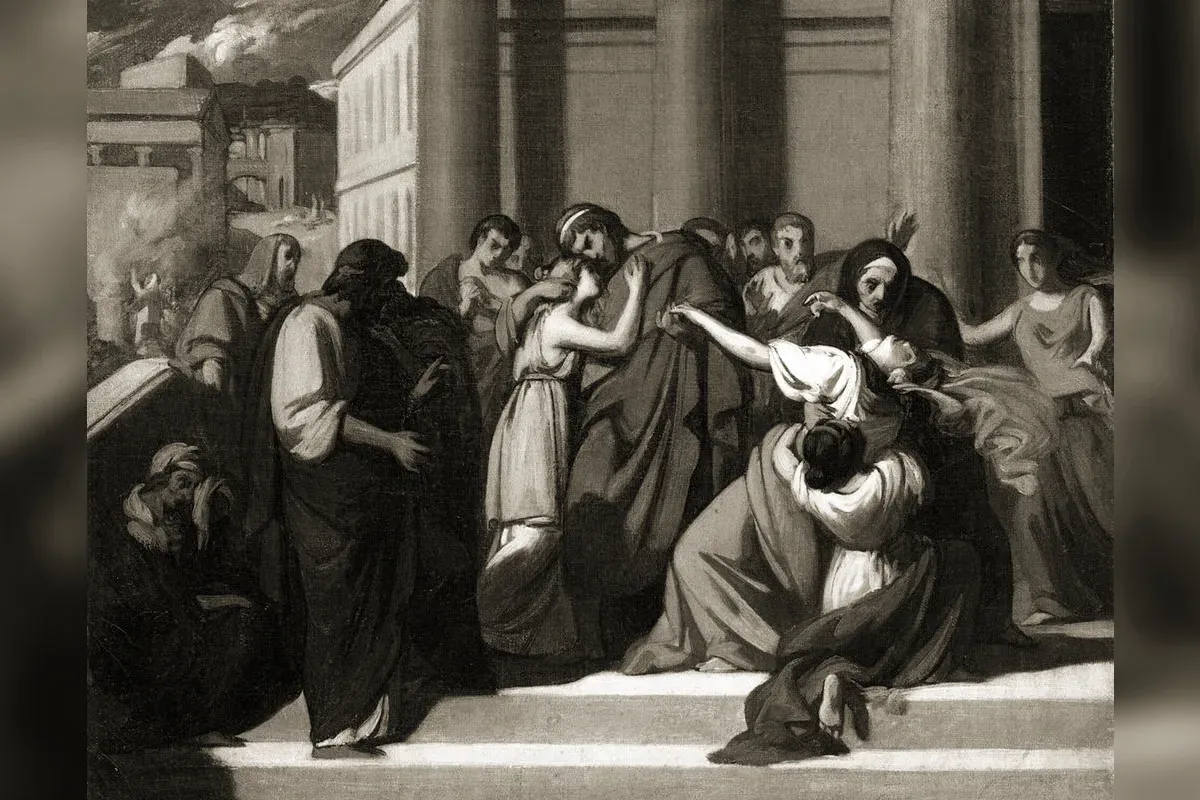
Jocasta is the queen of Thebes who becomes, without knowing it, both the mother and the wife of Oedipus. The genealogy on this site has to record her twice — as his parent and as his spouse — and Sophocles builds his play so that she is the first person on stage to work out what that means.
In the later tragic cycle, Jocasta and Oedipus are the parents of four children: Eteocles, Polynices, Antigone, and Ismene. Homer names none of this generation, so the tree records the genealogy used by the tragedians rather than treating it as part of every version.
She sees it first
The standard summary of Oedipus the King is that a man investigates a murder and discovers he is the murderer. That is accurate about Oedipus and wrong about Jocasta, who gets there well ahead of him and then tries to stop the inquiry.
The moment is precise. The Corinthian messenger reveals that Oedipus was not Polybus’ son but a foundling, handed over on Cithaeron with his ankles pinned. Oedipus hears this as a lead. Jocasta hears it as an ending — she stops arguing, refuses to explain, begs him to ask nothing further, calls him wretched, and says she will never speak again.
Oedipus, still elated, assumes she is ashamed he may turn out to be low-born. The audience knows she has understood, and that the play has roughly two hundred lines left. Her silence from that point is not ignorance. It is a woman watching a catastrophe arrive and having nothing left to delay it with.
The consolation that destroys her
Her most quoted speech is an attempt to reassure. Prophecies fail, she tells him: Laius was warned he would die at his son’s hands, and instead was killed by robbers at a crossroads, while the child was exposed on a mountain.
Every detail she offers to disprove the oracle is in fact a piece of evidence for it, and the word crossroads is what first frightens Oedipus. The scene is the clearest example in Greek tragedy of a character causing exactly the disaster she is trying to avert, using only true statements.
She then goes further, and this is the passage with the longest afterlife. Since chance governs everything and nothing can be foreseen, she says, it is best to live at random. As for marrying your mother — many men have lain with their mothers in dreams, and whoever treats such things as nothing bears life most easily.
Freud quotes precisely these lines in The Interpretation of Dreams, and they are a genuine part of his argument: he takes Jocasta’s remark as evidence that the ancients already knew such dreams to be common. The most influential psychological reading of the twentieth century rests on a consolation offered by a woman who does not yet know she is describing her own marriage.
The queen between two kings
The kingship passes through her, and the play never states it outright.
After Laius’ death, Thebes offers the throne and the widow to whoever rids the city of the Sphinx: marrying Jocasta is what makes a man king. Her brother Creon governs in the interval and takes power back after Oedipus falls. She is the hinge on which Theban sovereignty turns, between a husband who tried to kill their son and a son who killed her husband — which is why she can step between Oedipus and Creon at the height of their quarrel and speak to both men as though they were squabbling children.
Three deaths
In Homer she is called Epicaste, hangs herself when the gods make the truth known, and Oedipus goes on ruling Thebes, tormented by her Erinyes — with no self-blinding, no exile, and no children from the marriage.
In Sophocles her suicide is what triggers the blinding: Oedipus breaks into the chamber, cuts her down, and drives the pins of her own dress-brooches into his eyes. She becomes, posthumously, the instrument of his punishment.
In Euripides’ Phoenician Women she survives for years, tries to negotiate peace between Eteocles and Polynices, and kills herself on the battlefield over both their bodies.
These are not decorative variants. Each decides what Jocasta is — a dishonoured wife, an instrument in her son’s ruin, or a queen still trying to stop a war. The last gives her the largest political role and is the least known.
Ancient sources
- Homer, Odyssey, 11.271-280
- Sophocles, Oedipus the King, 707-725, 848-858, 977-983, 1054-1072
- Euripides, Phoenician Women
- Apollodorus, Library, 3.5.7-9
See also
Related entries
- Oedipus, king of Thebes and Greek tragic hero
- Antigone, heroine who defies Creon in Greek mythology
- Eteocles, king of Thebes and brother of Polynices in Greek mythology
- Ismene, sister of Antigone and daughter of Oedipus in Greek mythology
- Polynices, son of Oedipus and attacker of Thebes in Greek mythology
- Laius, king of Thebes and father of Oedipus in Greek mythology
- Oedipus, king of Thebes and Greek tragic hero
Frequently asked questions
Does Jocasta work out the truth before Oedipus?
Yes, and well before him. The moment is precise: when the Corinthian messenger reveals that Oedipus was a foundling with pinned ankles, she stops arguing, refuses to explain, begs him to ask nothing further and says she will never speak again. Oedipus, still elated, assumes she is ashamed he may be low-born. Her silence from that point is not ignorance but a woman watching a catastrophe arrive.
How does Jocasta die?
Three incompatible ways. In Homer she hangs herself and Oedipus goes on ruling. In Sophocles her suicide triggers his blinding — he uses the brooches from her dress, which makes her the instrument of his punishment. In Euripides' Phoenician Women she survives for years, tries to negotiate peace between her sons, and kills herself on the battlefield over both their bodies.