Greek mythology · Heroes & mortals
Oedipus, king of Thebes and Greek tragic hero
In brief
Oedipus, the Greek hero who unknowingly kills his father and marries his mother: the Delphic oracle, the riddle of the Sphinx, his tragic downfall, and ancient sources.
- fate and doom
- kingship of Thebes
- quest for truth
- pierced ankles
- +2
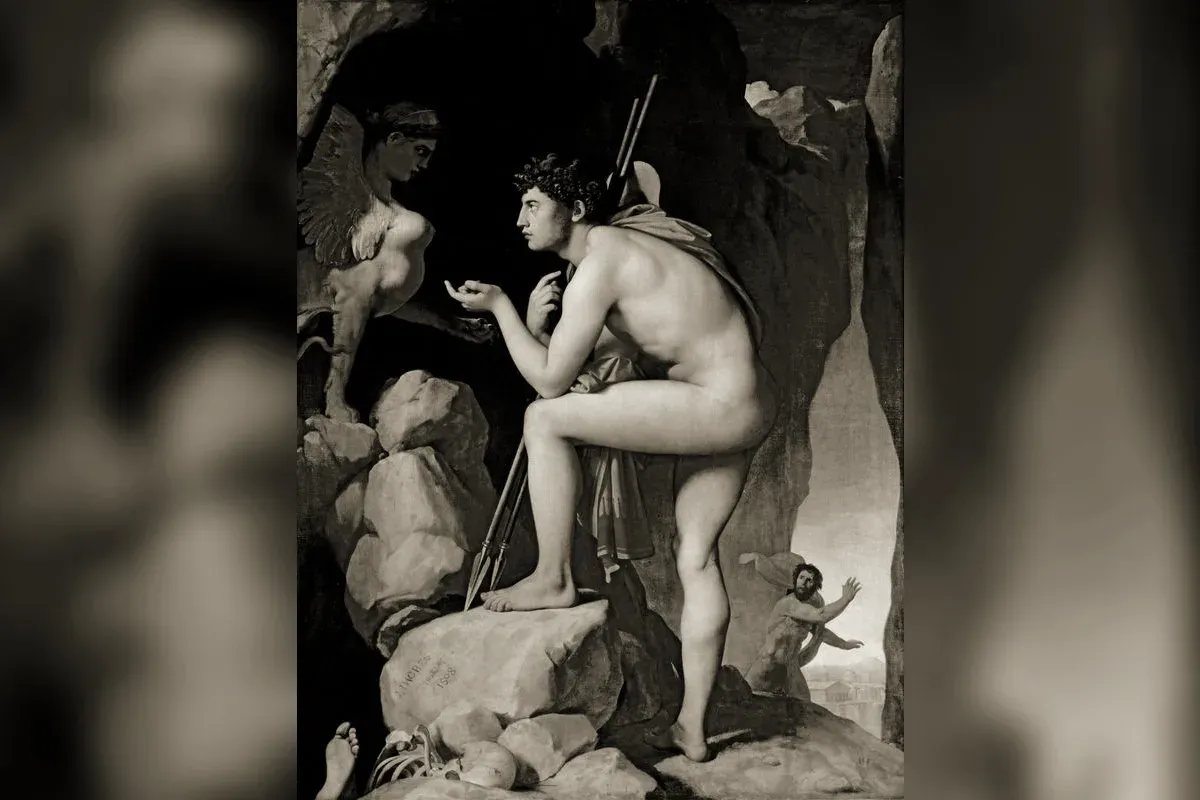
Who is Oedipus?
Oedipus is the tragic hero par excellence of Greek mythology: a king of Thebes who discovers, too late, that he has unknowingly fulfilled the most terrible prophecy imaginable — killing his father and marrying his mother. His very name, “swollen foot,” recalls the wound inflicted at birth by parents trying precisely to avoid this fate. The story of Oedipus is less a tale of exploits than an investigation: the hero who solves the riddle of the Sphinx ends up becoming the riddle he himself must unravel.
Birth and prophecy
Son of Laius, king of Thebes, and Jocasta, Oedipus is doomed from birth: an oracle warns Laius that his son will kill him. To escape the prophecy, Laius has the infant’s ankles pierced and orders him abandoned on Mount Cithaeron. A shepherd, moved by pity, hands him instead to a Corinthian counterpart, who gives him to King Polybus and Queen Merope of Corinth. The childless couple raise him as their legitimate son.
The Delphic oracle and the flight
Grown to adulthood, Oedipus one day hears an accusation that he is not truly the son of Polybus. Troubled, he consults the oracle at Delphi, which refuses to answer his question of origin but reveals his doom instead: he will kill his father and marry his mother. Convinced that Polybus and Merope are his biological parents, Oedipus flees Corinth forever — precisely the act that leads him straight toward Thebes, his true homeland, and toward the exact fulfillment of what he believes he is escaping.
The murder at the crossroads
On the road, at a crossroads near Delphi, Oedipus quarrels with an old man and his escort who refuse to yield the way. In the scuffle, he kills the stranger and nearly all his attendants. That man was Laius, his true father — the first half of the prophecy fulfilled without Oedipus knowing it.
The riddle of the Sphinx
Continuing on, Oedipus arrives at Thebes, terrorized by the Sphinx, a creature with a lion’s body, an eagle’s wings, and a woman’s torso, perched on a rock at the city’s gates. She poses every traveler a fatal riddle: whoever fails is devoured. Oedipus solves it — “what walks on four legs in the morning, two at noon, three in the evening? Man.” Defeated, the Sphinx throws herself from the rock. As reward, Oedipus receives the crown of Thebes, vacant since Laius’s death, and marries the widowed queen — Jocasta, his own mother.
Reign and the discovery of the truth
For years, Oedipus rules wisely, and Jocasta bears him four children — Antigone, Ismene, Eteocles and Polynices. Then a plague ravages Thebes. The oracle reveals that the scourge will not lift until Laius’s killer is found and driven out. The investigation Oedipus launches to identify that killer — aided by the blind seer Tiresias — leads him inexorably to his own identity: he is the murderer he is hunting, and Jocasta is both his mother and his wife.
The tragic turning point: blinding and exile
Faced with the truth, Jocasta hangs herself. Oedipus, discovering her body, gouges out his own eyes with the pins of her robe — a punishment he inflicts on himself, refusing to keep seeing a world he has defiled without knowing it. He leaves the throne and goes into exile from Thebes, guided in old age by his daughter Antigone, until he reaches Colonus in Attica, where he finds a peaceful end according to Sophocles.
What ancient sources change
Homer, in the Odyssey (Book 11), offers the oldest version: Jocasta (called Epicaste there) hangs herself upon learning the truth, but Oedipus keeps ruling Thebes, tormented by the Erinyes — without immediate blinding or exile. It is Sophocles, in Oedipus Rex (5th century BC), who fixes the canonical version: the self-mutilation and voluntary departure, which turn Oedipus into a figure of tragic lucidity rather than simply a cursed king. Sophocles extends his fate in Oedipus at Colonus, where the blind old man finds a mysterious, almost sacred death. Aeschylus, in his Theban trilogy — now lost except for Seven Against Thebes — treated the family curse passed on to his sons Eteocles and Polynices.
Why Oedipus matters in the Greek hero cluster
Unlike Theseus, who confronts a monster to found a city, or Heracles, who triumphs through strength, Oedipus is the hero of intelligence turned against itself: it is by solving another’s riddle that he fails to see through his own. This figure founds an entire later philosophical and psychoanalytic tradition, but its own mythological interest already lies in this tension between knowledge and blindness, executed with unmatched dramatic rigor in Greek theater.
Further reading
For the creature whose riddle seals Oedipus’s fate, see the page on the Sphinx. For the sanctuary whose prophecy triggers the whole tragedy, see the page on Delphi. For another hero confronting a guardian monster at a city’s gates, see the page on Theseus.
Ancient sources
- Homer, Odyssey, 11.271-280
- Sophocles, Oedipus the King
- Sophocles, Oedipus at Colonus
- Aeschylus, Seven Against Thebes
- Apollodorus, Library, 3.5.7-9
See also
Related entries
- Laius, king of Thebes and father of Oedipus in Greek mythology
- Jocasta, mother and wife of Oedipus in Greek mythology
- Antigone, heroine who defies Creon in Greek mythology
- Eteocles, king of Thebes and brother of Polynices in Greek mythology
- Ismene, sister of Antigone and daughter of Oedipus in Greek mythology
- Polynices, son of Oedipus and attacker of Thebes in Greek mythology
- Jocasta, mother and wife of Oedipus in Greek mythology
Frequently asked questions
Did Oedipus know he was killing his father and marrying his mother?
No, according to Sophocles's canonical version. Oedipus knows nothing of his Theban birth: raised in Corinth by King Polybus and Queen Merope, he sincerely believes them to be his biological parents. He flees Corinth precisely to escape the prophecy, not knowing he is heading straight for Thebes, his true homeland, and toward the exact fulfillment of what he thinks he is escaping.
What was the Sphinx's riddle and its answer?
The Sphinx asked: 'What walks on four legs in the morning, two legs at noon, and three legs in the evening?' Oedipus answers: 'Man' — who crawls on all fours as an infant, walks upright as an adult, and leans on a cane in old age. Defeated by the correct answer, the Sphinx hurls herself from her rock and dies, freeing Thebes from its scourge.
How does Sophocles's version differ from Homer's?
Homer, in the Odyssey (Book 11), mentions Oedipus briefly: Jocasta (named Epicaste there) hangs herself upon discovering the truth, but Oedipus keeps ruling Thebes, tormented by the Erinyes, without blinding himself or going into exile. It is Sophocles, in Oedipus Rex (5th century BC), who fixes the version that became canonical: the self-inflicted blinding and exile, which make Oedipus the tragic figure par excellence rather than merely a cursed king.