Greek mythology · Heroes & mortals
King Midas: the golden touch, the donkey's ears and the real Phrygian king
In brief
Midas is a king of Phrygia, son of Gordias, who was granted a wish by Dionysus for treating Silenus kindly: everything he touched turned to gold, including his food. Cleansed in the river Pactolus, he later preferred Pan's music to Apollo's and was given the ears of a donkey.
- kingship of Phrygia (Gordion)
- wealth and insatiable desire
- musical judgement and divine punishment
- the touch that turns everything to gold
- +3
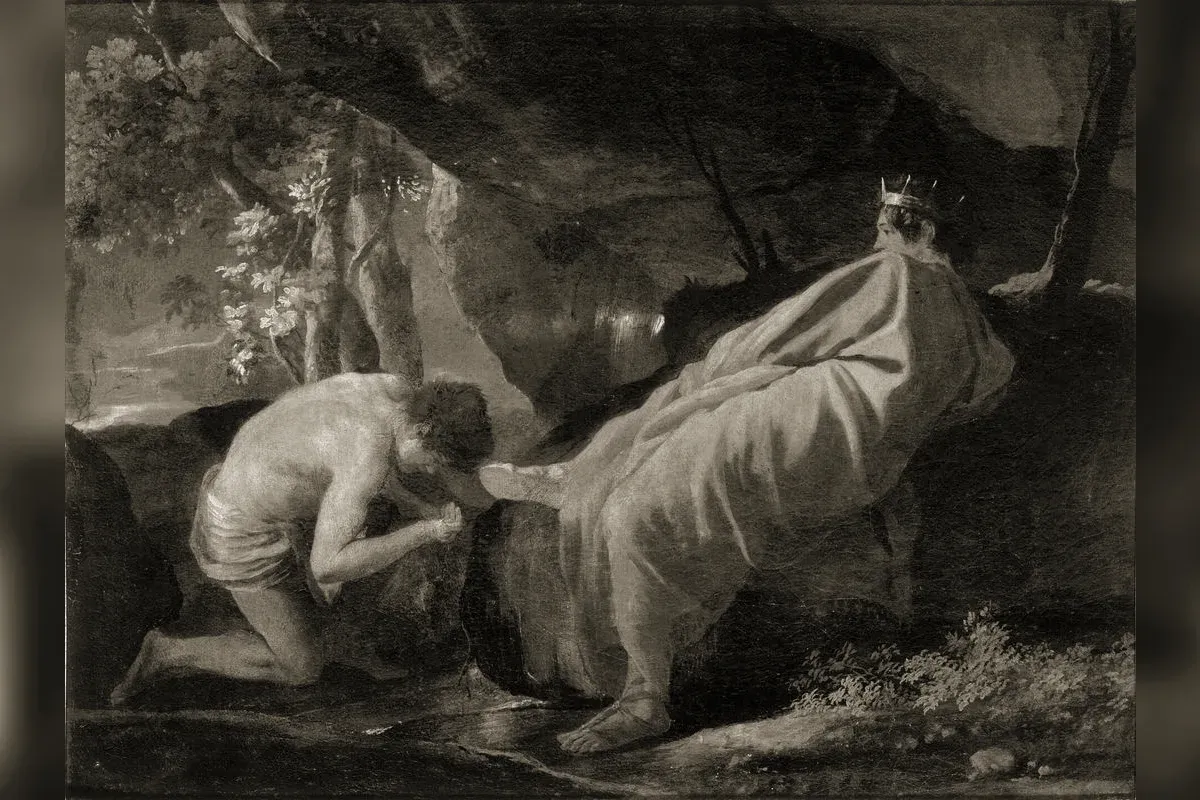
King Midas is the Phrygian king of Greek mythology, son of Gordias, remembered for two stories: the wish that turned everything he touched into gold, and the donkey’s ears Apollo gave him for judging a music contest badly. Ovid made both tales classic, but behind them stands a real Anatolian ruler — and a figure the Greeks used to think about wealth, wisdom and the blindness of the powerful.
A Phrygian king, between history and myth
Midas ruled from Gordion, in Phrygia, in what is now central Turkey. Herodotus calls him “Midas son of Gordias” and says he was the first foreign king, before the Lydian Gyges, to send offerings to Delphi: the royal throne on which he sat to give judgement, still on view in the Corinthian treasury in Herodotus’ day (1.14).
The king also left traces outside Greek tradition. The annals of the Assyrian king Sargon II, in the late eighth century BC, name a “Mita of Mushki”, first hostile and later reconciled with Assyria, who is usually identified with Midas of Gordion. Excavators at Gordion uncovered a huge burial mound that modern archaeologists nicknamed the “Midas Mound”; the name is a modern label, and whose tomb it really is remains debated.
Arrian preserves the founding legend of the dynasty, in his account of Alexander’s visit to Gordion (Anabasis, 2.3). An oracle told the Phrygians, torn by civil strife, that a wagon would bring them a king; Midas arrived riding on his parents’ wagon and was made king. He dedicated the wagon to Zeus the King — the same wagon that carried the Gordian knot Alexander later cut, or untied.
Hyginus offers a variant on his birth (Fabulae, 191): he calls Midas the son of the “Mother goddess”, the great Phrygian deity the Greeks knew as Cybele. Neither Herodotus nor Arrian gives him a divine mother; the detail mostly reflects how closely Phrygian kingship was tied to the cult of the Mother.
Catching Silenus
Before the golden touch comes Silenus, the old companion of Dionysus. Ancient writers told the capture in several ways — and in several places.
- Herodotus mentions the “gardens of Midas son of Gordias” below Mount Bermion in Macedonia, where wild roses grow with sixty petals each; there, the Macedonians said, Silenus was captured (8.138). He does not say how.
- Xenophon, describing the march of Cyrus the Younger, notes at Thymbrion in Phrygia a “spring of Midas, king of the Phrygians”, where Midas was said to have caught the satyr by mixing wine into the water (Anabasis, 1.2.13).
- Ovid reverses the scene: Phrygian peasants find Silenus drunk, tie him up with garlands and bring him to the king (Metamorphoses, 11.89-93).
The capture matters. Silenus was a wild, drunken spirit believed to hold wisdom that could only be taken from him by trickery. By trapping him, Midas acts as a king hunting for knowledge.
What Silenus told Midas
Two authors report the conversation. The famous one is Aristotle, in a lost dialogue (the Eudemus) quoted by Plutarch in the Consolation to Apollonius (115b-e). Midas, having caught Silenus, asks him what is most desirable for human beings. Silenus stays silent a long time; forced to speak, he says the best thing is not to be born, and the second best, once born, is to die as quickly as possible. It is one of the bleakest lines in Greek thought, and Nietzsche placed it at the heart of The Birth of Tragedy in 1872.
Theopompus of Chios, in the fourth century BC, gave a quite different version in a section of his Philippica known as the Meropis, summarized by Aelian (Varia Historia, 3.18). Here Silenus describes to Midas a vast continent beyond the Ocean, home to the Meropes, with two great cities, Eusebes (“Pious”) and Machimos (“Warlike”). Often compared with Plato’s Atlantis, the tale turns Midas into the listener of a utopia rather than of a grim maxim.
The golden touch
The standard version is Ovid’s (Metamorphoses, 11.85-145). Bacchus (Dionysus) has left Thrace after the death of Orpheus for the slopes of Tmolus and the river Pactolus. Silenus, his foster-father, has wandered off. Midas recognizes him — he had been initiated into the god’s rites by Orpheus and the Athenian Eumolpus (11.92-93) — entertains him for ten days and nights, and then returns him to the god in Lydia.
Grateful, Dionysus offers him any wish. Midas asks that whatever he touches become gold. The trial is thrilling at first: a twig, a stone, a clod of earth, ears of wheat, an apple, the posts of his door all turn to gold. Then dinner is served. Bread hardens between his teeth; wine pours into his mouth as molten gold. Rich and starving at once, Midas curses his wish and begs the god to take it back.
Dionysus sends him to the river that flows past Sardis, telling him to climb to its source and plunge his head and body into the water. The power passes into the stream, and from then on the Pactolus carries gold in its sands — a myth that explains a fact the ancients knew well: the alluvial gold of Lydia.
Aristotle already uses the story in the Politics (1.9, 1257b): Midas, starving because everything set before him turned to gold, shows that wealth measured in coin can leave a person lacking necessities. The parallel with Tantalus, another Anatolian king who goes hungry amid plenty, is striking — but Tantalus is punished by the gods, while Midas is punished by getting exactly what he asked for.
Apollo, Pan and the donkey’s ears
Sick of wealth, Midas retreats to the countryside and worships Pan. Ovid tells what follows (11.146-193). On Mount Tmolus, Pan shows off his reed pipes to the nymphs and dares to challenge Apollo. The mountain god Tmolus acts as judge. Pan plays a rustic tune that delights Midas, who happens to be there; Apollo, crowned with Parnassian laurel, strikes his lyre. Tmolus awards the prize to Apollo and everyone agrees — except Midas, who calls the verdict unjust.
Apollo will not let such dull ears keep a human shape. He lengthens them, fills them with whitish hair and makes them twitch: the ears of a slow-moving donkey. Midas hides them under a purple turban. Only the servant who cuts his hair knows the secret; unable to keep it, he digs a hole, whispers the truth into it and fills it in. Reeds grow on the spot and, a year later, rustle the buried words to the wind.
Hyginus (Fabulae, 191) tells it differently: Midas is chosen as judge in a contest between Apollo and Marsyas or Pan; when Tmolus gives the victory to Apollo, Midas sides with the challenger, and Apollo tells him his ears will match the way he judged. The pattern echoes other fatal verdicts such as the Judgement of Paris: a mortal asked to choose between gods always pays for the choice.
How Midas died
Historical tradition gives him a death without marvels. Strabo reports that when the Cimmerians swept in from the northern steppes, Midas killed himself by drinking bull’s blood (Geography, 1.3.21). Pseudo-Plutarch (Parallela Minora, 5) also credits him with a son, Anchurus, who threw himself into a chasm near Celaenae to save the city — a late and isolated tradition.
Legacy: the “Midas touch”
In English the “Midas touch” means a knack for making money or turning any venture into success. The phrase keeps the luck and forgets Ovid’s point that the gift was a curse. The popular image of Midas turning his own daughter to gold is not ancient at all: it comes from Nathaniel Hawthorne’s retelling in A Wonder-Book for Girls and Boys (1851). The donkey’s ears, meanwhile, became a standard tale of the secret that cannot be kept.
What the ancient sources say
- Herodotus (1.14; 8.138) attests the historical Midas son of Gordias, his gift to Delphi, and the gardens where Silenus was caught.
- Xenophon (Anabasis, 1.2.13) places Midas’ spring at Thymbrion and gives the wine trick.
- Aristotle cites the golden touch in the Politics and, through Plutarch, Silenus’ verdict on life in the Eudemus.
- Theopompus, via Aelian, has Silenus describe a distant continent.
- Ovid (Metamorphoses, 11.85-193) sets the canonical version: Silenus, the wish, the Pactolus, the contest of Pan and Apollo, the whispering reeds.
- Hyginus (Fabulae, 191) makes him the son of the Mother goddess and adds Marsyas to the contest.
- Strabo (1.3.21) records his death during the Cimmerian invasion; Arrian (Anabasis, 2.3) the wagon of Gordias.
Further reading
For the god who granted the wish, read the page on Dionysus; for the two musicians of the contest, see Pan and Apollo. For the poet who initiated Midas into the mysteries, see Orpheus. For another Anatolian king left hungry in the middle of plenty, compare Tantalus. To explore the rest of the cluster, return to the Greek mythology hub.
Ancient sources
- Herodotus, Histories, 1.14; 8.138
- Xenophon, Anabasis, 1.2.13
- Aristotle, Politics, 1.9, 1257b
- Aristotle, Eudemus (fragment), quoted in Plutarch, Consolation to Apollonius, 115b-e
- Theopompus, Meropis, in Aelian, Varia Historia, 3.18
- Strabo, Geography, 1.3.21
- Ovid, Metamorphoses, 11.85-193
- Hyginus, Fabulae, 191
- Arrian, Anabasis of Alexander, 2.3
Frequently asked questions
Was King Midas a real person?
Yes. A king called Midas ruled Phrygia from Gordion in the late eighth century BC. Assyrian annals of Sargon II call him Mita of Mushki, and Herodotus says Midas son of Gordias dedicated his judgement throne at Delphi. The golden touch and the donkey's ears are Greek legends that grew up around this historical ruler.
Did King Midas turn his daughter to gold?
Not in any ancient source. In Ovid, the classic version, Midas turns a twig, a stone, ears of wheat, an apple, his doorposts and finally his bread and wine to gold — no family member. The golden daughter was added in the nineteenth century by Nathaniel Hawthorne in A Wonder-Book for Girls and Boys (1851), and most modern retellings follow him.
What is the 'wisdom of Silenus'?
According to a fragment of Aristotle preserved by Plutarch, Midas captured Silenus and asked him what is best for mankind. After a long silence Silenus replied that the best thing is never to be born, and the next best is to die as soon as possible. Nietzsche made this answer famous again in The Birth of Tragedy.