Greek mythology · Mythical places
Elysium: the paradise of heroes in Greek mythology
In brief
Elysium in Greek mythology: a blessed realm promised to certain heroes, then a reward for just souls in later traditions.
- abode of the blessed
- heroic afterlife
- paradise for virtuous souls
- posthumous reward
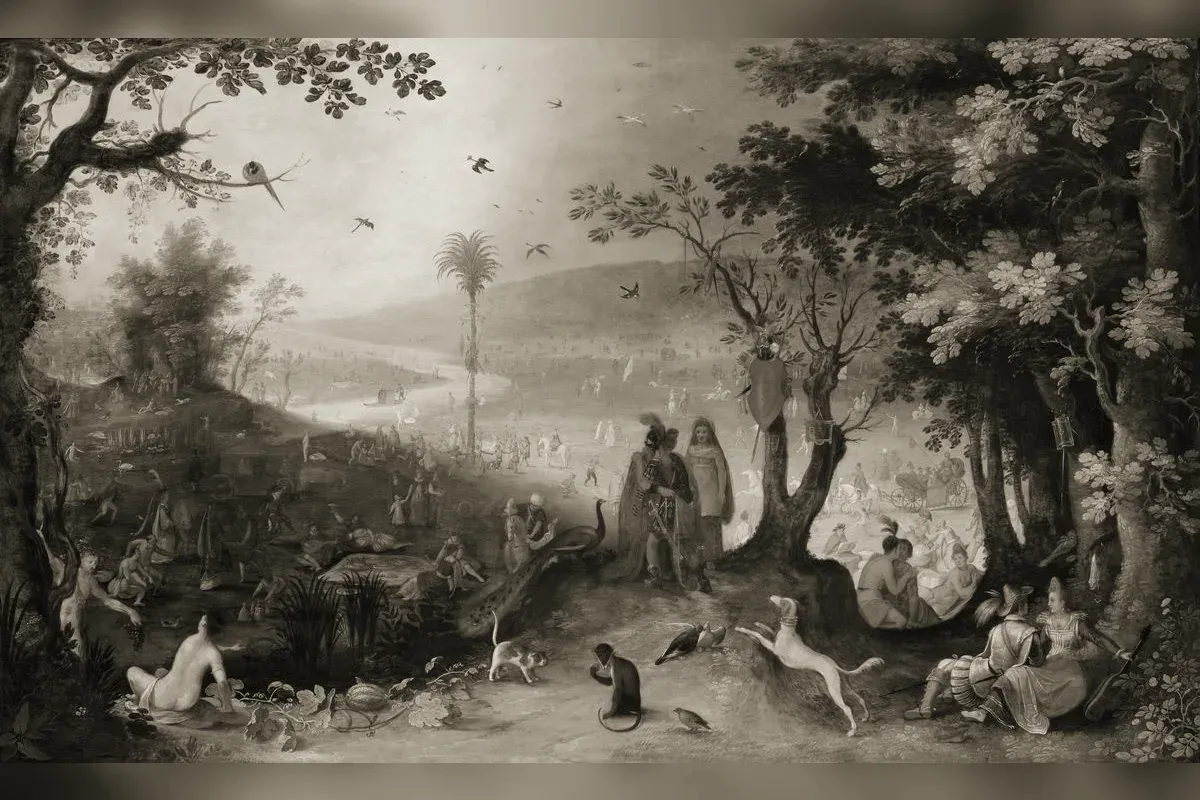
Elysium — or Elysion — is the blessed dwelling of certain heroes in Greek traditions about the afterlife. Its nature changes over time: in Homer it lies at the ends of the earth and is an exceptional divine favour; in later authors, Elysium or the Isles of the Blessed become a reward for a just life. It should not therefore be inserted into a single, unchanging map of the realm of the dead.
Elysion in Homer: a divine privilege, not a universal right
The first detailed mention of the Elysian Fields appears in Homer’s Odyssey, spoken by Proteus, the old sea-god, when he announces Menelaus’s posthumous fate:
“But for you, Menelaus, nurtured by Zeus, the gods do not wish you to die in Argos. They will send you to the Elysian plain at the ends of the earth, where fair-haired Rhadamanthus dwells, where life is easiest for men — no snow, no great cold, no rain — but always the Ocean sends the breezes of the West Wind blowing fresh to refresh men.”
Several details are revealing. First, Elysion here is a divine favour granted to Menelaus not for his personal merits but because he is Zeus’s son-in-law — husband of Helen, herself a daughter of the supreme god. Access to Elysium in Homer is a privilege of divine birth and kinship, not a moral reward open to all.
Second, the location is significant: the Elysian Fields lie “at the ends of the earth,” at the extreme west, on the shores of Ocean that girdles the world. This is not yet an underground place: it is a marginal space, far from the world of men but still at the level of the earth’s surface — not yet buried in the depths.
The physical description is deliberately opposed to the hardships of ordinary life: no snow, no cold, no rain, but the perpetual caress of Zephyrus, the west wind the Iliad nonetheless describes as a gale. It is a place of permanent comfort, the exact inverse of human existence subjected to storms and suffering.
Rhadamanthus, resident and later judge of the dead
Homer places Rhadamanthus, son of Zeus and Europa and brother of Minos, in Elysion, but does not yet describe a tribunal distributing every soul among several regions. That judicial function is developed in later traditions.
In Plato’s Gorgias, Zeus entrusts judgment of the dead to Rhadamanthus, Aeacus, and Minos: just souls reach the Isles of the Blessed and unjust souls Tartarus. This Platonic scheme does not name Erebus as a third destination for ordinary souls. Hades remains, in the broader mythological tradition, sovereign of the underworld.
Between Homer and Plato, Rhadamanthus’s role thus reveals an evolution: heroic privilege becomes a reward granted after moral judgment.
The Isles of the Blessed: the later, more egalitarian vision
Over time, the conception of Elysium evolved. Hesiod, in the Works and Days, introduces the notion of the Isles of the Blessed (Makarôn Nèsoi) — a distinct space, beyond Ocean, where the most deserving souls of the fourth race of men (the race of heroes) enjoy total beatitude, free from all care.
Pindar, in the 5th century BCE, develops a more elaborate and morally nuanced vision. In the Olympian Odes, the Isles of the Blessed are accessible to those who have kept their oaths across three successive lives, living with wisdom and justice through their three reincarnations. This conception incorporates a metempsychotic logic: souls reincarnate until they finally merit the blessed dwelling.
Plato explicitly sends just souls to the Isles of the Blessed in the Gorgias. The Republic also develops the posthumous rewards of justice and invokes the Isles of the Blessed when discussing philosopher-rulers. The Phaedo, however, describes the “true earth” and pure dwellings of souls without naming Elysium: it illuminates Platonic eschatology but is not a direct attestation of the Elysian Fields.
Who inhabits Elysium?
Greek traditions populate Elysion with a gallery of heroic and divine figures:
Achilles occupies a different place according to the source. In the Odyssey, Odysseus encounters his shade in the house of Hades; after their conversation Achilles strides away across the field of asphodel. In a later tradition attested by Pindar, he instead lives on the Isle of the Blessed.
Menelaus, as Homer states, is destined for Elysium because he is Zeus’s son-in-law. The poem says that he will not die in Argos but will be sent by the gods to the ends of the earth.
Peleus, father of Achilles, and Cadmus, founder of Thebes, also appear among the blessed in Pindar’s second Olympian Ode.
Elysium and accounts of the afterlife
Greek accounts of katabasis — descent into the underworld — do not all describe the same geography. In the Odyssey, Odysseus performs a nekyia, a rite that summons shades at the edge of the world of the dead. He speaks with Tiresias, his mother, and Achilles, among others, but the poem does not make him pass through Elysium.
Heracles descends alive into Hades during his labour involving Cerberus. According to Pseudo-Apollodorus, every shade flees before him except Meleager and the phantom of the Gorgon Medusa. The passage does not locate this encounter in Elysium.
The interior geography of the realm of the dead
Ancient texts do not supply a single, canonical map of the afterlife. In particular, the following terms should be distinguished:
- Erebus: a primordial deity and infernal darkness; the word can also denote the underworld or the direction to which shades return.
- The field of asphodel: a landscape crossed by shades in the Odyssey, including Achilles and Orion. It is not another name for Erebus.
- Tartarus: the abyss of torment, reserved for the great criminals — Tantalus, Sisyphus, Ixion — and for the Titans defeated in the Titanomachy.
- Elysion (Elysian Fields / Isles of the Blessed): the space of perpetual beatitude for deserving souls.
Authors progressively brought these notions together and reorganized them, especially Plato and then Virgil. Presenting them as three fixed districts of one kingdom would erase their chronological and literary differences.
Legacy and modern resonances
The Elysian Fields have survived the centuries to give their name to one of the world’s most famous avenues. Laid out westward from the Tuileries in 17th-century Paris — toward the setting sun, where the ancient Greeks symbolically placed the kingdom of the dead — the avenue des Champs-Élysées deliberately borrowed the name of the ancient paradise to evoke an ideal promenade, a secular garden of delight.
In literature, Elysium inspired Virgil in the Aeneid (Book VI), where Aeneas descends to the underworld, guided by the Cumaean Sibyl, and passes through a lush Elysium peopled with blessed warriors and philosophers. This Virgilian version, partially Christianized by Dante, continued to feed the Western imagination of paradise through the modern era.
Further reading
For the sovereign of the underworld, read the page on Hades. For the abyss in which the Titans are imprisoned, consult Tartarus. For Odysseus’s nekyia and his meeting with Achilles, consult the Odyssey. For the capture of Cerberus and the encounter with Meleager and Medusa, read the page on Heracles.
Ancient sources
- Homer, Odyssey, 4.561-569
- Hesiod, Works and Days, lines 167-173
- Pindar, Olympian, 2.61-83
- Plato, Gorgias, 523b-527a
- Pseudo-Apollodorus, Library, 2.5.12
- Virgil, Aeneid, 6.637-678
See also
Stories featuring this entity
Frequently asked questions
Who can enter Elysium in Greek mythology?
The criteria change from author to author. Homer sends Menelaus there by divine favour; Hesiod and Pindar place certain heroes on the Isles of the Blessed; in Plato's Gorgias, souls judged just reach those islands. Virgil supplies yet another arrangement in the Aeneid.
What is the difference between Elysium and Tartarus?
Traditions vary, but Elysium is a blessed dwelling while Tartarus is an abyss of imprisonment or punishment. The asphodel meadow receives shades in the Odyssey; Erebus denotes infernal darkness or the underworld and is not a synonym for that meadow.
Is Achilles in Elysium?
The sources differ. In the Odyssey, Odysseus meets Achilles' shade in the house of Hades, after which it strides away across the field of asphodel. Pindar, by contrast, places Achilles on the Isle of the Blessed.