Norse mythology · Gods & goddesses
Hodr, the blind god who kills Baldr in Norse mythology
In brief
Hodr is the blind god of Norse mythology, a son of Odin and brother of Baldr. Loki guides his hand to throw the mistletoe that kills the best-loved of the Aesir, making him the instrument of a murder he never intended. Killed in vengeance by Vali at one night old, he nevertheless returns to rule beside Baldr in the renewed world after Ragnarok.
- blindness and unwitting action
- unintended killing
- renewal of the world after Ragnarok
- the mistletoe shaft
- +2
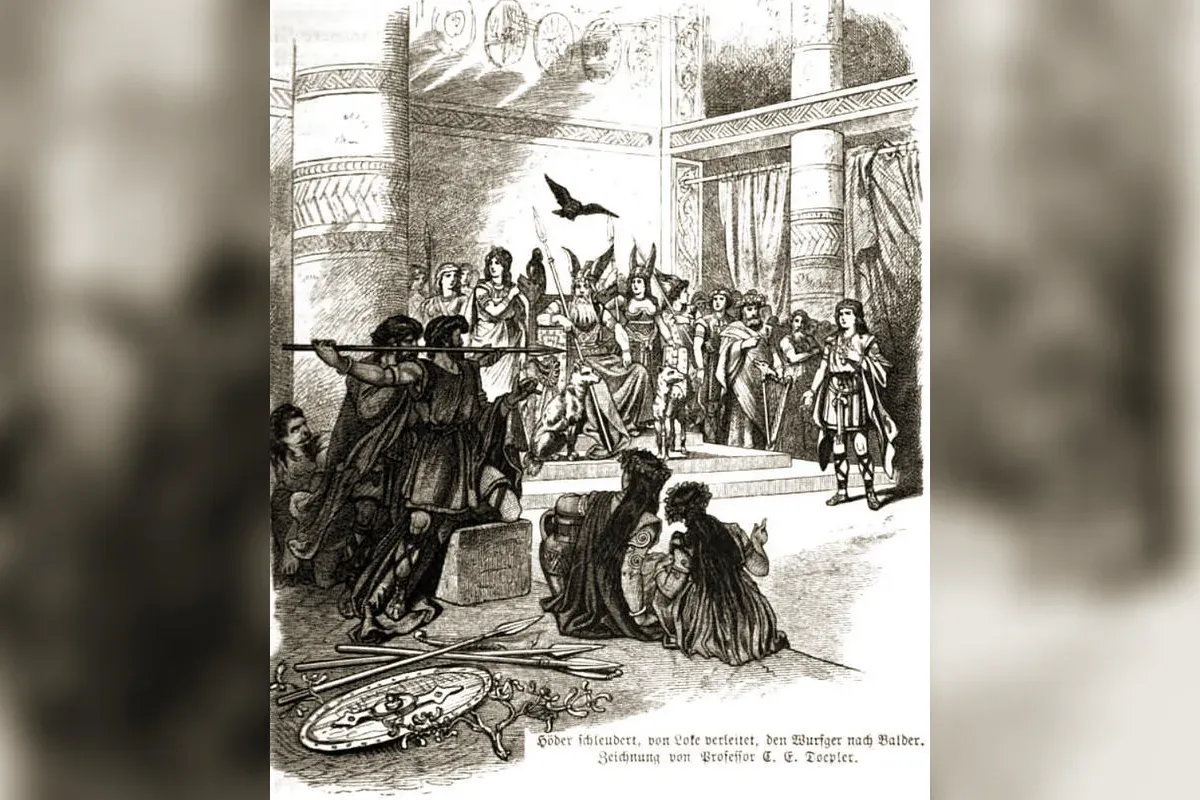
Who is Hodr?
Hodr is the blind god of Norse mythology, a son of Odin and brother of Baldr. Snorri Sturluson introduces him with unusual bluntness: “One of the Aesir is called Hodr: he is blind. He is strong enough, but the gods would wish that this god never needed to be named, for the work of his hands will long be remembered among gods and men.”
The whole character is in that sentence. Hodr has no domain, no attested cult and no story of his own. He exists in the mythology for a single act — and it was not his to choose.
The instrument of Baldr’s death
The mechanism is familiar: Frigg has made every thing in the world swear never to harm Baldr, all but the mistletoe, judged too young to take an oath. Reassured, the Aesir turn Baldr’s invulnerability into a game of the hall, hurling arrows, stones and blades at him while everything bounces away.
Hodr does not join in. Blind, he cannot aim, and he stands outside the ring. It is Loki who fetches him, asks why he alone does not honour his brother, slips the mistletoe into his hand and guides his arm. The shaft flies, passes through Baldr, and the god of light falls dead.
The cruelty of the design is deliberate. Loki does not kill; he has the killing done, and by the one god who cannot see what he is doing. The murder happens inside a sanctuary, where no blood may be shed and no one may take vengeance on the spot — which forces the Aesir to defer redress. The full story is told in the death of Baldr.
Genealogy: a son of Odin with no named mother
Hodr is counted among Odin’s sons. His mother, though, is never named: no text says he is the son of Frigg, even though he is consistently treated as the brother of Baldr, whose mother she certainly is.
That silence matters. It isolates him — the brother on the father’s side, the one left out of the mother’s oath-taking, the one standing outside while the others play. His entire position in the myth is that of an outsider inside the divine family.
Vali’s vengeance
Redress falls not on Loki but on Hodr, which regularly surprises modern readers. It follows a coherent legal logic all the same: the hand that threw the weapon is the hand that answers for it.
Odin therefore fathers on the giantess Rindr a son, Vali, conceived for the single purpose of avenging Baldr. Baldrs draumar gives the most arresting formulation: the avenger will neither wash his hands nor comb his hair until he has borne Baldr’s adversary to the pyre, and he will do it at one night old. Völuspá confirms the episode in a few lines.
So Hodr dies and joins his brother in the realm of Hel. The two sons of Odin, the victim and the instrument, are reunited in the same death — and that reunion sets up what follows.
The return after Ragnarok
Völuspá grants Hodr something few guilty figures obtain in any mythology: rehabilitation. After Ragnarok, when the earth rises green out of the sea again, the prophecy states that Baldr and Hodr will come back together to dwell in Odin’s victory-halls.
The detail carries real theological weight. The renewed world does not begin by excluding the killer; it begins with the two brothers living side by side, which presumes that Hodr’s act was understood for what it was — a hand moved by someone else. It is one of very few notes of reconciliation in the whole Norse corpus.
Saxo’s version: Høtherus, prince and rival
The Gesta Danorum of Saxo Grammaticus (c. 1200) tells a story so different that the character is barely recognisable.
In Saxo, Høtherus is a mortal prince raised at the court of King Gevarus, an outstanding swimmer, archer and musician — and not blind at all. He loves Nanna, Gevarus’s daughter, and comes up against Balderus, a demigod who wants her too. The rivalry becomes war. Høtherus obtains from a woodland being named Mimingus a sword capable of wounding Balderus, and finally kills him in battle. Odin then fathers Bous on Rinda to avenge his son: Bous kills Høtherus and dies of his own wounds soon after.
Here Høtherus is the hero of the narrative, Balderus the arrogant rival, and the killing a deliberate act of war rather than a manipulated accident. This is a textbook variant: two traditions, Icelandic and Danish, build opposite moral worlds out of the same names. Saxo is writing dynastic chronicle, where gods become kings and a love rivalry explains everything; Snorri is writing mythology, where Baldr’s death is a cosmic turning point.
What the ancient sources say
Völuspá (31-33) records the growing mistletoe, Hodr’s throw and the birth of the avenger in a handful of terse stanzas; stanza 62 announces the two brothers’ return. Baldrs draumar adds the prophecy of Rindr and Vali, drawn by Odin from a seeress woken out of the grave.
It is Snorri Sturluson who supplies the full scene — the blindness, Loki’s approach, the guided arm. Gylfaginning (33, 49 and 53) remains the reference account, but it is also the latest and the most literary.
Saxo Grammaticus preserves the euhemerised Danish version. No cultic evidence — no inscription, place name or theophoric personal name — attests a cult of Hodr anywhere: he belongs entirely to literature, which feeds the suggestion that the character exists because the story needed someone other than Loki to be holding the weapon.
Further reading
For the brother he kills against his will, whose death starts the countdown to Ragnarok, read the page on Baldr. For the god who guides his arm, see Loki. For the father who begets his avenger, consult Odin, and for the mother whose oath-taking missed the mistletoe, Frigg. For the queen who keeps both brothers until the end of the world, read Hel; the killing itself is told in the death of Baldr and their return in Ragnarok.
Ancient sources
- Snorri Sturluson, Prose Edda — Gylfaginning, 33, 49 and 53
- Poetic Edda — Völuspá, 31-33 and 62
- Poetic Edda — Baldrs draumar, 9-11
- Saxo Grammaticus, Gesta Danorum, Book III
See also
Related entries
Stories featuring this entity
Frequently asked questions
Why does Hodr kill Baldr?
He does not mean to. The gods amuse themselves by throwing weapons at Baldr, whom nothing can harm; Hodr, being blind, stands apart because he cannot aim. Loki comes to him, asks why he alone does not honour his brother, puts a sprig of mistletoe in his hand and guides his arm. The mistletoe — the one thing in the world that never swore to spare Baldr — goes straight through him. Hodr is an instrument, not a culprit in the ordinary sense.
Is Hodr blind in every source?
No. The blindness appears only in Snorri Sturluson, who opens his entry with 'One of the Aesir is called Hodr: he is blind.' The older poems of the Poetic Edda say only that Hodr threw the fatal shaft, with no mention of any disability. And in Saxo Grammaticus, Høtherus is a sighted mortal prince, an outstanding archer, swimmer and musician. The blindness belongs to the late Icelandic tradition, not to the myth as such.
Who avenges Baldr's death?
Vali, a son Odin fathers on the giantess Rindr for that sole purpose. Baldrs draumar puts it starkly: the avenger will neither wash his hands nor comb his hair before he has carried Baldr's enemy to the pyre, and he does it when one night old. Vengeance thus falls on the hand that threw the weapon rather than on Loki — Norse liability strikes first at the one who acts.