Norse mythology · Gods & goddesses
Mimir, keeper of the well of wisdom in Norse mythology
In brief
Mimir is the wisest being in Norse mythology, keeper of the well under a root of Yggdrasil where Odin left his eye as a pledge for one drink of knowledge. Sent as a hostage to the Vanir, he was beheaded; Odin preserved the head with herbs and charms, and still consults it on the eve of Ragnarok.
- wisdom and memory
- counsel and prophecy
- the underground waters of knowledge
- the well Mimisbrunnr, beneath a root of Yggdrasil
- +2
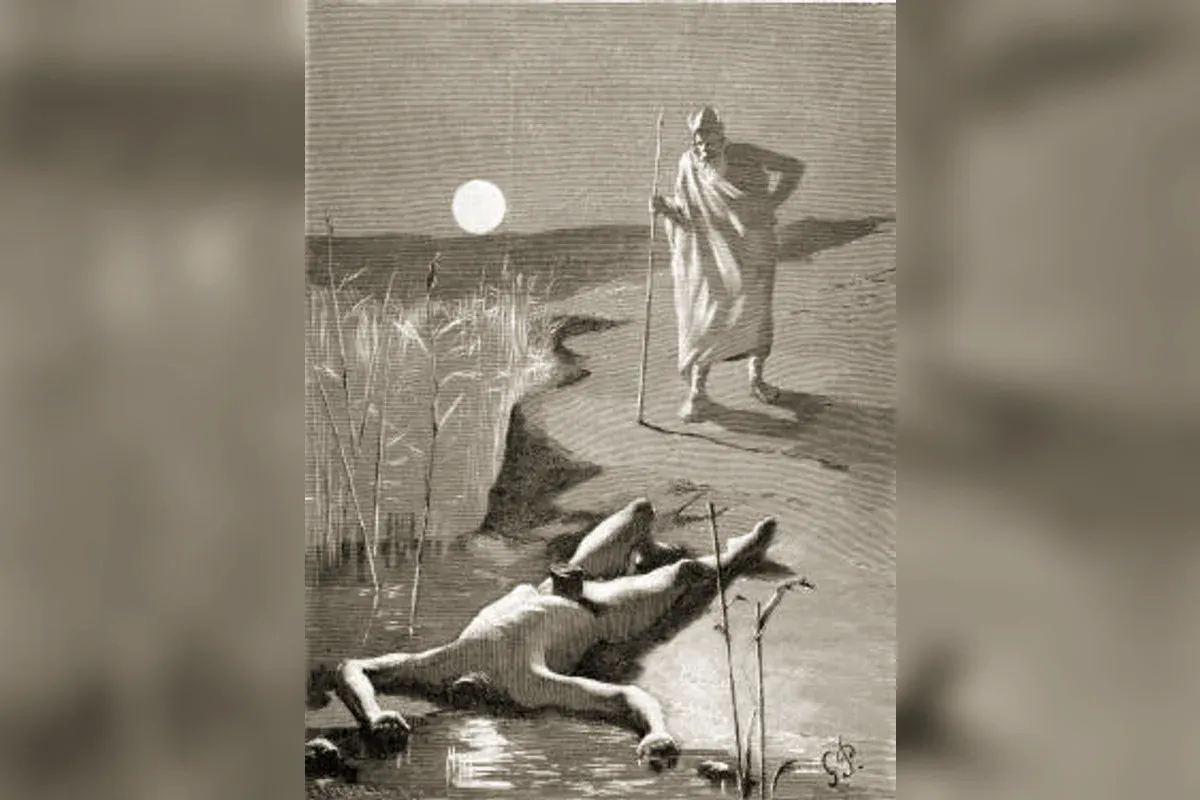
Who is Mimir?
Mimir is, in the words of the Norse texts themselves, the wisest of all beings. He has no cosmic department, no attested cult and no descendants: his function is to know, and to tell what he knows to whoever pays the price.
Two images fix him in memory. First a well at the foot of Yggdrasil, where wisdom and understanding are hidden and where Odin left his eye in pledge. Then a severed head, embalmed and speaking, which Odin carries with him and consults until the eve of the world’s end. The two images do not come from the same text, and fitting them together is one of the most argued-over problems in Norse mythology.
Mimir’s well and Odin’s eye
Gylfaginning maps the geography of knowledge precisely: beneath the second root of Yggdrasil, on the side of the frost giants, lies Mimisbrunnr, Mimir’s well, “in which wisdom and understanding are hidden”. Mimir owns it, and he is full of knowledge because he drinks of that water each morning from the Gjallarhorn — the horn Heimdall will sound on the first day of Ragnarok.
Odin comes to ask for a draught. Mimir grants it for a pledge: his eye. Völuspá puts it in two famous lines — all know that Odin hid his eye in Mimir’s renowned well, and that Mimir drinks mead there every morning from the Father of the Slain’s pledge.
The image is unusually dense. In Völuspá, the eye is Odin’s pledge and Mimir drinks from the well each morning; Snorri elsewhere specifies that he uses the Gjallarhorn. The texts do not explain the exchange further. It can be read as trading part of immediate sight for deeper wisdom, but that symbolic value remains an interpretation.
The severed head: hostage of the Vanir war
The other Mimir appears in Ynglinga saga, and the episode is almost political.
The war between Aesir and Vanir ends in a treaty and an exchange of hostages. The Vanir hand over Njord and his son Freyr; the Aesir send Hœnir, a man of impressive bearing whom they recommend as fit to govern, together with Mimir, wisest of their number.
The Vanir promptly make Hœnir a chieftain. But whenever Mimir is not at his side, Hœnir meets every question with the same formula: “let others decide”. The Vanir see they have been fobbed off with an empty figurehead. Believing themselves cheated in the exchange, they behead Mimir and send the head back to the Aesir. The saga reports the act without stating a legal rule that would permit it.
Odin does not discard it. He rubs it with herbs against decay, sings galdrar over it, and the head recovers speech. It tells him “many hidden things”.
One figure or two?
The two traditions are hard to reconcile. In Gylfaginning, Mimir is alive and drinking at his well; in Ynglinga saga, he is reduced to a head. Snorri reports both and harmonises neither.
Three readings circulate among commentators:
- one figure: the beheaded Mimir goes on inhabiting his well as a head — which conveniently explains why Odin rides “to Mimir’s well” to consult a head on the eve of Ragnarok;
- two homonyms: a primordial giant of the well, and an Aesir counsellor given as a hostage, fused by the Icelandic tradition;
- a late rationalisation: Snorri, writing the Ynglinga saga as a history of the kings of Sweden, turned a mythic being whose nature he no longer grasped into a diplomatic incident.
None of them wins outright. What matters is not to present the synthesis as something the sources say: what has come down to us is a contradictory dossier, not a biography.
The counsellor of the last hour
Mimir’s final appearance is his most solemn. When the Gjallarhorn sounds and the leaves of Yggdrasil begin to shake, Völuspá shows Odin speaking with Mimir’s head; Gylfaginning adds that he rides to Mimisbrunnr to take counsel there, for himself and for his army.
The gesture is desperate and entirely consistent. Odin has always known that Ragnarok is coming and that he will die in it: every rune learnt, every einherjar recruited, every question put to the severed head has only ever served to delay or to understand, never to prevent. Mimir is the knowledge you still have when you no longer have any power.
Kinship and echoes
Hávamál (140) contains an enigmatic line in which Odin says he learned nine mighty songs from “the famous son of Bölthorn, father of Bestla”. Since Bestla is Odin’s mother — see the Norse creation myth — that figure is his maternal uncle, and a long scholarly tradition identifies him with Mimir. The identification is plausible and attractive, but it stays a hypothesis: the stanza names nobody.
Other names echo his without any secure link: Hoddmimis holt, “Hoddmimir’s wood”, where Vafþrúðnismál shelters the two humans Líf and Lífthrasir who survive the end of the world; and Mimameid, “Mimi’s tree”, which many identify with Yggdrasil.
A last echo comes from Denmark: in Saxo Grammaticus’s Gesta Danorum, a woodland being named Mimingus owns the one sword able to kill Balderus, and the prince Hodr takes it from him. The motif of the holder of an irreplaceable thing that must be fetched is the same — but the connection with the Eddic Mimir is a resemblance of names, no more.
What the ancient sources say
The Poetic Edda supplies the oldest and briefest attestations: Völuspá (28) for the pledged eye, Völuspá (46) and Sigrdrífumál (14) for the speaking head, Hávamál (140) for Bölthorn’s son, Vafþrúðnismál (45) for Hoddmimir.
Snorri Sturluson arranges these fragments in two incompatible ways: in Gylfaginning (15 and 51) Mimir is the living master of a cosmic well; in Ynglinga saga (4 and 7) he is an Aesir counsellor beheaded by the Vanir, inside a rationalised history where the gods are kings out of Asia settled in Scandinavia.
No source gives him parents, spouse or children. Mimir has no place in the family tree of the gods, which fits his function exactly: he is not a link in a lineage but a reservoir — one the gods come to draw from for as long as they can meet his price.
Further reading
For the god who leaves his eye in the well and consults the head to the very end, read the page on Odin. For the tree beneath whose root Mimisbrunnr opens, see Yggdrasil. For the keeper of the horn he drinks from, consult Heimdall. For the Vanir hostages exchanged under the same treaty, read Njord and Freyr; and for the battle he foresees, Ragnarok.
Ancient sources
- Poetic Edda — Völuspá, 28 and 46
- Poetic Edda — Sigrdrífumál, 14
- Poetic Edda — Hávamál, 140
- Poetic Edda — Vafþrúðnismál, 45 (Hoddmimir's wood)
- Snorri Sturluson, Prose Edda — Gylfaginning, 15 and 51
- Snorri Sturluson, Ynglinga saga, 4 and 7
See also
Stories featuring this entity
Frequently asked questions
Why did Odin give his eye to Mimir's well?
Because Mimir demanded a pledge worth what he was handing over. Völuspá says Odin hid his eye in Mimir's famous well and that Mimir drinks mead there every morning. Odin trades half his physical sight for one draught of the water of knowledge: he pays in immediate perception for what he gains in depth of understanding. The bargain sums up Odin entirely — a god who mutilates himself in order to learn.
How was Mimir beheaded?
Ynglinga saga tells that at the end of the war between Aesir and Vanir the two sides exchanged hostages. The Aesir sent Hœnir, an imposing figure they presented as fit to rule, together with Mimir to supply his answers. Whenever Mimir was absent, Hœnir replied to every question with 'let others decide', and the Vanir realised they had been given a façade. They beheaded Mimir and sent the head back. Odin embalmed it with herbs, sang charms over it, and it went on speaking to him.
Is Mimir a god, a giant or something else?
The sources disagree. Ynglinga saga counts him among the Aesir, since they hand him over as their own hostage; the Eddic poems present him rather as a primordial being tied to the roots of Yggdrasil and older than the gods, and some readers place him on the giants' side through the identification with Bölthorn's son. The indeterminacy is part of the figure: Mimir belongs to no camp, he belongs to knowledge.