Egyptian mythology · Creatures
Bennu, the solar bird behind the phoenix
In brief
The Bennu is a sacred heron of Heliopolis, the first being to alight on the primeval mound at the first sunrise. Ba (soul) of Ra and later of Osiris, it embodies the renewal of cycles. The Greeks turned it into the phoenix — but the Egyptian Bennu never burns and never rises from its ashes.
What is the Bennu?
The Bennu is a sacred heron of Egyptian mythology, the first being to alight on the mound that rose from the primeval waters at Heliopolis, at the moment of the first sunrise. It descends from no one: it created itself, and its name, built on the verb “to rise,” states its function exactly. Texts make it the ba — the soul — of Ra, and later of Osiris. This is the bird the Greeks renamed the phoenix, adding to it a funeral pyre that Egypt never knew.
The bird of the first morning
The Heliopolitan creation account begins with an inert expanse of water, the Nun, from which a mound of earth emerges. Depending on the version, Atum rises there — or the Bennu alights on it and utters a first cry that breaks the silence and sets time going.
On that mound stood the benben stone, a conical block kept in the sanctuary at Heliopolis and held to be the first solidified matter and the first point the sun ever touched. Bennu and benben share the same root, that of rising: bird and stone are two forms of a single event. The stone is also the formal model of the pyramidion crowning obelisks and pyramids — Egyptian funerary architecture reproduces, at the summit of each monument, the point where light appeared.
The choice of the heron is not decorative. In a valley that lives by the annual withdrawal of the waters, a motionless wading bird standing on a barely uncovered mudbank is the very image of land reappearing.
The ba of Ra, then of Osiris
Egyptians had no word for “symbol” in our sense; they had the ba, the mobile part of a being that can manifest elsewhere and in another form, often as a bird. The Bennu is the ba of Ra: when the solar god must be seen, this heron is what appears, and it is sometimes shown perched on the prow of the solar barque.
Chapter 83 of the Book of the Dead is a spell “for taking the form of a Bennu,” in which the deceased declares: I am the Bennu, the soul of Ra. Chapter 17, a foundational text of the corpus, glosses differently: the Bennu is Osiris. For Egyptian thought this is no contradiction — the two gods meet each night in the Duat, and solar renewal is the model for funerary renewal.
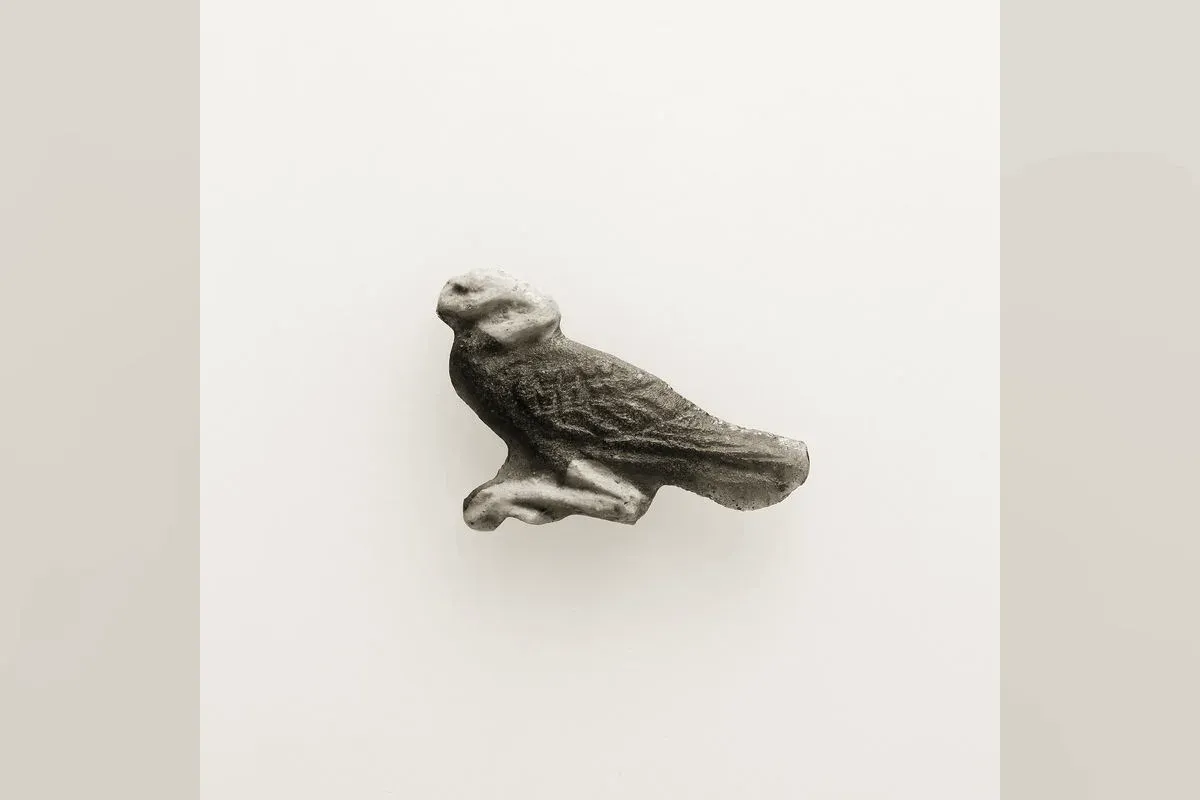
Hence a material practice: Bennu-shaped amulets, in gold or hardstone, laid on Late Period mummies, often near the heart. The dead take the bird of the rising with them.
Lord of cycles
The Bennu is not tied to the morning alone. Texts associate it with the great cycles: the Nile inundation, the return of festivals and, above all, long calendrical revolutions. It bears the title “lord of jubilees,” the heb-sed festivals of royal regeneration meant to recur at fixed intervals.
It is this trait — a bird whose return marks a period — that most interested Greek and Roman authors, to the point of eclipsing everything else.
What the ancient sources say: manufacturing the phoenix
Herodotus is the first link (Histories, II, 73). He reports that the priests of Heliopolis speak of a bird called the phoinix, red and gold, the size of an eagle, which comes from Arabia every five hundred years to bring its father’s body to the temple of the Sun, wrapped in a ball of myrrh. The historian immediately adds that he has never seen it except in paintings and that he finds the story hard to believe. The detail matters: from the outset the phoenix is a reported tale, not an observation.
Pliny the Elder (Natural History, X, 2) sets the cycle at five hundred and forty years, describes a nest of cinnamon and frankincense, and has a worm emerge from the father’s body, from which the new bird grows. Tacitus (Annals, VI, 28) records an appearance of the phoenix in Egypt under Tiberius and hesitates between five hundred years and a period of one thousand four hundred and sixty-one — the Sothic “great year,” calculated from the drift of the Egyptian calendar against the heliacal rising of Sirius. Ovid, in the Metamorphoses, makes it an example of universal transformation.
None of these texts sets the bird alight. The pyre, the deliberate burning and the rebirth from ashes appear only later, in late antique literature — the poem De ave Phoenice attributed to Lactantius, then the Physiologus, which turned the phoenix into a figure of Christ’s resurrection and gave it an immense medieval afterlife.
The trajectory is clear: an Egyptian heron of the sunrise becomes, among the Greeks, a bird on a five-century cycle; among late authors, a bird that burns and returns. Saying that the phoenix comes from Egypt is accurate; saying that Egyptians believed in a bird reborn from its ashes is not.
Further reading
For the solar god whose visible soul the Bennu is, read the page on Ra. For the creator who rises from the same primeval mound, see Atum and the Egyptian creation myth. For the god of funerary renewal with whom the bird is identified, consult the page on Osiris. To place the mound of Heliopolis among the world’s other beginnings, read the comparison of creation myths.
Ancient sources
- Coffin Texts, spell 335
- Book of the Dead, chapters 17 and 83
- Herodotus, Histories, II, 73
- Tacitus, Annals, VI, 28
- Pliny the Elder, Natural History, X, 2
See also
Stories featuring this entity
Frequently asked questions
Is the Bennu the same thing as the phoenix?
The Greek phoenix descends from the Bennu but resembles it only from a distance. Herodotus, visiting Heliopolis, transposed the Egyptian bird into a *phoinix* with a five-hundred-year cycle that carries its father's embalmed body in myrrh. The Egyptian Bennu neither dies nor burns nor rises from ashes: it embodies the renewal of the sun, not an individual resurrection.
What bird is the Bennu?
A heron, usually a long-legged grey heron, recognisable by two long plumes trailing from the back of its head and sometimes by the atef crown of Osiris. The choice is not arbitrary: the heron stands motionless on the shallows just as the water withdraws, exactly like the first mound of earth emerging from the Nun.
Why is the Bennu linked to Osiris as much as to Ra?
Because it embodies renewal, and Egypt knows two kinds. The Book of the Dead has the deceased say 'I am the Bennu, the soul of Ra,' yet elsewhere glosses the same bird as Osiris. The first renewal is the sun's each morning, the second the dead man's return to life: one image serves both, which is why Bennu-shaped amulets were placed on mummies.