Egyptian mythology · Creation myths
The Egyptian Creation Myth: Atum and the Ennead
In brief
The Egyptian creation myth: from the primordial Nun to Atum, the birth of the Heliopolitan Ennead and the order of the world against the chaos of Apophis.
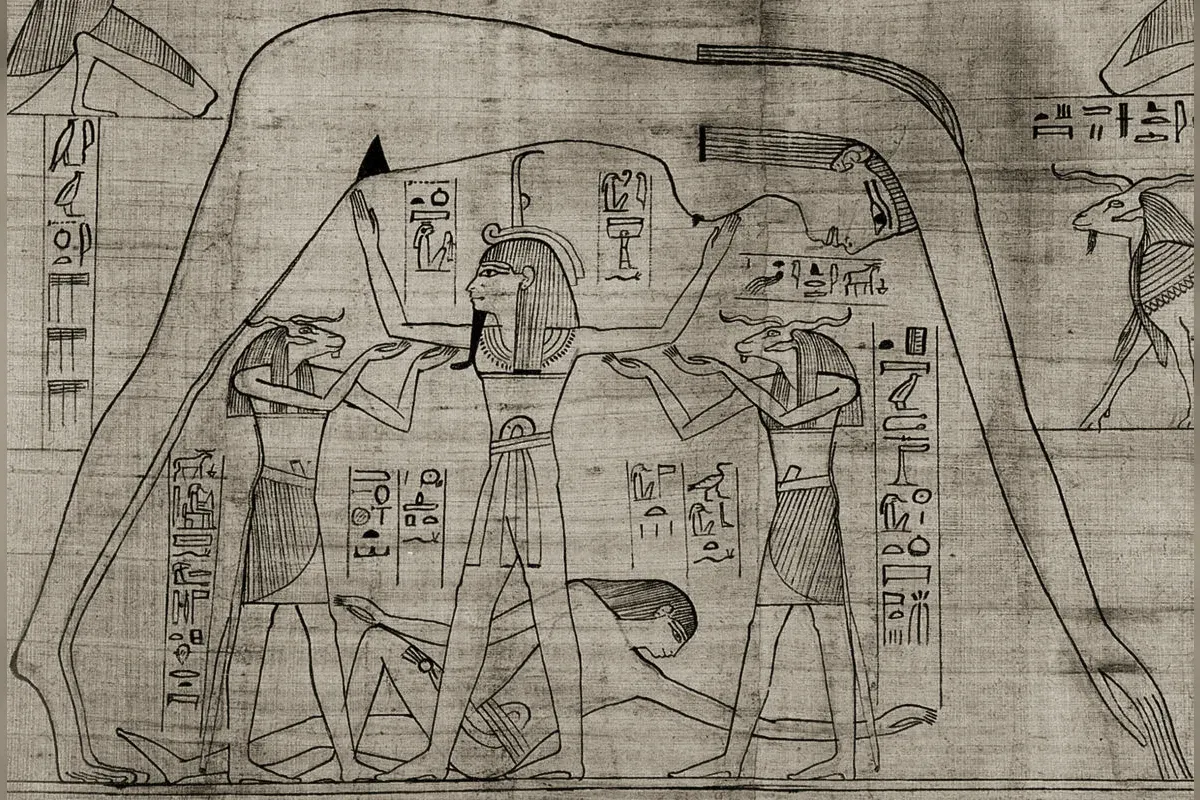
The Egyptian creation myth has no single version but several, each belonging to a major religious center. The most influential, that of Heliopolis, tells how a solitary god, Atum, brings himself into being on a mound risen from the waters of chaos, then produces, generation after generation, the nine gods of the Ennead. Reconstructed from the Pyramid Texts and the Coffin Texts, this cosmogony expresses a core idea of Egyptian thought: creation is never finished, and the ordered world must be re-created each day against the return of chaos.
The Nun: the primordial ocean
Before all things there stretched the Nun, a primordial ocean — dark, inert, and without limits. This is not nothingness: it is an infinite, undifferentiated water, holding in potential all the forms to come but none yet realized. The Nun is the original chaos of the Egyptians — not an enemy, but a state before the world, a sleeping matter.
From these waters rises a first stable point: the primeval mound, a hillock of emerged earth. This image points directly to the Egyptian experience of the Nile floods, when the first hills reappear as the waters recede. Creation begins where something at last distinguishes itself from the undivided.
Atum: the self-created god
On this mound appears Atum, “the All” or “the Complete One.” He is the self-created god, the one who comes into existence by his own will, without a parent. Often merged with the solar god under the name Atum-Ra, he embodies the setting sun and the potential totality of the world.
Alone, Atum begets the first divine couple without a female partner. The texts describe this act in several ways — through expectoration or through his own seed — to express one and the same truth: from the undivided One is born the first duality. Thus appear Shu, the air and the principle of life, and Tefnut, moisture. With them the differentiation of the world begins.
Shu and Tefnut: the parting of sky and earth
Shu and Tefnut, in turn, beget a fundamental couple: Geb, the earth, and Nut, the sky. Remarkably, Egypt inverts the usual scheme: here the earth is male and the sky female.
Geb and Nut are born so tightly entwined that no space exists between them. At the creator’s command, Shu steps between them and lifts Nut above Geb, parting the sky from the earth and opening the space in which life can unfold. This image — the god of air holding at arm’s length the starry vault above the reclining earth — is one of the most famous representations in Egyptian art. The separation of the primordial couple is the act that makes the world habitable.
The full Ennead: Osiris, Isis, Seth, and Nephthys
From the union of Geb and Nut is at last born the final generation, the one that links the cosmogony to the story of kingship: Osiris, Isis, Seth, and Nephthys. Together with Atum, Shu, Tefnut, Geb, and Nut, these four deities form the Ennead — the group of nine gods of Heliopolis.
This genealogy is not merely cosmic: it sets the stage for the great dynastic drama of the Osiris myth, in which the murder of Osiris by Seth and his resurrection by Isis found kingship and the promise of life after death. Creation thus opens directly onto Egypt’s political and funerary order.
Maat against Apophis: a creation to be renewed
For the Egyptians, the created world is never definitively secured. The cosmic order, Maat, must be upheld ceaselessly against the forces of chaos, never wholly defeated. This struggle takes mythic form in the sun’s nightly voyage: each night the barque of Ra crosses the underworld and confronts the serpent Apophis, embodiment of the chaos that seeks to swallow the light and bring back the Nun.
Every dawn at which the sun rises again is therefore a re-creation of the world. The Egyptian cosmogony is not a single, distant event: it is a daily process, a victory always to be won anew. This conception explains the central place of the solar cult and of Maat in Egyptian religion.
What the ancient sources change
There is no Egyptian “Book of Genesis”: the cosmogony is reconstructed from scattered sources. The Pyramid Texts (Old Kingdom), the oldest religious texts in the world, already mention Atum and the Ennead. The Coffin Texts (Middle Kingdom) and then the Book of the Dead enrich the account. The Bremner-Rhind Papyrus preserves a hymn in which Atum himself describes his creation.
Above all, each city offered its own version. The Memphite theology, carved on the Shabaka Stone, makes Ptah the true creator, who conceives the world with the heart (thought) and brings it into being with the tongue (the word) — a strikingly abstract theology of creation through speech. At Hermopolis, it is eight primordial gods, the Ogdoad, who hatch a cosmic egg. These systems do not exclude one another: they illuminate the same mystery from complementary angles.
The meaning of the myth
The Egyptian creation rests on a powerful intuition: the world is born by differentiation from an original unity, and it remains forever threatened with a return to chaos. Hence the vital importance of Maat, of kingship, and of the solar cult, charged with upholding day after day the order wrested from the Nun. Where other mythologies tell of a finished creation, Egypt conceives a world perpetually begun again.
Further reading
For the self-created god at the origin of everything, read the page on Atum. For the god of air who parts sky from earth, see the page on Shu. For the sky goddess who arches above the world, consult the page on Nut. For the dynastic drama that continues the cosmogony, read the Osiris myth. For the serpent of chaos that threatens creation each night, see the page on Apophis.
Story beats
- 01The Nun, primordial ocean, before all existence
- 02Atum brings himself into being on the primeval mound
- 03The birth of Shu (air) and Tefnut (moisture)
- 04Geb (earth) and Nut (sky) parted by Shu
- 05Osiris, Isis, Seth, and Nephthys, last generation of the Ennead
- 06The order of the world (Maat) upheld against the chaos of Apophis
Ancient sources
- Pyramid Texts
- Coffin Texts
- Bremner-Rhind Papyrus
- Memphite Theology (Shabaka Stone)
See also
Related entries
- Atum, the creator god of Heliopolis in Egyptian mythology
- Ra, the Egyptian sun god: creator, solar cycle and Amun-Ra
- Shu, Egyptian god of air who separates sky from earth
- Tefnut, Egyptian goddess of moisture and dew in mythology
- Geb, Egyptian god of the earth and heir to the throne
- Nut, sky goddess who gives birth to the sun in Egyptian myth
- Apophis, the serpent of chaos and enemy of Ra in Egyptian myth
Frequently asked questions
How was the world created according to the Egyptians?
According to the Heliopolitan cosmogony, there first existed the Nun, a dark and limitless primordial ocean. From these waters rises a mound of earth on which the god Atum brings himself into being. Alone he creates the first divine couple, Shu and Tefnut, who beget Geb and Nut, and then the whole Ennead. The ordered world is thus born by gradual differentiation from the original unity.
What is the Heliopolitan Ennead?
The Ennead is the group of nine primordial deities of the Heliopolitan system: Atum, his children Shu and Tefnut, their children Geb and Nut, and the latter's children Osiris, Isis, Seth, and Nephthys. This genealogy structures the Egyptian creation myth and links creation to the story of divine kingship.
Are there several creation myths in Egypt?
Yes. Each major religious center had its own cosmogony. Heliopolis foregrounds Atum and the Ennead; Memphis makes Ptah the creator through thought and word; Hermopolis imagines an Ogdoad of eight primordial gods and a cosmic egg. These versions coexist without truly contradicting one another, since they describe the same act from different angles.