Egyptian mythology · Gods & goddesses
Bes, the dwarf god who guarded homes and childbirth
In brief
Bes is the dwarf god of Egyptian household religion: bearded, grimacing, shown frontally in an art that draws everything in profile. He has no temple of his own and no genealogy, but he guards women in labour, infants and sleepers, and his amulets travelled across the Mediterranean.
- protection of the home
- childbirth and infancy
- sleep and nightmares
- apotropaic music, dance and laughter
- +4
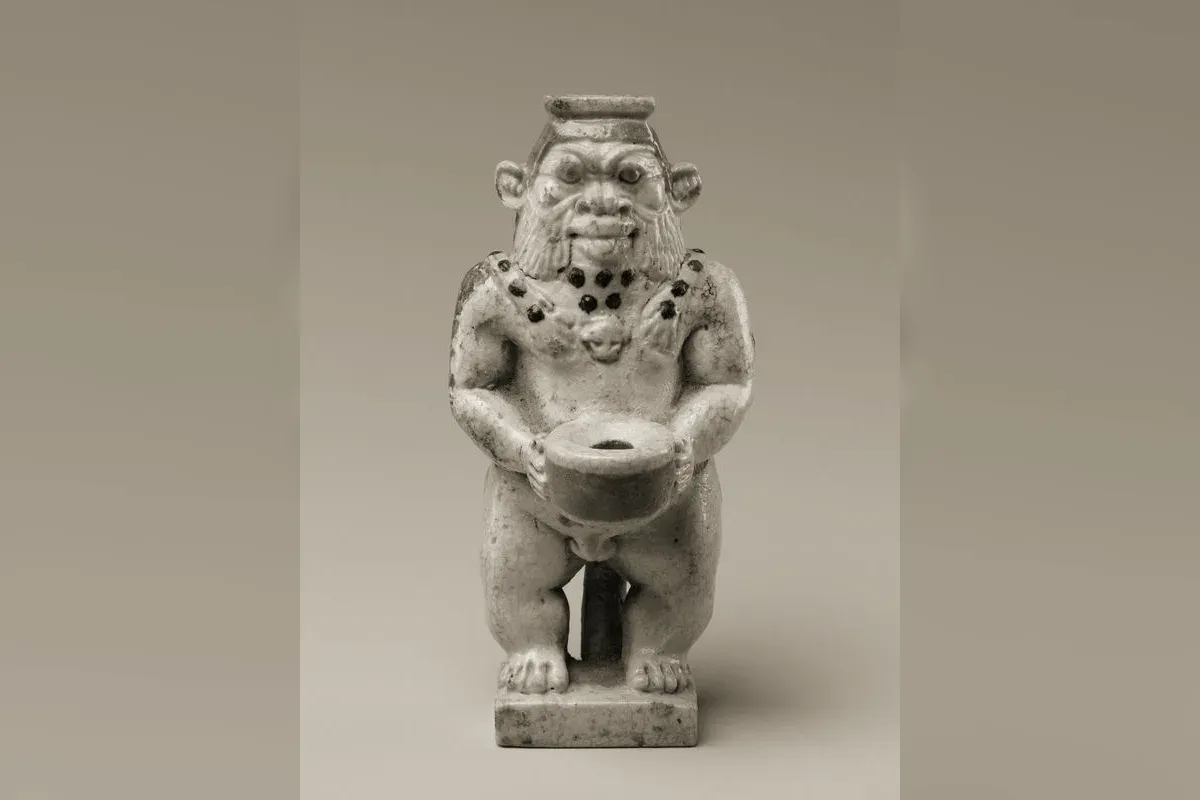
Who is Bes?
Bes is the dwarf god of Egyptian household religion: squat, bearded, tongue out, crowned with a spray of plumes, and — the decisive detail — characteristically shown face-on. He has no myth, no genealogy, no great temple in his name. His function lies elsewhere: he guards the bedroom, the bed, the woman in labour and the newborn child. Along with Taweret, he is probably the deity ordinary Egyptians had before their eyes most often.
An anomaly in Egyptian art
Egyptian art is an art of profile. Faces, feet and shoulders obey strict conventions that three thousand years barely dented. Bes, however, looks straight out at the viewer, as the masks of Hathor do — one of the very few other exceptions.
That frontality is functional. A god in profile is engaged in a scene; a god face-on is turned toward whatever is coming. Bes’s face is not handsome and does not try to be: knotted brows, bristling mane, protruding tongue. It is a threat mask, of the same order as Greek gorgoneia or medieval grotesques, meant to drive back what approaches the sleeper or the cradle.
His body follows the same logic. Short stature in Egypt carried no stigma: dwarfs held attested positions at court, and the dwarf god concentrates a compact, low-set strength suited to defending an enclosed space.
Guardian of birth
Childbirth was the most dangerous moment in the life of an Egyptian woman and her child. Official religion, busy with the cosmos and the king, had no answer for it; domestic magic did.
The objects show this precisely. Middle Kingdom apotropaic wands, cut from a split hippopotamus tusk, line up protective figures — including dwarf spirits now associated with Bes, Taweret, snakes, lions, knives — and were probably used to trace a magic circle around mother and infant. Headrests carry his image to guard sleep; mirrors set him on their handles; amulets hang him around children’s necks.
At Deir el-Medina, the village of the royal tomb workers, excavation uncovered houses whose front room held a built platform painted with female figures and a dancing Bes. It has been read, without absolute certainty, as a space connected with birth or with the period after it — in either case, the god is at home there.
In the Late Period this competence finally entered the architecture of the great sanctuaries: the mammisi, or “birth houses”, of Dendera and Edfu, where the birth of the divine child was celebrated, carry carved figures of Bes atop their columns.
A god without a genealogy
Looking for Bes’s parents is a dead end, and an instructive one. He has no father, no mother, no offspring, no place in the Ennead. A Beset, a female counterpart, appears in iconography and magical papyri, but she belongs to ritual doubling rather than to divine marriage.
He simply does not belong to the same register as Ptah or Osiris. The gods of the official pantheon have a theology, a genealogy and a priesthood; Bes has a clientele. He belongs to what Egyptologists call personal piety, the religion of amulets and spells that the great texts almost entirely ignore and that archaeology finds in every house.
The word “Bes” is itself a modern convenience. Egyptians used several names — Aha, “the fighter”, among them — for a family of dwarf spirits with related features, which scholarship eventually gathered under a single label.
Music, dance and laughter as weapons
Bes often holds a tambourine, sometimes a knife, and he dances. The combination may surprise in a guardian; it is perfectly coherent.
Noise, in Egyptian magic, is a weapon: rattles, drums and shouting drive off hostile forces as they drive birds from a field. Bes shares that competence with Hathor, goddess of music and intoxication, and with Bastet, whose festivals mixed dance, wine and sistra. Laughter itself protects: a grotesque god defuses the fear he is charged with fighting.
That is why he appears on the magical stelae known as cippi of Horus, where the face of Bes surmounts the young Horus mastering snakes and scorpions. Water was poured over these stelae to charge it with the engraved spells and then drunk — Egyptian healing magic at its most concrete, of a piece with the protective symbolism of the Eye of Horus.
From Egypt to Cyprus and Rome
Few Egyptian gods travelled so widely. Bes amulets turn up in Nubia, the Levant, Cyprus, Phoenicia, Carthage and across the Roman world, often long after their buyers had stopped knowing who he was.
The reason lies in his nature. A national god transports badly: he requires a temple, a priesthood, a liturgical language. A household god fits into a three-centimetre faience amulet and answers a universal need — keeping a child safe. Bes spread as an object rather than as a cult, which explains his presence in archaeological contexts that show no other trace of Egyptian religion.
His popularity even outlasted Egypt’s own upheavals. During the reform of Akhenaten, which closed the temples and proscribed the names of other gods, the houses of Akhetaten went on yielding amulets of Bes and Taweret: the revolution of the sun disk never reached the bedrooms.
The oracle of Bes at Abydos
The latest episode of his career is also the one best documented by a foreign author. In the Roman period the temple of Seti I at Abydos housed an oracle of Bes — Besa in Greek — consulted in writing: the petitioner deposited his question on a slip and received, or came to collect, the answer.
Ammianus Marcellinus records how the practice turned to disaster (Res Gestae, XIX, 12). Under Constantius II, slips addressed to the oracle were intercepted; since some concerned the future of imperial power, the affair was treated as conspiracy. It led in 359 to the trials at Scythopolis, a series of treason proceedings that the historian, hostile to such repression, describes as an indiscriminate hunt. The oracle was suppressed.
It is a logical end for such a god: Bes, who had never threatened anyone, vanishes from the sources not for theological reasons but because an imperial administration grew nervous about what people were asking him.
Further reading
For the hippopotamus goddess who shares the protection of childbirth with him, read Taweret. For the goddess of music and joy whose instruments he borrows, see Hathor. For the cat goddess of hearth and festival, consult Bastet. For the Egyptian amulet most widespread after his own, read the Eye of Horus. For the religious reform his presence in the houses quietly contradicted, see Aten.
Ancient sources
- Middle Kingdom apotropaic wands
- New Kingdom magical papyri (spells protecting childbirth)
- Houses and chapels of Deir el-Medina
- Mammisi of Dendera and Edfu
- Ammianus Marcellinus, Res Gestae, XIX, 12
Frequently asked questions
What is Bes the god of?
Bes protects domestic space: the bedroom, the bed, the woman giving birth, the newborn, the sleeper exposed to nightmares. He has no cosmic domain and takes part in no major myth. His competence is entirely defensive and close at hand — he governs nothing, he keeps things away.
Why is Bes generally shown face-on?
Egyptian art shows almost everything in profile; the frontal face is a rare exception reserved for a handful of figures, Bes and the masks of Hathor among them. That frontality is not a stylistic detail: a god who looks the viewer in the eye is facing whatever comes, and his grimacing mask works as a deterrent. The form states the function.
Did Bes have temples?
Not in the sense of a great national sanctuary, and that is what makes him interesting: he turns up in houses, on beds, mirrors, headrests, amulets and magic wands. He does appear on the columns of the mammisi, the 'birth houses' attached to late temples, and an oracle was dedicated to him at Abydos in the Roman period.