Egyptian mythology · Gods & goddesses
Ptah, creator god of Memphis and craftsmen
In brief
Ptah is the creator god of Memphis: he conceives the world in his heart and brings it into being by naming it. Patron of craftsmen and builders, husband of Sekhmet and father of Nefertem, he embodies a creation by thought and speech, distinct from the bodily cosmogony of Heliopolis.
- creation by thought and speech
- craft, sculpture and metalwork
- architecture and building
- kingship and the legitimation of power
- +4
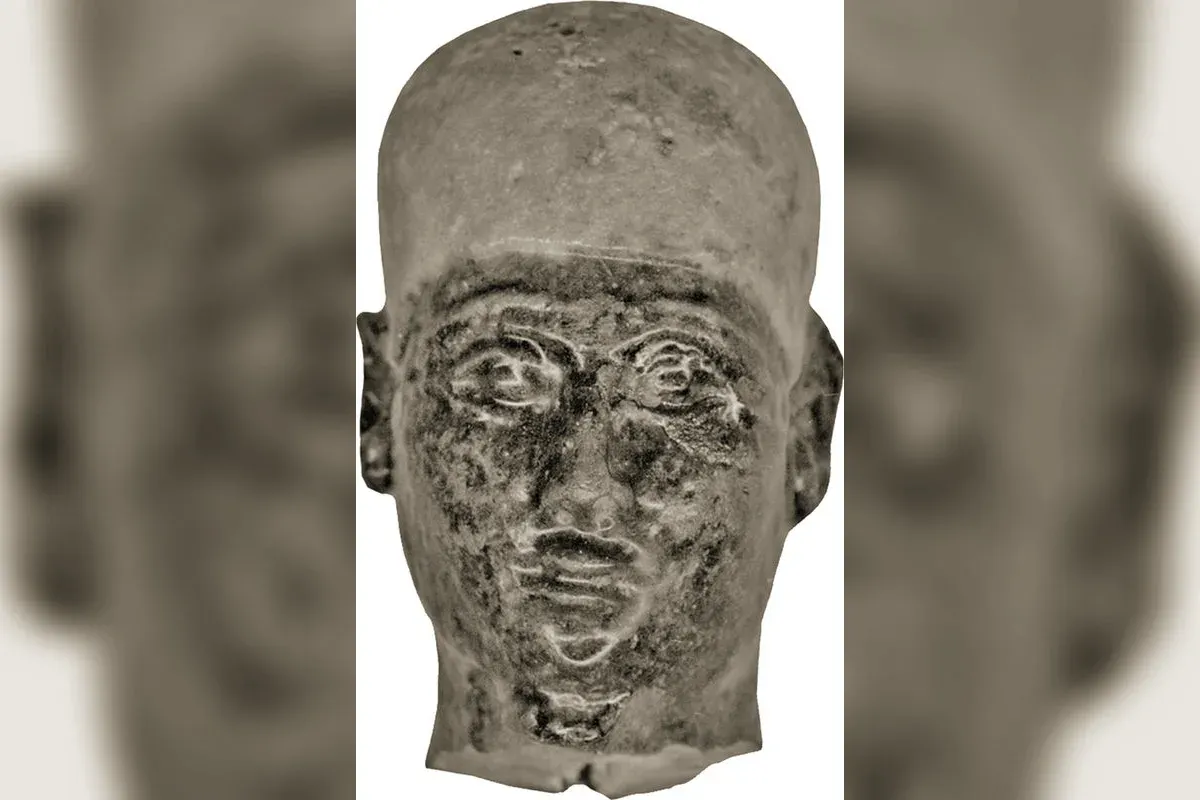
Who is Ptah?
Ptah is the creator god of Memphis, the one who brings the world into being through thought and speech. Where Atum begets the first gods from his own body, Ptah conceives each being in his heart and then realises it by pronouncing its name. This intellectual creation makes him, quite logically, the patron of craftsmen: the sculptor who frees a statue from its block repeats, on his own scale, the god’s gesture. Husband of Sekhmet and father of Nefertem, he forms with them the tutelary triad of Egypt’s first capital.
A creator who thinks and speaks
The central document is the Shabaka Stone, a slab of black granite inscribed under the Kushite pharaoh Shabaka (late 8th century BC) and now in the British Museum. It carries what Egyptologists call the Memphite Theology, the most fully developed account of creation by the word in all Egyptian literature.
Its mechanism is described with almost anatomical precision. The heart (ib) is the organ of thought: there each thing is first conceived. The tongue repeats what the heart has conceived, and the thing comes into existence. The text then generalises the principle: everything the eyes see, the ears hear and the nose breathes reports back to the heart, and it is the tongue that utters it. Ptah is not merely the first creator; he is the model of every creative act.
The theological move is bold. The text does not deny the Heliopolitan cosmogony — it absorbs it. The Ennead, the nine gods issued from Atum, becomes “the teeth and lips” in Ptah’s mouth, the apparatus with which he speaks names. Shu and Tefnut are no longer the first beings but the first words. The Memphite priesthood does not contest the Heliopolitan creation story; it builds a storey on top of it.
God of craftsmen, goldsmiths and builders
The high priest of Ptah bore a title unique in Egypt: wer kherep hemut, “greatest of the directors of craftsmen.” The most senior priesthood in Memphis was, by name, a workshop foreman’s office. Nothing states more plainly what Ptah was to Egyptians: less a god of the sky than a god of the workshop, where matter is transformed according to a plan.
The patronage was concrete. The workmen of Deir el-Medina, who cut and decorated the tombs of the Valley of the Kings, honoured him in chapels and votive stelae; metal casters, stone cutters and goldsmiths claimed him as their own. The god’s very name, linked to the idea of fashioning, kept that association alive.
His animal is not an attribute but a living being: the Apis bull, selected for its coat and markings, was held to be Ptah’s herald at Memphis, his animate manifestation. At its death it was mummified and buried in the galleries of the Serapeum at Saqqara, where dozens of colossal sarcophagi have been found.
Genealogy: a god with no birth
Ptah has no parents, and this is a theological necessity rather than a gap: a creator who had been begotten would not be first. Texts describe him as self-existent, often merged with Tatenen, “the risen land,” the personified primeval mound emerging from the waters — Ptah-Tatenen is then the soil of Egypt itself become a god.
His family, by contrast, is perfectly structured. With the lioness goddess Sekhmet and their son Nefertem, god of the primeval lotus, he forms the Memphite triad. The arrangement is theologically striking: the creator who conceives, the power that destroys, and the child born from the flower that opens at the first dawn. Memphis gathered conception, force and renewal into a single family.
In the Late Period a historical figure joined that family: Imhotep, architect of Djoser’s step pyramid, deified more than a millennium after his death and presented as a son of Ptah. A god of craftsmen adopting the most famous of architects as his son — the logic is impeccable.
Ptah-Sokar-Osiris and the funerary side
Memphis was also home to Sokar, the falcon god of the necropolis and master of the underground workshops. The proximity of the two cults produced an early Ptah-Sokar, and then, once Osiris had become the great god of the dead, Ptah-Sokar-Osiris.
This composite form is among the most widespread in all Egyptian funerary equipment: thousands of painted wooden statuettes, mummiform and crowned with plumes, were deposited in Late Period tombs, some of them containing a copy of the Book of the Dead or a fragment of papyrus. The reasoning is transparent: the god who manufactured the world is best placed to remanufacture a body in the Duat.
What the ancient sources say
The Shabaka Stone raises an instructive dating problem. The text itself claims to be a copy of an ancient roll “eaten by worms,” which the king had carved in stone to save it. Taken at face value for a long time, that claim dated the Memphite Theology to the Old Kingdom, which would have made it the oldest known philosophical treatise in the world. Internal criticism — vocabulary, phrasing, orthography — reversed the consensus: most Egyptologists now read it as a Ramesside composition, possibly contemporary with Shabaka himself. The displayed archaism was an argument from authority, not an archival fact. The slab was later reused as a millstone, destroying the centre of the text.
The Pyramid Texts already know Ptah, but discreetly, as god of Memphis and of craftsmen. The Great Hymn to Ptah in Papyrus Berlin 3048 develops his cosmic dimension in full. Papyrus Harris I, under Ramesses III, records the scale of the donations made to his estate — Memphis remained, to the end, the second religious power in the country after Thebes.
To the Greeks, Ptah was Hephaestus, the smith god. Herodotus credits the founding of the Memphis temple to Min, the first king (Histories, II, 99), and reports that Cambyses, on entering the sanctuary, burst out laughing at the god’s statue, a squat figure he compared to the Pataikoi that Phoenicians fixed to the prows of their ships (III, 37). The anecdote, meant to prove the Persian king’s impiety, incidentally preserves a popular iconography of Ptah: the protective dwarf god of the amulets.
Hut-ka-Ptah, or how a temple named a country
The great sanctuary of Memphis was called Hut-ka-Ptah, “the estate of the ka of Ptah.” The word travelled abroad early: it appears as Hikuptah in ancient Near Eastern diplomatic records. From there derives, on the most widely accepted etymology, the Greek Aigyptos — and so “Egypt.”
The Egyptians called their own country Kemet, “the Black Land,” after the fertile silt. The name the rest of the world gave them was never theirs: it was the name of Ptah’s house.
Further reading
For the lioness goddess who shares the Memphite triad with him, read the page on Sekhmet. For the Heliopolitan creator whom Memphite theology sets out to surpass, see Atum and the Egyptian creation myth. For the god of the efficacious word and of writing, consult the page on Thoth. For the god of the dead with whom Ptah merges in funerary statuettes, see Osiris. To place Memphite creation among the world’s great cosmogonies, read the comparison of creation myths.
Ancient sources
- Shabaka Stone (Memphite Theology), British Museum EA 498
- Pyramid Texts
- Great Hymn to Ptah (Papyrus Berlin 3048)
- Papyrus Harris I
- Herodotus, Histories, II, 99; III, 37
See also
Related entries
Stories featuring this entity
Frequently asked questions
What is Ptah the god of?
Ptah is the creator god of Memphis and the patron of craftsmen. His creation involves neither mating nor bodily fluid: he conceives each being in his heart, which Egyptians held to be the organ of thought, then brings it into existence by pronouncing its name. That dual competence — to think a form, then to realise it — is why he also patronises sculptors, goldsmiths, architects and the workmen of the royal tombs.
How does Ptah's creation differ from Atum's?
At Heliopolis, Atum begets Shu and Tefnut from his own body, and life spreads by generation. At Memphis, the Shabaka Stone keeps that genealogy but subordinates it: the entire Ennead becomes 'the teeth and lips' in Ptah's mouth, the instrument by which he names things. Memphite theology does not delete the Heliopolitan account; it places it inside a prior act of thought and speech.
Is the name Egypt really derived from Ptah?
The great temple of Memphis was called *Hut-ka-Ptah*, 'the estate of the ka of Ptah.' That phrase, transcribed *Hikuptah* in ancient Near Eastern diplomatic correspondence, is the most widely accepted origin of Greek *Aigyptos*, from which English 'Egypt' descends. The country is therefore named, indirectly, after the sanctuary of its craftsman god — the Egyptians themselves called their land *Kemet*, 'the Black Land.'