Egyptian mythology · Gods & goddesses
Taweret, the hippopotamus goddess of childbirth
In brief
Taweret is the Egyptian goddess of pregnancy and childbirth, shown as an upright female hippopotamus with a lioness's legs and a crocodile's back. She has no great temple and no genealogy: hers is a household religion of amulets, beds and magic wands — and she alone guards the northern constellation where Seth is moored.
- pregnancy and childbirth
- protection of newborns and mothers
- defence of the home and of sleep
- watch over the northern sky
- +4
Who is Taweret?
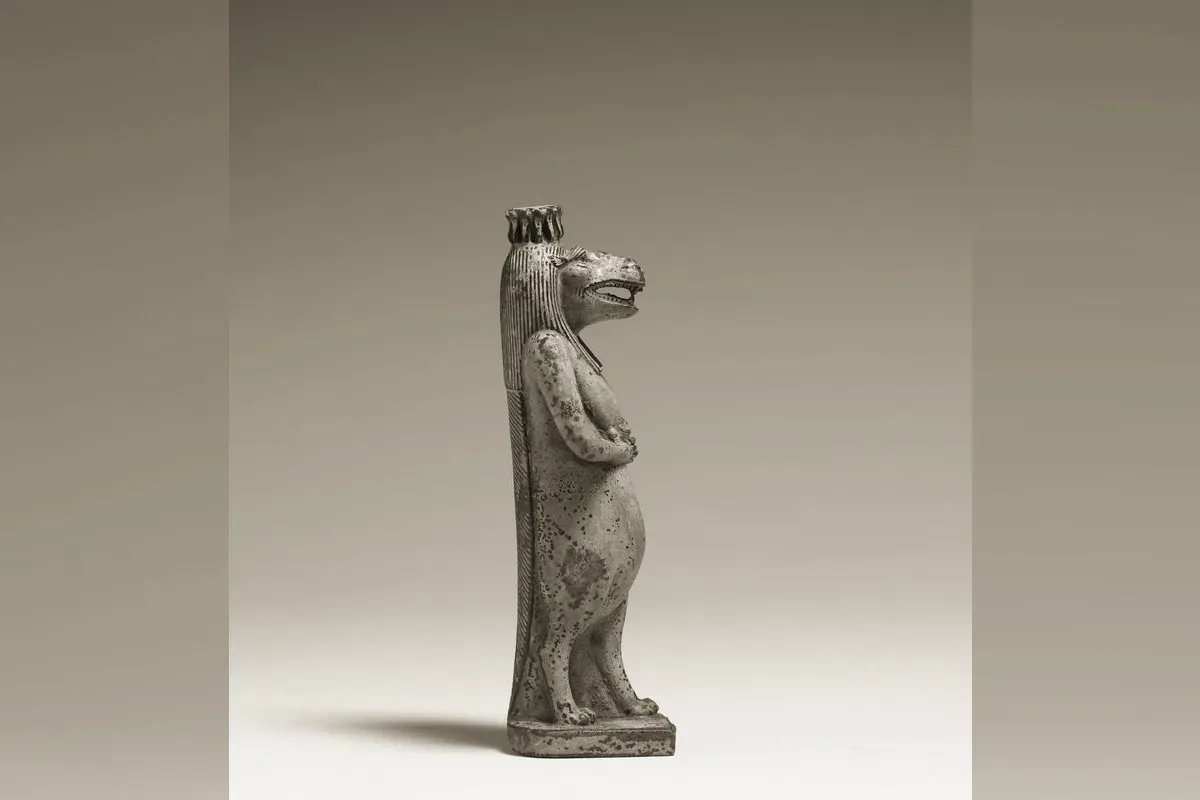
Taweret — “the Great One” — is the Egyptian goddess of pregnancy and childbirth, shown as an upright female hippopotamus with the belly and breasts of a pregnant woman, a lioness’s legs and a crocodile’s back. She has no myth, almost no temple and no genealogy: she belongs to household religion, practised at home, around the bed and the cradle. That is exactly what makes her valuable — she gives access to what ordinary Egyptians feared and asked for, rather than to what state priests wrote on temple walls.
A composite body, entirely functional
Every element of her appearance does defensive work. The female hippopotamus is, in the Nile valley, the most dangerous animal to approach when it is guarding its young: the animal model of the charging mother. The lioness’s legs add the great cat’s power, that of Sekhmet. The crocodile back and tail, sometimes drawn as a small crocodile lying along her spine, summon the predator of the river, the domain of Sobek.
The result combines the three most feared animals in Egypt — precisely those that make up Ammit, the devourer of the tribunal of the dead. The contrast is illuminating: the same ingredients build absolute terror in a funerary setting and the most reassuring of protectors in a domestic one. What matters is not the nature of the force but the direction in which it is turned.
In her forepaws Taweret most often holds the sa sign, a loop of reed or papyrus meaning “protection,” sometimes a lit torch — fire drives off spirits — or a knife.
The goddess of the bed and of birth
Childbirth was a major danger in Egypt, for mother and child alike. The religious response ran not through great temples but through objects.
The most spectacular are the Middle Kingdom apotropaic wands, cut from a hippopotamus tusk split lengthwise and incised with a file of protective figures in which Taweret stands beside the dwarf god Bes, snakes, lions and knives. They were probably used to trace a magic circle around mother and infant; some show wear at the tips, as though genuinely drawn along the ground.
The rest of the equipment follows: amulets worn at the neck, headrests carrying her silhouette to protect sleep, beds whose legs repeat her form, milk or ointment vessels shaped as the goddess and pouring through the nipple. At Deir el-Medina, the village of the artisans who cut the royal tombs, excavation has yielded a remarkable density of such objects: in people’s homes, Taweret was everywhere.
Her popularity crossed the Mediterranean. Archaeologists recognise in the “Minoan genius,” the upright composite figure pouring libations on Cretan seals, a direct adaptation of Taweret’s iconography — one of the best established cases of figurative borrowing from Egypt to the Aegean in the Bronze Age.
The hippopotamus of the northern sky
Taweret also has an astronomical existence, and it is one of the more surprising files in Egyptian religion. On the astronomical ceilings — Senenmut’s tomb under Hatshepsut, those of Seti I and the Ramesseum — a northern constellation is drawn as an upright female hippopotamus called Reret, “the Sow.”
She holds a mooring post. Tied to that post is the constellation of the Foreleg (Meskhetiu), the group of stars we call the Big Dipper and which the Egyptians identified as the foreleg of Seth, torn off and banished to the northern sky. These stars never set: they circle the pole indefinitely, and it had to be explained why a power of disorder, once defeated, remained visible every night. The Egyptian answer is that someone holds it. That someone is the hippopotamus.
The goddess who guards the cradle guards the sky on the same principle: keeping what threatens from breaking loose.
Ipet, Reret and the other hippopotamuses
Taweret is not alone in her family of forms. Egypt knows several hippopotamus goddesses with neighbouring functions, often conflated: Ipet (or Apet), who has a late temple at Karnak where the birth of Osiris was celebrated, Reret, and Hedjet, “the White One.” Texts sometimes distinguish them; iconography almost never does.
That instability is a fact about the religion, not a muddle: these figures form a set of interchangeable female protective powers, called on as needed. The question “which hippopotamus goddess is this?” is often less useful than “what is she protecting against here?”
What the ancient sources say
Most of the evidence for Taweret is material: amulets, furniture, excavated objects. The only sustained narrative about her comes from a Greek author, Plutarch, and must be read with care. In On Isis and Osiris (chapter 19) he reports that Thoeris, the concubine of Typhon — that is, of Seth — went over to Horus, and that a serpent sent after her was cut to pieces; a rite commemorated the episode by cutting a cord.
The testimony is late, external, and reads Egypt through Greek categories. No Egyptian source makes Taweret the wife or concubine of Seth. What Plutarch does preserve is probably accurate on one point: a link between the hippopotamus goddess and Seth genuinely exists — but it is a link of custody, the mooring post in the northern sky, not of marriage.
This is why this page attaches Taweret to no divine family: the Egyptian sources give her none, and inventing one so that she could join a family tree would betray what she is — a protective power without genealogy, invoked for what she does rather than for whom she descends from.
Further reading
For the lioness goddess whose legs and ferocity Taweret borrows, read the page on Sekhmet. For the funerary creature built from the same three animals but turned into a threat, see the page on Ammit. For the god whose constellation is moored under her guard, consult the page on Seth. For the great divine mother of official theology, to whom Taweret is the household counterpoint, read the page on Isis.
Ancient sources
- Apotropaic wands of hippopotamus ivory (Middle Kingdom)
- Astronomical ceilings of Senenmut (TT 353) and Seti I
- Votive stelae and objects from Deir el-Medina
- Plutarch, On Isis and Osiris, 19
Frequently asked questions
What is Taweret the goddess of?
Taweret protects pregnant women, mothers in labour and infants. She belongs to daily life rather than official theology: she appears on amulets worn at the neck, on headrests, on ointment jars and on the magic wands laid beside the mother's bed. Her domain is the most dangerous moment in an Egyptian life — birth.
Why is Taweret shown as a hippopotamus?
Because the female hippopotamus was famous for the ferocity with which it defends its young — and because it ranked, with the crocodile and the lion, among the most feared animals of the Nile. Her composite body combines all three: hippopotamus, lioness's legs, crocodile back. The goddess answers the threats hanging over a newborn with a greater threat still, entirely turned into protection.
Did Taweret have temples?
Very few, and late. Her worship belongs to household religion: neighbourhood chapels, domestic altars, personal objects. That monumental modesty is misleading — the sheer number of surviving amulets makes her one of the deities most present in the real lives of Egyptians, far more so than state gods far better served in stone.