Egyptian mythology · Gods & goddesses
Aten, Akhenaten's sun disk: a god with no body
In brief
The Aten is the sun disk that Akhenaten raised to sole god around 1350 BC. Shown with no human or animal body, as a disk whose rays end in hands, it has no genealogy, no myth and no Osirian afterlife: its theology survives in the Amarna hymns and vanished with its king.
- light and solar radiance
- creation and maintenance of all life
- kingship and the pharaoh's exclusive mediation
- bare sun disk, with no human or animal figure
- +3
Who is the Aten?
The Aten is the sun disk, and for some twenty years in the middle of the fourteenth century BC the royal cult presented it as the only legitimate divine power. Pharaoh Amenhotep IV, who took the name Akhenaten (“effective for the Aten”), redirected resources from other cults, had divine names chiselled away, founded a new capital and imposed a cult with no statue, no myth and no genealogy. It is the most debated episode in Egyptian religious history, and the only one that those who came after deliberately erased.
From a common noun to a sole god
Jtn is not a proper name: it is the Egyptian word for the sun disk, the object seen in the sky. It occurs long before Amarna. The Tale of Sinuhe, in the Middle Kingdom, says of the dead king that he “flew to heaven and united with the disk” — a funerary formula with no hint of religious reform.
Under Amenhotep III, the word began to behave like a divine name. The royal barge was called “the Aten Gleams”, officials bore titles connected with the Aten, and the reign developed an already insistent solar theology. His son’s break therefore sits inside a longer evolution, which makes it more intelligible without making it less radical: Akhenaten did not discover the Aten, he abolished everything else.
That everything else meant, above all, Amun of Thebes, whose priesthood then held considerable landed wealth. The reform was theological, but it was also a seizure of political control.
Rays that end in hands
Amarna iconography is instantly recognisable, and unique in the whole history of Egyptian art.
Every Egyptian god has a body: Ra has a falcon’s head, Anubis a jackal’s, Sobek a crocodile’s. The Aten has none. It is a disk, ringed by a uraeus, from which long straight rays descend, ending in small hands. Some of those hands hold the ankh sign and offer it to the nostrils of the king and queen.
The device carries the entire theology. The god cannot be depicted, and so cannot be shut inside a statue; but it touches, and it touches specific people. The rays reach only Akhenaten, Nefertiti and their daughters. The ordinary subject does not pray to the Aten: he prays to the royal couple, who alone receive the light. It is a religion without an intercessory priesthood — because the intercessor is the king.
A god whose name is written in cartouches
A technical detail, but a decisive one: the Aten received a didactic name inscribed in two cartouches, like a pharaoh. No other Egyptian god was treated this way. The god was, literally, written as a king.
That name was moreover revised during the reign, which lets us follow the doctrine hardening. The early form still mentioned other deities: “Ra-Horakhty who rejoices in the horizon, in his name of Shu who is in the disk.” Around year 9 a second version dropped Horakhty and Shu, replaced by phrases naming only Ra and the Aten. Within a handful of hieroglyphs, a theology can be watched purging its last polytheistic residue.
Akhetaten, a city and roofless temples
In year 5 the king founded Akhetaten, “the horizon of the Aten”, on an untouched site in Middle Egypt — today’s Tell el-Amarna. Boundary stelae cut into the cliffs marked out the territory and recorded the king’s oath never to leave it. Choosing virgin ground was not a whim: no earlier god held rights there.
The architecture followed the doctrine. The classic Egyptian temple leads, court by hall, toward a dark sanctuary housing the divine statue. The Aten temples are open to the sky, roofless and shrineless, crowded with hundreds of offering tables exposed to the sun. One did not go there to see the god in the gloom: one stood beneath him.
The funerary consequence is equally striking. The Amarna tombs show no Osiris, no weighing of the heart, no night journey through the Duat. The dead there hope to come forth by day to receive the light — the afterlife ceases to be an underground kingdom governed by a dead god. This may be the reform’s deepest break, and the one least tolerated.
The Great Hymn to the Aten
The reign’s major text is carved in the tomb of Ay at Amarna. The Great Hymn to the Aten describes sunrise, the darkness in which “the earth is in silence” while lions come out and serpents bite, then the return of day: people rise, herds graze, birds beat their wings, fish leap in the river. The poem takes in foreign lands, Syria and Nubia, down to the child in the womb and the chick that speaks inside the egg.
Its kinship with Psalm 104 has been noted since the nineteenth century and remains much debated: the same images of a night full of predators, of daylight putting everyone back to work, of a god who feeds every creature. Explanations range from direct borrowing to a shared poetic stock across the ancient Near East. No textual dependence has been demonstrated, and a striking resemblance should not be turned into proof of influence.
One thing is clear in the hymn itself: it closes by recalling that Akhenaten alone knows the god. The light is universal; understanding it is not.
A god without family or story
The Aten has no father, mother, wife or child, and no myth attaches to it. That absence is not a gap in the record: it is a choice.
A god with a genealogy implies other gods; a god with a myth implies episodes, adversaries, narrative time. The Aten refuses both. It does not fight Apophis each night as Ra does, does not die and rise like Osiris, begets nothing in the manner of Atum. It rises and it sets: its theology is a physics.
That is also its weakness. A religion without a story offers little purchase for daily piety. Excavation of the Amarna houses showed this vividly: in the very capital of the reform, residents kept amulets of Bes and Taweret, gods of birth and sleep. The disk ruled the state; the bedrooms stayed crowded.
The erasure
Akhenaten died around 1336 BC. Within a few years everything was undone. His successor Tutankhaten changed his name to Tutankhamun, left Amarna and issued the Restoration Stela, which describes abandoned temples, sanctuaries overrun with weeds, and gods turning their backs on the country.
The reaction went further under Horemheb and the Ramessides: the Aten temples were dismantled block by block, Akhenaten’s name was omitted from the king lists, and the Amarna period was treated as a blank in official history.
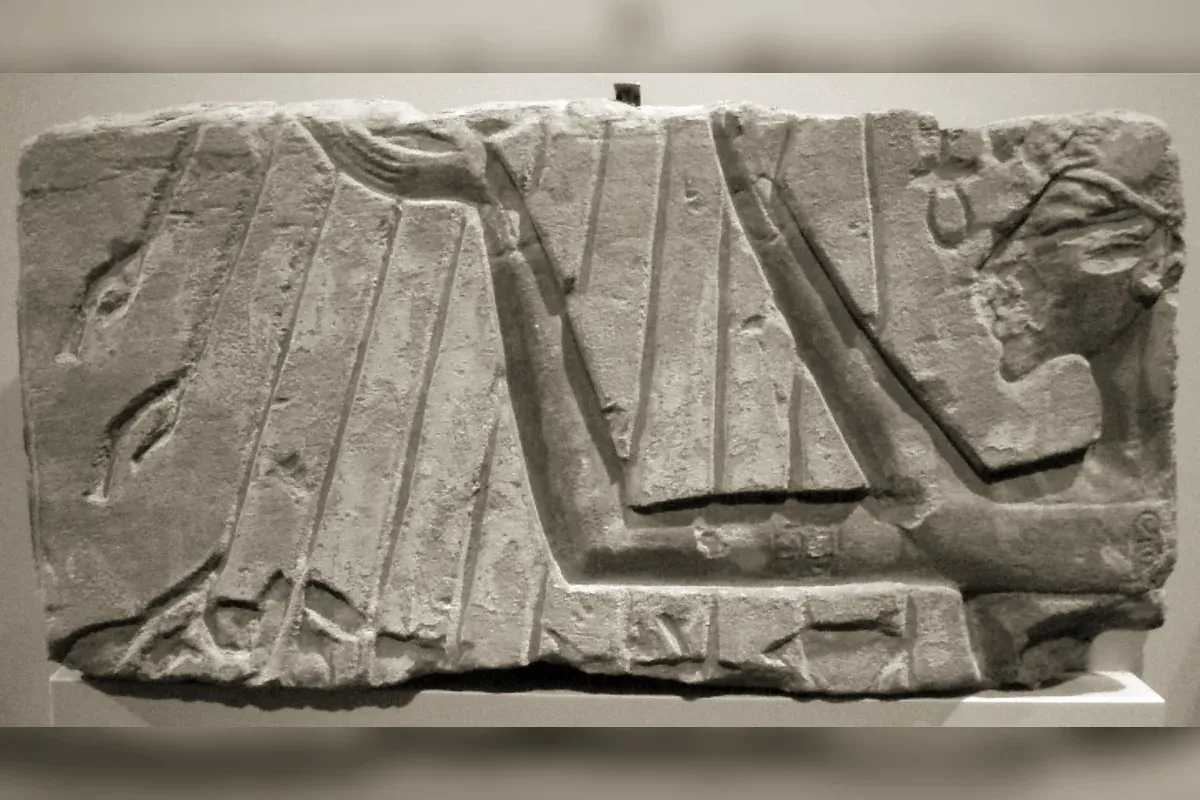
That destruction had an unintended effect. The Aten temple blocks, small and easy to handle — the talatat — were reused as fill inside the pylons at Karnak. Tens of thousands were extracted from them in the twentieth century, their reliefs intact, preserved by the masonry meant to make them disappear. We know Akhenaten’s Theban temples today thanks to the monuments built to erase them.
Further reading
For the great solar god of whom the Aten is both heir and rival, read Ra. For the Theban god the reform directly targeted, see Amun. For the household god that Amarna’s residents went on invoking, consult Bes. For the Osirian afterlife the Aten cult set aside, read the Duat and the judgment of the dead. For the Heliopolitan cosmogony it turned away from, see the Egyptian creation myth.
Ancient sources
- Great Hymn to the Aten, tomb of Ay at Amarna
- Shorter Hymn to the Aten (Amarna tombs)
- Boundary stelae of Akhetaten
- Restoration Stela of Tutankhamun (Cairo CG 34183)
- Talatat blocks reused in the pylons at Karnak
- Tale of Sinuhe (early use of the word *jtn*)
Frequently asked questions
Did Akhenaten invent the Aten?
No. The word *jtn* had long meant the sun disk; it appears in the Middle Kingdom Tale of Sinuhe to say that the dead king united with the disk. Under Amenhotep III, Akhenaten's father, the Aten gained prominence and gave its name to the royal barge. Akhenaten did not invent the name: he placed the Aten at the centre of an exclusive royal cult and stripped it of anthropomorphic form.
Was the religion of the Aten really monotheistic?
Specialists often prefer to speak of monolatry, or of an exclusive state religion. Official worship centred on the Aten, while other cults lost revenues and divine names — especially Amun’s and even the plural “gods” — were chiselled out, which goes further than mere preference. But the cult ran entirely through the king and queen, the only recipients of the rays, and the archaeology of Amarna's houses shows that residents kept invoking Bes and Taweret. The monotheism belonged to the state, not necessarily to the household.
Why does the Aten have no statue and no face?
Because its theology refuses mediation by image. Every other Egyptian god has a body — human, animal or mixed — that can be housed in a statue and carried out in procession. The Aten remains a disk: it cannot be clothed, carried, or faced in a dark sanctuary. Its temples are accordingly open to the sky, with no shrine and no gloom — the god is visible only where it shines.