Egyptian mythology · Gods & goddesses
Mut, mother goddess of Thebes and Lady of Isheru
In brief
Mut is the great goddess of Thebes, wife of Amun and mother of Khonsu in the Theban triad. Her name means simply 'mother' and is written with the vulture sign. Her precinct at Karnak, ringed by the crescent-shaped Isheru lake, held hundreds of Sekhmet statues: Mut is also the dangerous lioness who must be calmed.
- divine and royal motherhood
- sovereignty
- protection of the king
- rage and appeasement of the Distant Goddess
- +5
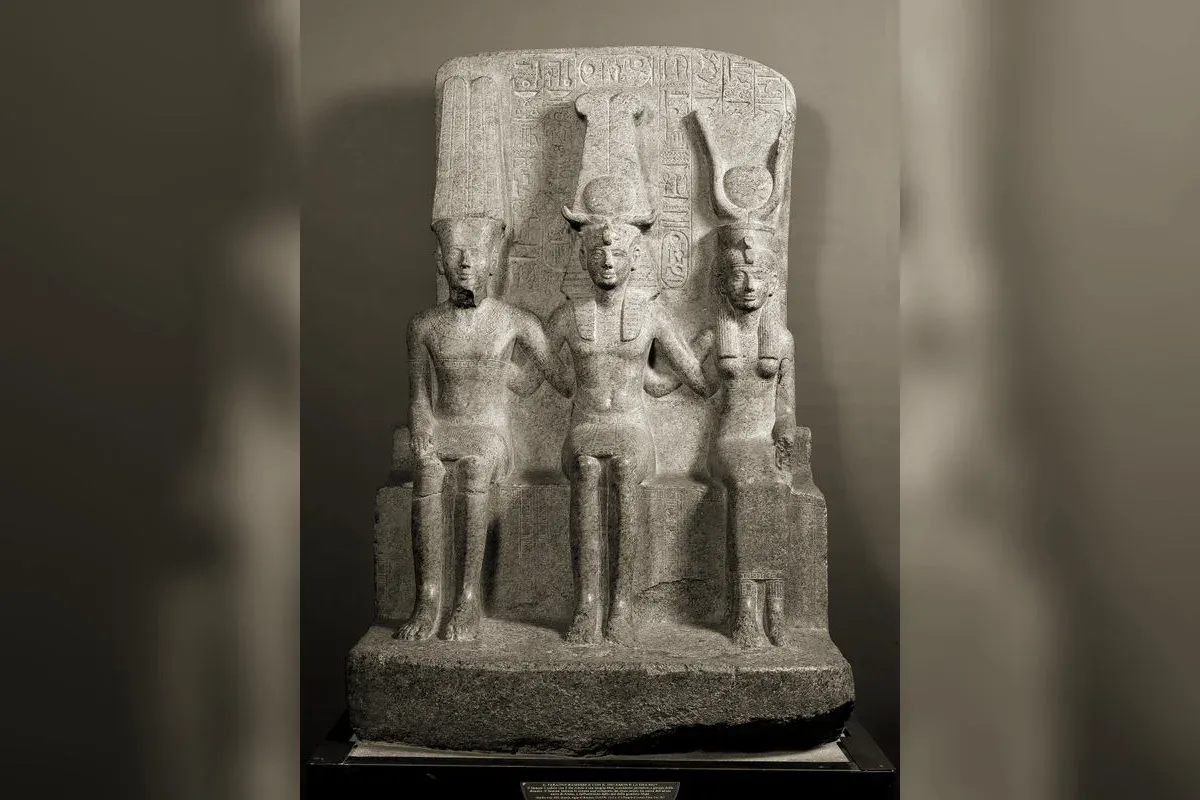
Who is Mut?
Mut is the great goddess of Thebes, wife of Amun and mother of Khonsu: together the three form the Theban triad, the divine family around which the theology of the New Kingdom capital is organised. Her name, mwt, is simply the Egyptian word for “mother”, written with the vulture hieroglyph.
That apparent plainness conceals a double deity. Mut is the mother who suckles the king and grants him legitimacy; she is also the lioness who has to be calmed, one of the faces of the Eye of Ra. Her sanctuary at Karnak, ringed by a crescent-shaped lake, is a piece of ritual engineering built for that second nature.
A goddess whose name is an ordinary word
Most Egyptian deities carry an opaque name, a place name or a frozen epithet. Not Mut: her name reads “mother” in everyday language, and the hieroglyph that writes it — the vulture — also writes that same common word in secular texts.
The consequence is theological. Mut is not the mother of one god in particular; she is motherhood as a function. Theban hymns call her mother of all the gods and, more concretely, mother of the living king. From the New Kingdom onward the vulture headdress she wears becomes the insignia of the great royal wives: queens put on her attribute to signal that they hold on earth the position Mut holds in heaven.
The wife who replaced Amaunet
The Amun–Mut couple is not original. In the Ogdoad of Hermopolis, where Amun appears as the power of the hidden, his female counterpart is Amaunet — a grammatical double rather than a person, built by simply putting his name in the feminine. Amaunet continued to be worshipped at Karnak, and her statue still accompanied Amun in certain processions, but she never became a narrative figure.
Mut takes that place from the Middle Kingdom and settles into it for good in the New Kingdom, when Amun becomes king of the gods and Thebes the religious centre of Egypt. The substitution tracks Amun’s promotion: a state god needs a wife with a cult, a temple and a priesthood, not an abstraction.
She brings Khonsu with her, the moon god, who becomes the child of the triad. A parallel Theban tradition also makes Mut the adoptive mother of Montu, the region’s older war god from before Amun’s rise — a convenient way of absorbing a local deity without demoting him.
Isheru: a lake built to calm a goddess
Mut’s precinct lies at Karnak, south of Amun’s domain and linked to it by an avenue of sphinxes. Its most striking feature is the horseshoe-shaped sacred lake that wraps the temple on three sides: the Isheru.
The shape is not decorative. Lakes of the isheru type are associated with dangerous goddesses — the ones the myth of the Distant Goddess describes storming off into the desert as a furious lioness, to be brought back, appeased and cooled. Water is the ritual instrument of that appeasement. To build Mut a temple girdled by water is to acknowledge that the mother is also the lioness.
The same diagnosis explains the intervention of Amenhotep III, who filled the precinct with a massive series of granodiorite statues of Sekhmet, the pure lioness. Several hundred survive, now scattered through museums worldwide; a widely held hypothesis reads them as a litany in stone covering the whole year, at two statues a day. What the king installed in Mut’s precinct was a permanent appeasement machine.
Mother of the king
Mut’s political role is explicit. On the reliefs of Karnak and Luxor she suckles the ruler, takes him by the hand, sets the crown on his head. Divine suckling is not a tender gesture: it transmits a royal substance, it manufactures a pharaoh.
She is also the only goddess in the pantheon regularly shown wearing the pschent, the Double Crown of Upper and Lower Egypt. Hathor wears the horns and disc, Isis the throne, Neith the Red Crown of the Delta — Mut wears the full insignia of earthly kingship. It marks no single domain: it marks sovereignty itself.
Each year, at the Opet festival, her processional barque left Karnak alongside those of Amun and Khonsu for the temple of Luxor. The divine family travelled in full, and the rite regenerated the power of the god and of the king at once.
What the ancient sources say
Mut is poorly served by Greek authors, who rarely identified her — when they mention her it is by a loose comparison with Hera, matching the equation of Amun with Zeus that Herodotus applies to Thebes. Almost everything we know about her therefore comes from Egyptian sources themselves.
The Great Hymn to Amun of Leiden Papyrus I 350, composed under the Nineteenth Dynasty, sets the goddess within the most elaborate Theban theological system Egypt produced. Papyrus Berlin 3053, known as the Ritual of Mut, preserves the daily cult performed for her: one of the few temple rituals to survive for a goddess.
The walls of her own precinct at Karnak, built and rebuilt from Hatshepsut down to the Ptolemies, remain the most continuous source. They track a goddess who grows in importance as Thebes does, and who keeps her cult long after the city has ceased to be a capital.
The legacy of a quiet goddess
Mut has no myth of her own. No story recounts her birth, no episode stages her alone: she is always the wife of Amun, the mother of Khonsu, the lioness to be calmed, the nurse of the king. That absence of narrative explains her modest modern fame beside Isis or Hathor.
It measures something else, though: the room a state religion gives to a function rather than to a story. For more than a thousand years Thebes maintained, at great cost, a temple, a lake and a priesthood for a goddess whose name means nothing more than “mother”.
Further reading
For the god whose throne and sanctuary she shares, read the page on Amun. For their lunar son, third member of the triad, see Khonsu. For the other face of the lioness whose statues filled her precinct, see Sekhmet, and for the appeased version of the same energy, Bastet. To follow the Eye of Ra system she belongs to, read the pages on Ra and Hathor.
Ancient sources
- Inscriptions of the temple of Mut at Karnak (Isheru precinct)
- Ritual of Mut, Papyrus Berlin 3053
- Great Hymn to Amun, Leiden Papyrus I 350
- Opet festival reliefs, Luxor temple
- Red Chapel of Hatshepsut, Karnak
See also
Frequently asked questions
Who is Mut in Egyptian mythology?
Mut is the great goddess of Thebes, wife of Amun and mother of Khonsu. Her name means 'mother' and is written with the vulture sign. She is not a mother goddess in the domestic sense: she is the mother of the king, the one who suckles and legitimises him, and for that reason the only female deity regularly shown wearing the Double Crown of the pharaohs.
Why is Mut sometimes shown as a lioness?
Because she belongs to the group of Eye of Ra goddesses, that feminine solar power which both protects and destroys. Her precinct at Karnak, laid out around the crescent-shaped lake called Isheru, is exactly the kind of sanctuary designed to receive and cool a dangerous goddess. Amenhotep III installed there hundreds of granodiorite statues of Sekhmet, the other face of that rage.
Was Mut always the wife of Amun?
No. Amun's female counterpart in the Hermopolitan Ogdoad is Amaunet, his abstract pair. Mut gradually displaces her at Thebes from the Middle Kingdom onward and takes the position permanently in the New Kingdom, when Amun becomes king of the gods. The divine couple of Karnak is therefore a couple made by the political history of the city, not an original pairing.