Egyptian mythology · Gods & goddesses
Khonsu, the Theban moon god and divine healer
In brief
Khonsu is the moon god of Thebes, son of Amun and Mut in the Theban triad. His name means 'the Traveller': he crosses the night sky as the moon crosses its phases. God of measured time, he became in the New Kingdom a healer and exorcist whose statue was sent abroad to cure the possessed.
- the moon and the monthly cycle
- measurement of time and the calendar
- healing and exorcism
- protection against hostile spirits
- +4
Who is Khonsu?
Khonsu is the Egyptian god of the moon and the third member of the Theban triad, beside his father Amun and his mother Mut. His name, ḫnsw, means “the Traveller”: it denotes not the heavenly body but its motion, the nightly crossing begun again each month. God of measured time and of the calendar, he became in the New Kingdom a healer and exorcist of the first rank, whose statue was dispatched abroad to free the possessed. Few Egyptian gods changed face so completely: the throat-cutter of the oldest texts became the divine child who cures.
The god who crosses the sky
Khonsu’s name describes an action. The verb khenes means “to traverse, to travel through,” and for Egyptians the moon is the traveller par excellence: it changes shape, vanishes, returns — and its return is what makes counting possible.
The Egyptian month is lunar in origin, and the religious calendar — festival dates, priestly rotas — stayed indexed to the phases of the moon even after a 365-day civil year was adopted. Khonsu is therefore the god of a practical body of knowledge as much as of a heavenly body. He shares that field with Thoth, the other great lunar deity, master of reckoning and writing: Thoth counts, Khonsu crosses. One is the scholar, the other the moving body.
From this mastery of time follows a graver function: Khonsu fixes the span of life. What the moon divides, it also limits.
Iconography: the mummified child
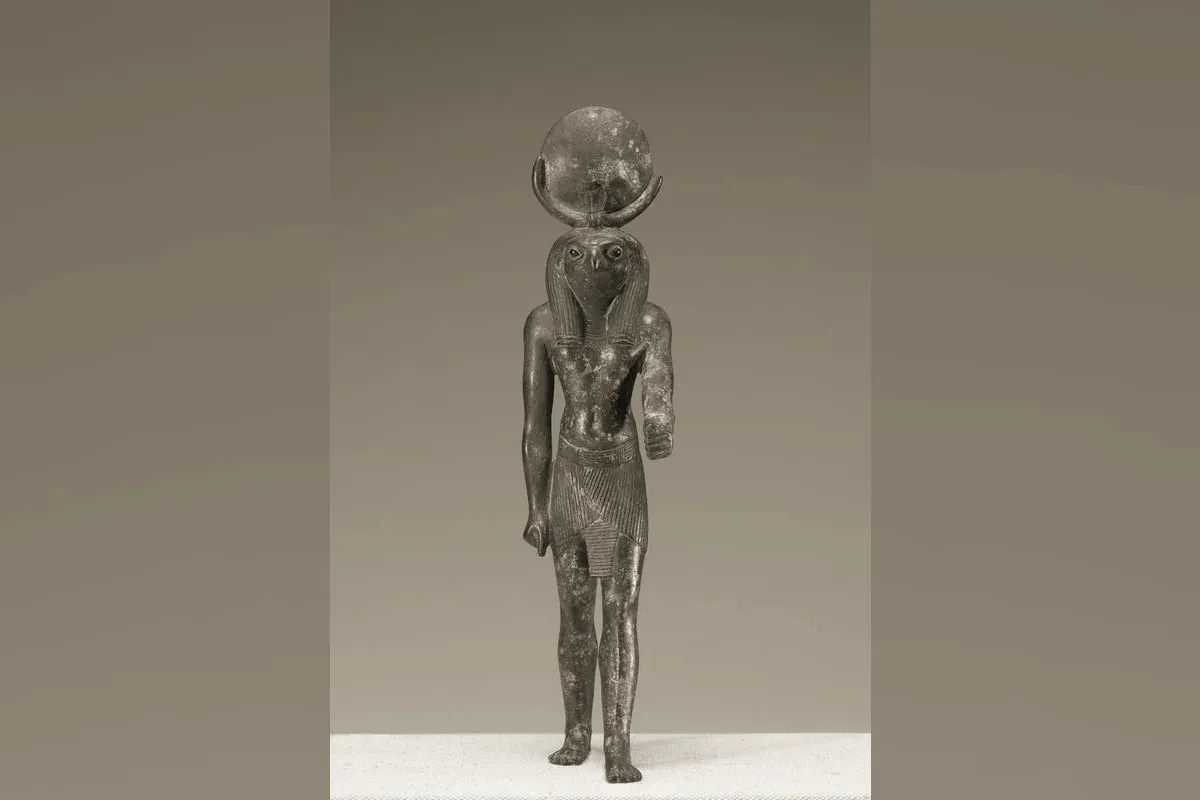
Khonsu is instantly recognisable. He appears as a mummiform young man, body sheathed and arms free, holding the heqa crook and the flail like Osiris. At his temple hangs the sidelock of youth, the side braid worn by Egyptian princes. On his head sits the lunar crescent supporting the full disk — an image that has travelled widely, including into modern depictions.
The combination is theologically exact: the sidelock says son, the mummiform body says fully realised god, the disk says moon. Khonsu is a child holding all the power of an adult god, which is precisely the position of a triad’s third member.
Karnak, Luxor and the Opet festival
At Karnak, Khonsu has his own temple in the south-west corner of the great precinct of Amun. Built largely under Ramesses III on earlier structures, it is among the best preserved buildings on the site and is often used to teach the plan of a classical Egyptian temple: court, hypostyle hall, barque sanctuary.
Each year, at the Opet festival, the statues of Amun, Mut and Khonsu left Karnak in their processional barques for the temple of Luxor, three kilometres to the south, before returning. The festival, several weeks long under Ramesses III, regenerated royal power together with divine power. Khonsu travelled there literally — the god of the journey, carried in procession.
The healing god: the Bentresh Stela
The most famous text devoted to Khonsu is the Bentresh Stela, now in the Louvre. It tells this story: the king of a distant land of Bakhtan asks pharaoh to send a god to cure his daughter Bentresh, who is possessed by a spirit. A form of Khonsu is sent first; when the case proves serious, the great statue of Khonsu-the-Provider itself makes the journey. The god arrives, confronts the spirit, secures its surrender in a courteous exchange, and the princess recovers. The prince of Bakhtan then tries to keep the statue; a dream dissuades him, and Khonsu returns to Thebes laden with gifts.
The text is doubly interesting. First, it documents a real practice: Egyptian divine statues delivered oracles, travelled, and answered by movements that priests interpreted. Second, it poses an exemplary dating problem. The stela presents itself as a document of the reign of Ramesses II, complete with titulary and circumstantial detail, but its script, language and formulas place it in the Late Period, long after the events narrated — a prestige composition dressing a late claim in Ramesside costume in order to underwrite a priesthood’s authority. Like the Shabaka Stone for Ptah, it is a false archaism serving a sanctuary.
What the ancient sources say
The earliest attested Khonsu is no healer at all. In the Cannibal Hymn of the Pyramid Texts (spells 273-274, pyramid of Unas, c. 2350 BC), the dead king ascends to devour the gods and absorb their power; Khonsu figures there as the executioner who kills the lords for him and carves them up. It is a text of unembarrassed violence whose brutality long troubled commentators.
A millennium separates that Khonsu from the benevolent youth of Karnak. Yet the two figures do not entirely contradict each other: it is because he is capable of violence that Khonsu can drive out evil spirits. The exorcist keeps the strength of the slaughterer, turned against demons.
At Kom Ombo, local theology adopts him into another family: there he is the son of Sobek and Hathor, proof that a child god could be attached to several couples depending on the sanctuary. Egyptian triads are local structures, not branches of a single family tree.
Afterlife and modern retellings
Khonsu’s name now circulates far beyond Egyptology, largely through comics and television, which cast him as a capricious moon god imposing his will on a human avatar. That version dramatises a real trait — Khonsu speaks and demands, through the voice of his oracle — but leaves out most of what Egyptians actually wanted from him: the measurement of time and the healing of the sick.
Further reading
For his father and the great god of Thebes, read the page on Amun. For the other Egyptian lunar deity, master of reckoning and writing, see the page on Thoth. For the crocodile god whose son he becomes at Kom Ombo, see the page on Sobek. For the Memphite creator whose great text raises the same dating problem, read the page on Ptah.
Ancient sources
- Pyramid Texts, spells 273-274 (Cannibal Hymn)
- Bentresh Stela (Louvre C 284)
- Inscriptions of the temple of Khonsu at Karnak
- Opet festival reliefs, Luxor temple
See also
Frequently asked questions
What is Khonsu the god of?
Khonsu is the god of the moon and therefore of divided time: the lunar cycle sets the Egyptian month and fixes the dates of festivals. That calendrical competence also makes him the god who reckons how long a person will live. In the New Kingdom he gained a second speciality — healing and the expulsion of hostile spirits — which made him genuinely popular.
What is Khonsu's place in the Theban triad?
He is its son. The Theban triad joins Amun, the hidden god and king of the gods, his wife Mut, the vulture goddess, and Khonsu, their lunar child. The three divine statues processed together from Karnak to Luxor during the Opet festival, and Khonsu had his own temple at Karnak, completed under Ramesses III and among the best preserved in the complex.
Why does Khonsu appear as a violent god in the earliest texts?
Because the figure changed. In the Cannibal Hymn of the Pyramid Texts, around 2350 BC, Khonsu is a bloody executioner who cuts the throats of gods so that the dead king may devour them. Only in the New Kingdom, a millennium later, does he become the benevolent young god who heals. The two images belong to one tradition: his power to drive out demons comes precisely from that original violence.