Egyptian mythology · Gods & goddesses
Thoth, Egyptian god of wisdom, writing and the moon
In brief
Thoth, the ibis-headed Egyptian god: scribe of the gods, keeper of the judgment of souls, master of writing and magic in the mythology of ancient Egypt.
- wisdom
- writing
- knowledge
- moon
- +11
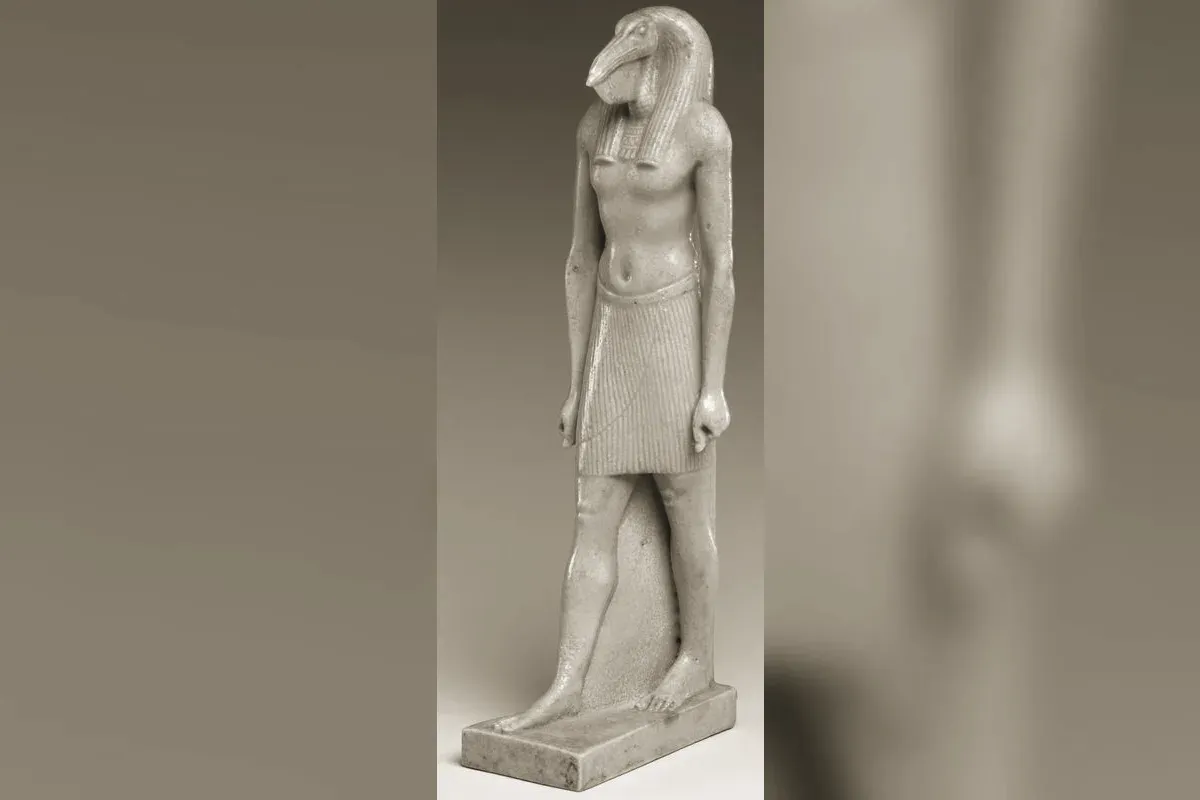
Who is Thoth?
Thoth is one of the most intellectual figures in the Egyptian pantheon — the god of wisdom, writing, the moon, and magic, scribe of the gods and guarantor of cosmic order. Depicted with an ibis head or in the form of a baboon, he holds the pen of truth during the judgment of souls, calculates the celestial cycles, and invents hieroglyphs — the founding gift of all Nilotic civilisation.
Role, nature and domains
Thoth occupies a unique position in the Egyptian pantheon: he is neither a primordial creator god like Ra, nor strictly a god of the dead like Osiris. He is the intermediary, the mediator, the recorder of all divine and human realities.
His main functions are:
- Scribe of the gods: Thoth transcribes divine decrees, records judgments, counts the years of pharaohs’ reigns, and inscribes destinies in the books of the sky.
- Master of the moon: his ibis head crowned with a crescent and lunar disc marks him as the guarantor of the calendar and cosmic cycles.
- Inventor of writing: hieroglyphs are medu netjer (“words of God”), revealed to mankind by Thoth. This invention is also that of transmissible knowledge, memory, and magic.
- Guardian of Maat: Thoth is the chief ally of Maat, goddess of truth and cosmic justice — he verifies that weighings are accurate and that accounts are balanced.
Genealogy and origins
Thoth’s genealogy varies across regional traditions. In the Heliopolitan cosmology, he is often presented as a son of Ra — born from the solar god’s head, embodying his speech. In other traditions, he creates himself through the power of his own discourse: the god of divine speech needs no birth to exist — he simply is from the moment language exists.
His main cult centre was Khemenu (Hermopolis Magna, in Middle Egypt), where he was venerated as one of the eight primordial gods of the Ogdoad — the chaotic forces that preceded creation.
Thoth and the Osirian myth
Thoth’s role in the cycle of Osiris is central, though often understated.
After the death of Osiris, it is Thoth who helps Isis and Nephthys reassemble the dismembered body — by reciting the magical formulae (heka) necessary for embalming and for reactivating the ka (vital force). He is the grand master of funerary magic, without whom the Osirian resurrection would be impossible.
Later, during the long conflict between Horus and Seth for the throne of Egypt, Thoth intervenes several times as impartial arbiter: he draws up the acts of the divine tribunal, records the pleadings of the gods, and helps restore Horus’s eye when Seth tears it out.
The judgment of the dead and the weighing of the heart
It is in the Hall of Two Truths that Thoth’s role is most celebrated. During the judgment of souls presided over by Osiris, Thoth stands beside the scales with his reed pen and register.
While Anubis watches the pans of the scale — the deceased’s heart on one side, the feather of Maat on the other — Thoth records the result. If the heart is lighter than the feather, he declares the deceased “true of voice” (maa-kheru) and inscribes his admission to the Field of Reeds. If the heart is too heavy, Ammit the Devourer consumes the soul — and Thoth records this annihilation as well.
Thoth’s absolute neutrality is his essential attribute in this context: he does not lie, does not interpret, does not falsify. He is divine exactness.
Magic, writing and legacy
The god Thoth is associated with the concept of heka — magic as a primordial cosmic force that precedes the gods themselves in some traditions. Knowing the right words, speaking them in the right order, writing them with precision: that is what Thoth embodies.
The Book of the Dead — the survival guide to the Duat — is sometimes said to have been written by Thoth himself. The magical formulae it contains are presented as revealed divine words.
In the first century BCE, Greco-Egyptian syncretism produced Hermes Trismegistus (“the Thrice-Great”), a composite figure blending Thoth and the Greek Hermes. The Hermetic tradition — a corpus of philosophical and esoteric texts produced between the 1st and 3rd centuries CE — claims this heritage. Western alchemy and Christian Kabbalah would carry its traces through to the Renaissance.
What the ancient sources say
The Pyramid Texts (c. 2400 BCE) already mention Thoth as an assistant to the royal resurrection. The Coffin Texts and the Book of the Dead develop his role in the judgment of souls. The Papyrus of Hunefer (c. 1275 BCE, held in the British Museum) famously depicts the weighing of the heart with Thoth holding his register. The Texts of Hermopolis elaborate his own cosmology as a primordial god.
Further reading
For the god of the dead who presides over the tribunal where Thoth records verdicts, read the page on Osiris. For the goddess who calls on Thoth’s magic to reassemble her husband, see the page on Isis. For the jackal-headed god who watches the scales alongside Thoth, see the page on Anubis. For the creature whose intervention Thoth records when a heart is judged impure, see the page on Ammit. For the complete cycle of death and resurrection in which Thoth plays a quiet but decisive role, read The Osiris Myth. For the full account of the weighing of the heart he records, see The Judgment of the Dead.
See also
Related entries
Stories featuring this entity
Comparisons
Frequently asked questions
Did Thoth create writing in Egyptian mythology?
Yes. In Egyptian tradition, Thoth is the creator or revealer of hieroglyphs — the 'words of God' (medu netjer). Writing is not a human invention but a divine gift transmitted by Thoth. This status also gives him mastery over all sacred texts, magical formulae, and divine record-keeping.
What is Thoth's role in the weighing of the heart?
During the judgment of the dead in the Hall of Two Truths, Thoth is the divine scribe: he transcribes the verdict in his register, recording whether the deceased's heart is lighter or heavier than the feather of Maat. His perfect neutrality guarantees the reliability of the judgment. Anubis oversees the scales, but it is Thoth who records the result before the court of Osiris.
Are Thoth and Hermes the same god?
No, but the Greeks identified them through interpretatio graeca. Hermes Trismegistus ('Hermes the Thrice-Great') is a late Greco-Roman syncretism drawing on Thoth's attributes: magic, writing, and secret knowledge. The Hermetic tradition and Western alchemy would later claim this lineage. Thoth nonetheless remains a fully distinct Egyptian deity, separate in iconography, mythology, and function.