Greek mythology · Gods & goddesses
Ceto, sea goddess and mother of the Gorgons in Greek mythology
In brief
Ceto, power of the primordial sea: her union with Phorcys, the Graeae and Gorgons, and the genealogy of Greek monsters.
- deep sea
- maritime danger
- monstrous genealogy
- sea creatures
- +1
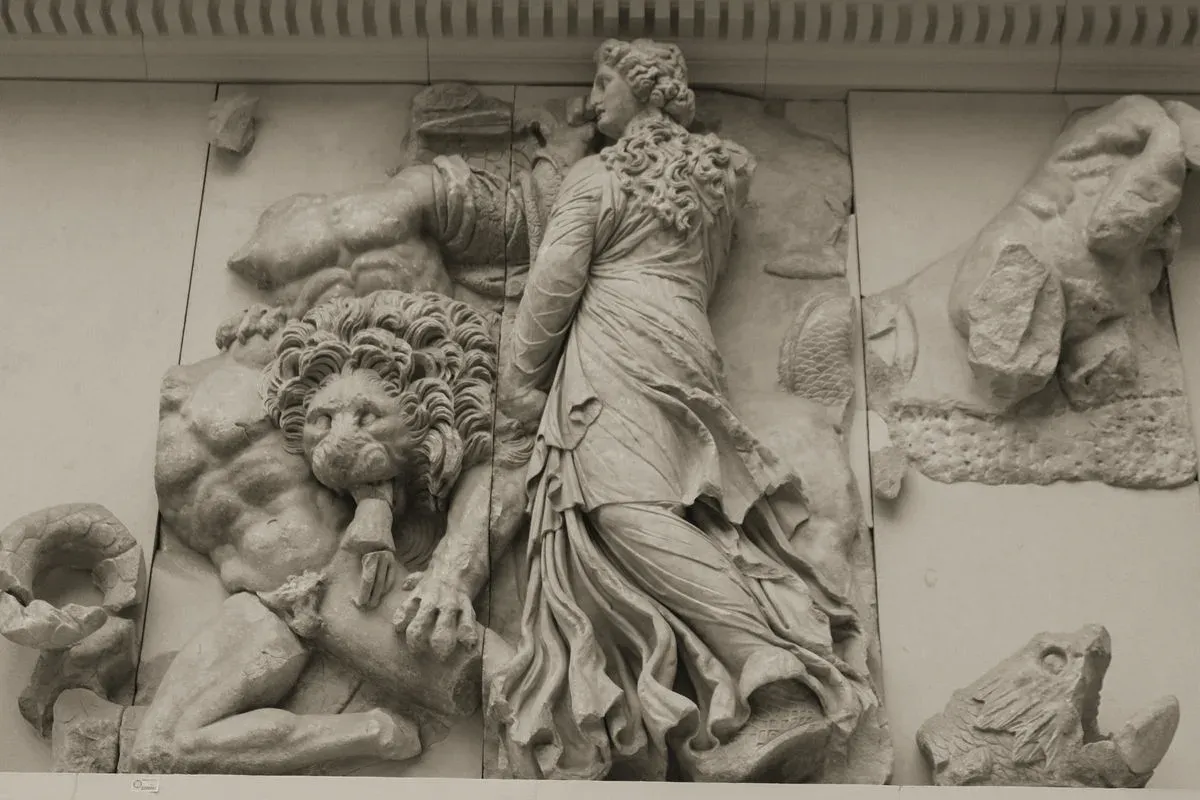
Ceto is a primordial sea power and, with Phorcys, the ancestor of a large part of Greek mythology’s monsters. A daughter of Pontus, the Sea, and Gaia, she has almost no individual story. Her work is genealogical: she gives a shared origin to beings placed at the far edges of the inhabited world.
The sea monster inside the name
Ceto’s name is related to Greek ketos, a term used for large sea animals and marine monsters; it ultimately lies behind the modern word “cetacean.” That does not mean ancient poetry gives the goddess a monstrous body. Hesiod includes her among the early divinities born from the sea and even calls her fair-cheeked.
The distinction is useful. Ceto is not a beast waiting for a hero to kill her. She is the divine source from which beasts descend, part of a generation in which a region of the cosmos and a personal deity are barely separate concepts.
The family of Phorcys and Ceto
With her brother Phorcys, Ceto produces the Graeae, grey-haired from birth, followed by the three Gorgons: Stheno, Euryale, and mortal Medusa. Hesiod’s catalogue continues with a guardian serpent and a half-woman, half-snake creature commonly identified as Echidna, although the grammar of the passage leaves some parentage open to debate.
Later mythographers reorganized the family and sometimes attached the Hesperides, Scylla, or the Sirens to it. There is therefore no single family tree accepted by every ancient author. The Hesiodic core is nevertheless coherent: Ceto’s daughters inhabit the west beyond Ocean, the region of Night, caves, and underground spaces.
A mother outside the heroic action
Perseus kills Medusa, Heracles destroys several descendants of Echidna, and other heroes repeatedly enter the distant spaces occupied by this family. Ceto never intervenes. She has none of Leto’s maternal retaliation and takes no side in the Olympian struggles.
That absence explains her place in the Theogony. Hesiod is arranging the universe, not giving every deity an adventure. By turning scattered monsters into relatives, he makes them an old branch of the same cosmos that produces gods and humans. Ceto stands at that branch’s root, joining the fertile primordial sea to the opponents whose defeat will later define heroic fame.
Ancient sources
- Hesiod, Theogony, 233-336
- Apollodorus, Library, 1.2.6; 2.4.2
See also
Frequently asked questions
Is the parentage of Echidna certain?
No, and the uncertainty is grammatical. Hesiod's catalogue at Theogony 295-296 leaves the antecedent genuinely ambiguous, so scholars have long disagreed about whether Echidna's mother is Ceto or Callirhoe. The tree on this site follows the reading that assigns her to Phorcys and Ceto, but the passage will not settle the question on its own.
Do Ceto's children have anything in common?
A geography. They live far from cities — beyond Ocean, near Night, in caves or under the earth — and they guard thresholds that heroes cross only with divine help. Later authors reorganised the family and attached the Hesperides, Scylla or the Sirens to it, so it is safer to speak of a Hesiodic core than of a single tree accepted throughout antiquity.