Greek mythology · Gods & goddesses
Phorcys, god of sea dangers in Greek mythology
In brief
Phorcys, primordial sea god: with Ceto, the father of the Gorgons, the Graeae, Echidna and Ladon — a family tree of nearly every Greek monster.
- marine depths
- dangers of navigation
- creatures of the sea
- body of an old sea god
- +2
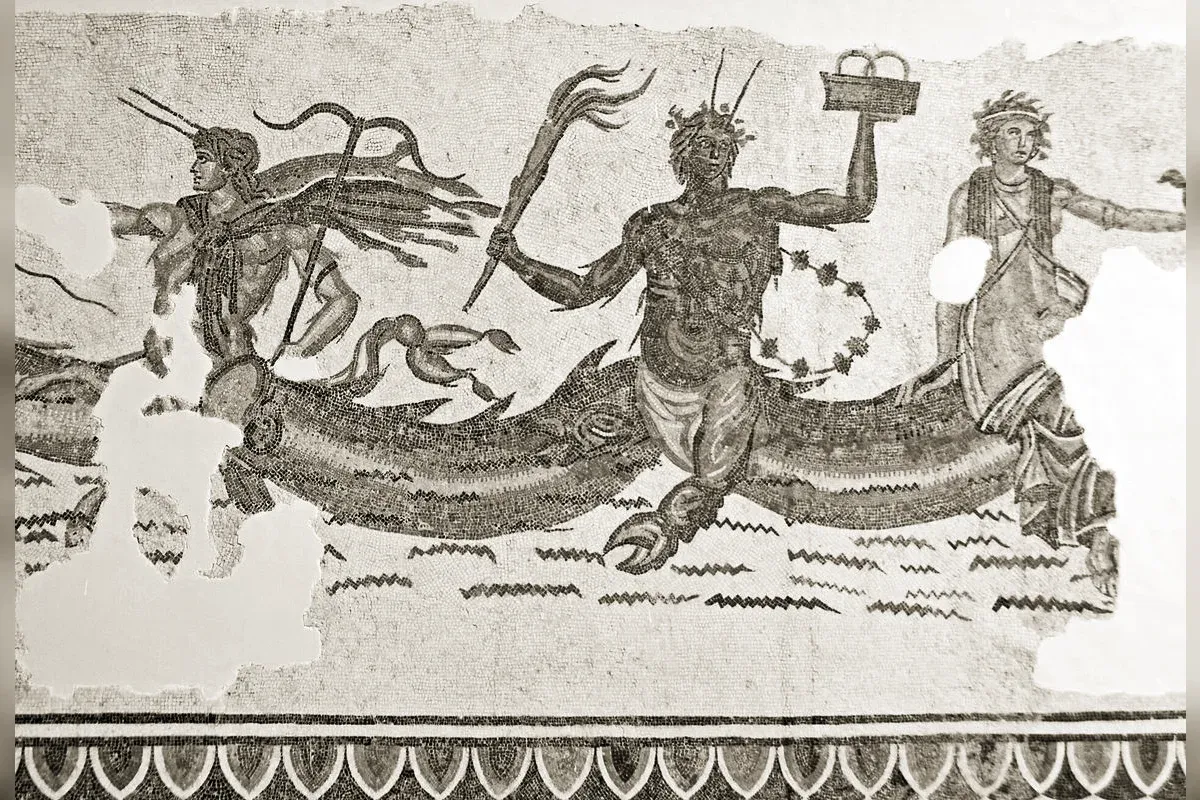
Phorcys is a primordial sea god, son of Pontus and Gaia, and — with his sister and consort Ceto — the father of most of the monsters in Greek myth. Hesiod’s catalogue of their offspring is one of the densest passages in the Theogony, and it amounts to a family tree of everything a Greek hero has to kill.
An old man of the sea
Phorcys belongs to a specific type. Pontus, the sea itself, fathers a set of ancient marine deities — Nereus, Thaumas, Phorcys, Ceto and Eurybia — who share a set of traits: they are old rather than young, they are prophetic, they are shape-shifters, and they predate the Olympians without opposing them.
Homer calls Phorcys “the old man of the sea” and gives him a harbour on Ithaca: the sheltered cove between two headlands where the Phaeacians set the sleeping Odysseus ashore with his treasure, beside the cave of the nymphs and an olive tree. It is the first Ithacan ground the hero touches, and it is named for a monster-breeding sea god, without comment.
Homer also makes him the father of the nymph Thoosa, who bears Polyphemus to Poseidon — so the Cyclops that Odysseus blinds is Phorcys’ grandson.
The catalogue
With Ceto he fathers, in Hesiod’s order:
The Graeae — Pemphredo and Enyo, grey from birth, sharing one eye and one tooth between them, whom Perseus robs to force directions out of them.
The Gorgons — Sthenno, Euryale and Medusa, the last alone being mortal, which is the only reason the story of Perseus is possible.
Echidna, half beautiful woman and half monstrous serpent, who mates with Typhon and produces Cerberus, the Hydra, the Chimera and the Sphinx.
And Ladon, the hundred-headed serpent coiled around the golden apples of the Hesperides.
Some traditions add Scylla and the Sirens to the list, which is why the genealogy on this site places them here.
Why the monsters come from the sea
Count what descends from this one couple, adding Echidna’s brood: the Gorgons, the Graeae, Cerberus, the Hydra, the Chimera, the Sphinx, Ladon, and arguably Scylla and the Sirens. That is close to the complete inventory of Greek monsters, and nearly every major heroic labour is an encounter with a member of this family.
The placement is deliberate. Greek cosmology puts what is unformed, ancient and hostile at the edges of the world and at the bottom of the sea — the parts of the map that trade routes did not domesticate. Olympian order radiates outward from a centre; monsters are what the centre has not reached yet.
Phorcys himself does nothing. He fights nobody, is punished for nothing, and receives no cult of consequence. His entire function is to be the place the monsters come from, which makes him one of the load-bearing names in Hesiod’s architecture and one of the least visible.
Ancient sources
- Hesiod, Theogony, 233-239, 270-336
- Homer, Odyssey, 1.71-73; 13.96-112
- Apollodorus, Library, 1.2.6, 2.4.2
- Apollonius of Rhodes, Argonautica, Book 4
See also
Related entries
- Gaia, the primordial Earth and mother of the Greek gods
- Echidna, mother of monsters in Greek mythology
- Scylla, the six-headed sea monster of the strait
- The Sirens, deadly enchanters of Greek mythology
- Medusa, the Gorgon with the Petrifying Gaze
- Ceto, sea goddess and mother of the Gorgons in Greek mythology
Stories featuring this entity
Frequently asked questions
Which monsters descend from Phorcys?
With his sister Ceto he fathers the Graeae, grey from birth and sharing one eye between them; the Gorgons, of whom Medusa alone is mortal; Echidna, who with Typhon produces Cerberus, the Hydra, the Chimera and the Sphinx; and Ladon, the hundred-headed serpent of the golden apples. Some traditions add Scylla and the Sirens. Counting the second generation, that is close to the complete inventory of Greek monsters.
Why do the monsters come from the sea?
The placement is deliberate. Greek cosmology relegates the unformed and the hostile to the bottom of the sea and the edges of the map — the parts trade routes had not domesticated. Olympian order radiates outward from a centre; monsters are what the centre has not reached yet. Phorcys himself fights nobody and receives no cult of consequence: his entire function is to be the place they come from.