Greek mythology · Gods & goddesses
Chaos in Greek mythology: the primordial gap, not disorder
In brief
Greek Chaos means a gaping void, not confusion: what Hesiod actually wrote, what is really born from it, and how Ovid reversed the meaning of the word.
- the original gap
- the interval between sky and earth
- the gulf bordering Tartarus
- dark void
- +1
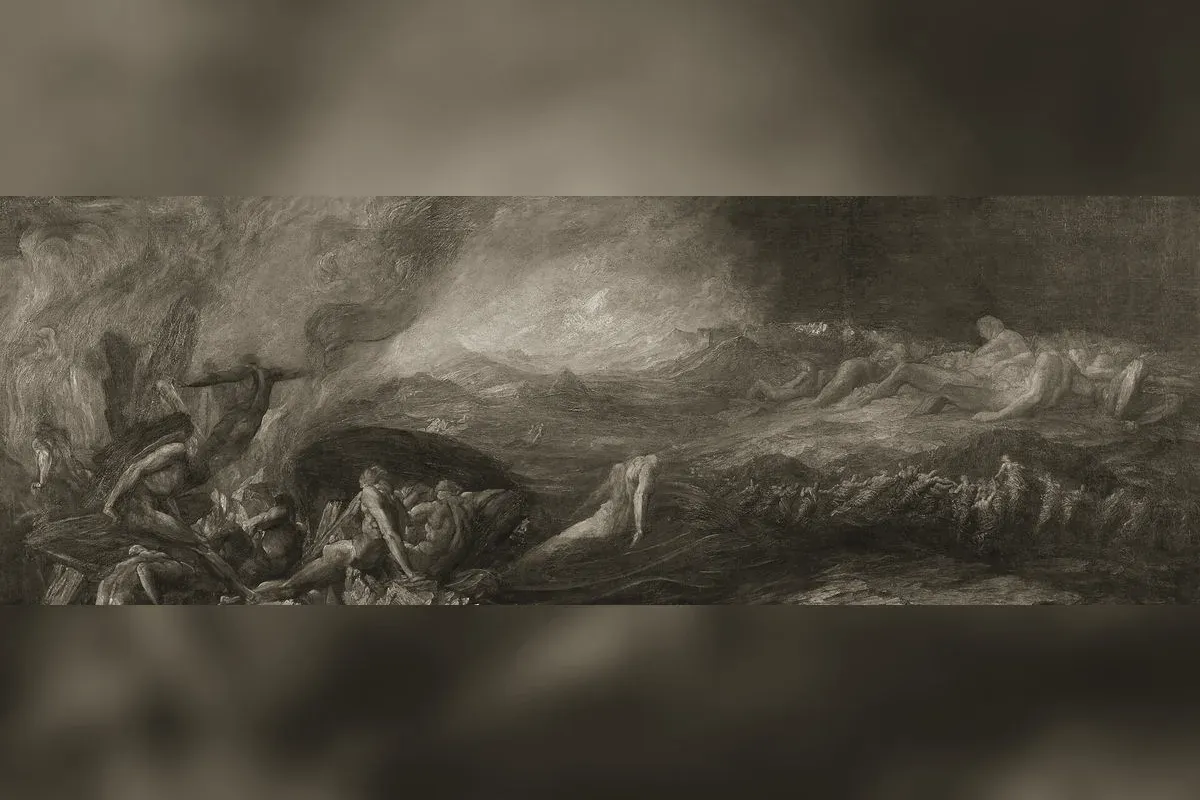
Chaos is the first term in Greek mythology: what comes to be before anything else. But it is not disorder, not a soup of matter, and barely a god at all. The Greek word χάος means a gap — a gaping opening, a chasm that yawns. Getting that right is the key to why the Greek account of origins does not work like the creation stories it is usually compared to.
A word, not a person
χάος belongs with χαίνω and χάσκω, “to yawn, to gape open.” The term names an opening or gap. That etymology is secure; assigning it a list of disputed English cognates is unnecessary to understand Hesiod’s text.
That has an immediate consequence for translation. Rendering χάος as “chaos” smuggles into Hesiod an idea he does not have: confused mixture. Modern scholars prefer “the Gap,” “the Chasm,” or “the Void.” Greek Chaos is not a state of matter; it is an emptiness that opens.
It also explains why Chaos has no face, no gesture and no biography. Unlike Gaia, who bears children, schemes and takes sides, Chaos does nothing. It is not a character with a will; it is the spatial condition without which nothing could appear.
What Hesiod actually says
The founding passage runs to ten lines of the Theogony (116-125), and it needs reading closely, because it is routinely made to say the opposite of what it states.
Hesiod writes that Chaos came to be first of all. Then — with the same verb, and no term of descent — came to be wide-bosomed Gaia, misty Tartarus in the depths of the earth, and Eros, fairest among the immortal gods.
Only then does generation proper begin: from Chaos were born Erebus and black Nyx. And from Nyx joined with Erebus came Aether, the bright upper air, and Hemera, Day.
The implication is sharp and usually missed: Chaos is not the parent of everything. Its direct offspring amount to two children, both dark — underground gloom and night. Earth, gulf and desire appear beside it, not out of it. Hesiod sets four first principles side by side; he does not derive three of them from a fourth.
That is a structural difference from many other traditions, as the survey of creation myths compared shows: here the origin is not one thing, it is several from the very first line.
A place as much as a principle
Chaos returns later in the Theogony, and those passages are decisive, because they treat it as a region of the cosmos rather than an entity.
At line 700, during the Titanomachy, the thunderbolt of Zeus starts a blaze so vast that “a marvellous heat seized Chaos.” You cannot heat an abstract principle; you can heat a space.
At lines 736-745, and again at 807-814, Hesiod describes the ends of the world, where the sources and limits of earth, sea, sky and Tartarus lie — “a great chasm” whose floor a falling body would not reach in a full year. Chaos is that chasm, under the earth, immediately next to the prison of the Titans.
Hesiod’s Chaos therefore has two faces in sequence: a moment, in the first line, and a place, at the end of the poem. That is exactly what a gap should be — the first opening, which stays open.
The ancient variants
No Greek cosmogony held exclusive authority, and Chaos occupies a different position depending on the tradition.
Aristophanes, in Birds (690-702), gives his chorus a parodic theogony built from real material: in the beginning were Chaos, Night, black Erebus and broad Tartarus — no Gaia, no Uranus. Night lays a wind-egg from which golden-winged Eros hatches, and Eros, mating with winged Chaos, fathers the race of birds. The joke only lands if the audience recognises an existing doctrine, so it attests a version in which Chaos is later and far more fertile than in Hesiod.
The Orphic theogonies diverge further. The Derveni Papyrus, a charred fourth-century BC roll commenting on a poem attributed to Orpheus, presents Night as Zeus’s counsellor and refers to Protogonos, the First-Born. It attests a different genealogy without supporting a simple story in which “Phanes” merely replaces Hesiod’s Chaos.
In Hyginus, finally, the Latin preface to the Fabulae complicates the order again: Ex Caligine Chaos — from Mist came Chaos, and from Chaos and Mist came Night, Day, Erebus and Aether. Chaos loses its opening position entirely.
These divergences are not transmission errors. They are a reminder that there was no official story of the origin, and that the Theogony is one synthesis among several, made canonical by its literary quality and its use in schools.
Ovid, or how the meaning flipped
The decisive shift is Roman, and it can be dated.
In Metamorphoses Book 1 (5-20), Ovid opens with a definition that fixed the word for two thousand years: before sea, land and sky, nature wore a single face across the whole world, quem dixere Chaos — “which men called Chaos.” And he specifies: rudis indigestaque moles, a raw and undigested mass, an inert weight in which the badly joined seeds of things lay heaped in discord. Cold fights hot in it, wet fights dry, soft fights hard.
None of this is in Hesiod. Ovid describes not a void but a badly ordered fullness: matter waiting for form, which a demiurge will come to separate and arrange. It is a philosophical Chaos, fed by Presocratic and above all Stoic cosmology, and very far from the archaic gap.
And that is the version the Middle Ages and the Renaissance read, because they read Ovid in Latin far more than Hesiod in Greek. The modern sense of “chaos” — confusion, disorder, jumble — descends directly from the Metamorphoses, not from the Theogony.
A god with no cult and no image
Chaos receives no Greek cult: no sanctuary, no priesthood, no festival, no offering. No ancient depiction of it is known either, which makes sense — how do you give a body to an opening?
It only becomes a character very late, and in the West. Milton, in Paradise Lost, seats it on a throne as “the Anarch,” ruling the formless space between Hell and the created world — an Ovidian Chaos rather than a Greek one, given a temperament and a realm.
One last and stranger trace is worth recording. In the seventeenth century the Flemish physician and chemist Jan Baptist van Helmont coined the word gas from χάος to name the invisible fluids he was isolating. The Greek word for the original gap became, by a piece of learned derivation, the name of a state of matter.
Ancient sources
- Hesiod, Theogony, 116-125; 700; 736-745; 807-814
- Aristophanes, Birds, 690-702
- Bacchylides, fr. 5 Snell
- Hyginus, Fabulae, preface
- Ovid, Metamorphoses, 1.5-20
- Derveni Papyrus, columns VII-XI
See also
Related entries
Stories featuring this entity
Frequently asked questions
What does the word Chaos actually mean in ancient Greek?
It first means a gap, a gaping opening or a chasm and belongs to the family of χαίνω, 'to yawn open.' Hesiod's Chaos is therefore not the disordered mixture of matter later described by Ovid.
Is Chaos the father of all the Greek gods?
No, and this is the most common misreading. Hesiod says Chaos came to be first, then that Gaia came to be — not that she was born from it. Only Erebus and Nyx, Night, are explicitly generated by Chaos. Gaia, Tartarus and Eros appear alongside it, with no stated descent.
Why does chaos mean disorder today?
Because of Ovid. At the opening of the Metamorphoses he defines Chaos as rudis indigestaque moles, a raw and undigested mass in which the seeds of things war with one another. That Chaos-as-matter, quite unlike the Greek gap, is what Latin passed on to European languages, and it eventually buried the original sense.