Greek mythology · Gods & goddesses
Circe, sorceress-goddess of Aeaea in Greek mythology
In brief
Circe in the Odyssey: the drugs that make men swine, the herb moly, the oath Odysseus extracts from her, and how a goddess became a witch.
- magic and pharmaka
- transformation
- purification
- knowledge of sea routes
- +4
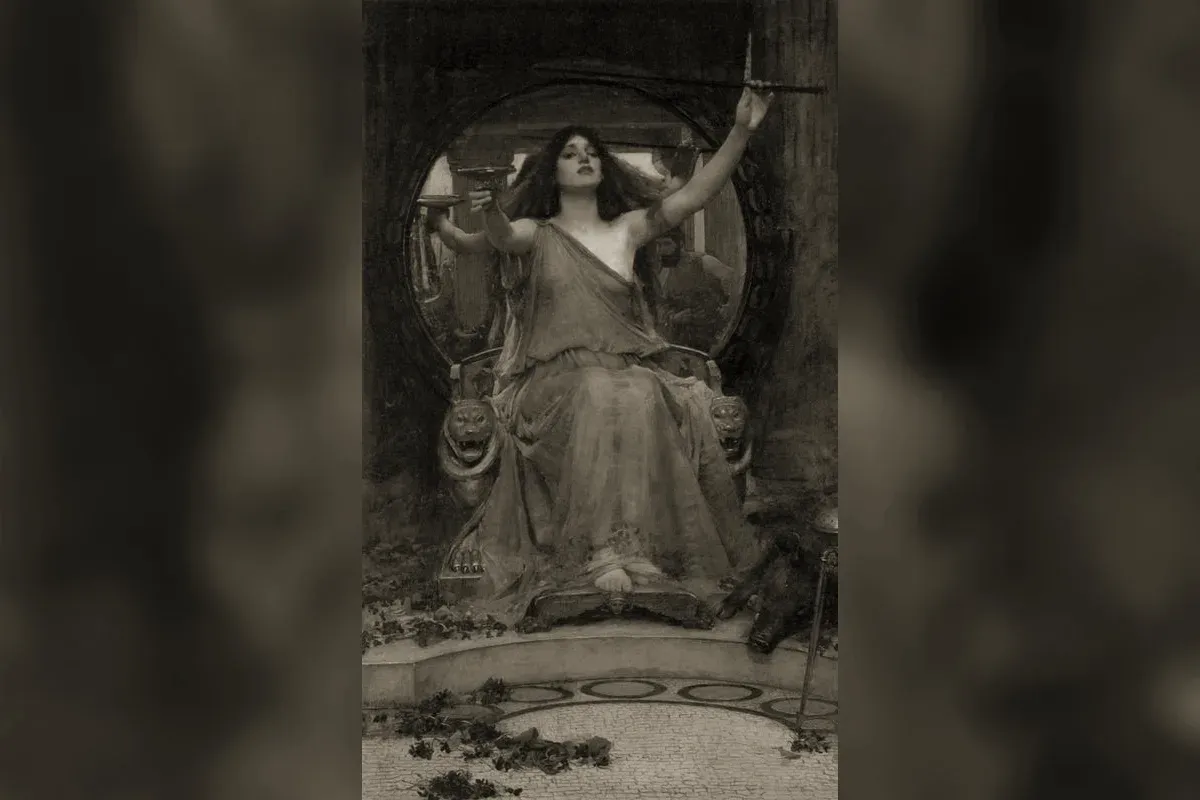
Circe is a goddess of the Sun’s family who lives alone on the island of Aeaea, surrounded by wolves and lions she has drugged into docility. She turns Odysseus’s crew into pigs, is forced to turn them back, and then becomes the single most useful ally he has. Homer calls her a goddess throughout. Almost everything that made her a “witch” happened later.
The Odyssey specifies her parentage: Circe is the daughter of the sun god Helios and the Oceanid Perse, and the sister of Aeetes. That family connection explains why the Sun and Colchis remain attached to her story in later accounts.
The house in the wood
A scouting party finds her hall in a clearing, hears a woman singing at a great loom, and is invited in. She serves them cheese, barley and honey in Pramnian wine, with a drug mixed in; then she touches them with a wand and pens them in a sty. They have pigs’ bodies, bristles and voices — and, Homer specifies, their minds unchanged. That last detail is what makes the episode horrifying rather than comic.
One man, Eurylochus, hangs back and reports. On his way to the house Odysseus meets Hermes, who gives him the herb moly: black at the root, with a milk-white flower, hard for mortal men to dig but not for gods. It is the only named magical plant in Homer, and antiquity never agreed on what it was; ancient botanists and modern pharmacologists have proposed snowdrop, wild rue, mandrake, and half a dozen others, without resolution.
The oath
Protected by the moly, Odysseus drinks and does not change. When Circe strikes him with the wand he draws his sword, and she immediately recognises him: Hermes had told her the man who resists her drugs would be Odysseus.
What follows is the part retellings usually smooth over. She invites him to her bed; he refuses until she swears a formal oath by the gods that she will attempt no further harm against him — a sensible precaution, since a naked and unarmed guest is exactly what she has been ruining. Only after the oath does he accept. The relationship begins as a negotiated truce between two people who have each just tried to destroy the other, and it lasts a year.
The one who knows the route
Circe’s real importance to the poem is informational. It is she who tells Odysseus he must go down to the dead and question Tiresias — a journey no one has proposed and no one wants. When he returns from the underworld she debriefs him and then gives the sailing directions for the rest of the voyage: the Sirens and the wax, the choice between Charybdis and Scylla, and the absolute prohibition on touching the cattle of the Sun.
Everything that happens for the next several books is either her instruction followed or her instruction ignored. In the Argonautica she performs a different technical function again, purifying Medea and Jason of Apsyrtus’ blood — the same skill set applied to pollution rather than to bodies.
From goddess to witch
Homer’s Circe is dia thea, a bright goddess, daughter of the Sun and sister of Aeetes of Colchis. She belongs to a family of divine practitioners that also includes Medea and Pasiphae, and her powers are treated as divine prerogative, not deviance.
The reduction to “sorceress” is a later, largely Roman and post-classical development, helped along by Ovid — whose Circe transforms Scylla out of jealousy and Picus out of spite, motives Homer never gives her — and completed by allegorists who found her a convenient emblem of appetite turning men into beasts. Reading the Odyssey directly restores something stranger: a solitary immortal, spinning at her loom on an empty island, who tests everyone who lands and helps whoever survives the test.
Ancient sources
- Homer, Odyssey, 10.133-574; 12.1-141
- Apollonius of Rhodes, Argonautica, 4.659-752
- Ovid, Metamorphoses, 13-14
- Hesiod, Theogony, 1011-1014
See also
Related entries
Stories featuring this entity
Frequently asked questions
Is Circe a witch or a goddess?
Homer calls her a goddess throughout — dia thea, daughter of the Sun and sister of Aeetes of Colchis. Her powers are treated as divine prerogative, not deviance. The reduction to sorceress is a later, largely Roman development, helped by Ovid, whose Circe transforms Scylla out of jealousy and Picus out of spite, motives Homer never gives her, and completed by allegorists who found her a convenient emblem of appetite.
Why does Odysseus make Circe swear an oath?
Because a naked and unarmed guest is exactly what she has been ruining. When his sword forces her to yield she invites him to her bed, and he refuses until she swears a formal oath by the gods to attempt no further harm. Only then does he accept. The relationship begins as a negotiated truce between two people who have each just tried to destroy the other — and it lasts a year.