Greek mythology · Creatures
Charybdis, the whirlpool that swallows the sea
In brief
Charybdis is the sea-swallowing whirlpool of Greek mythology that faces the monster Scylla across a narrow strait: three times a day she sucks down the sea and three times she spews it back. Homer never gives her a body, and ancient writers placed her in the Strait of Messina.
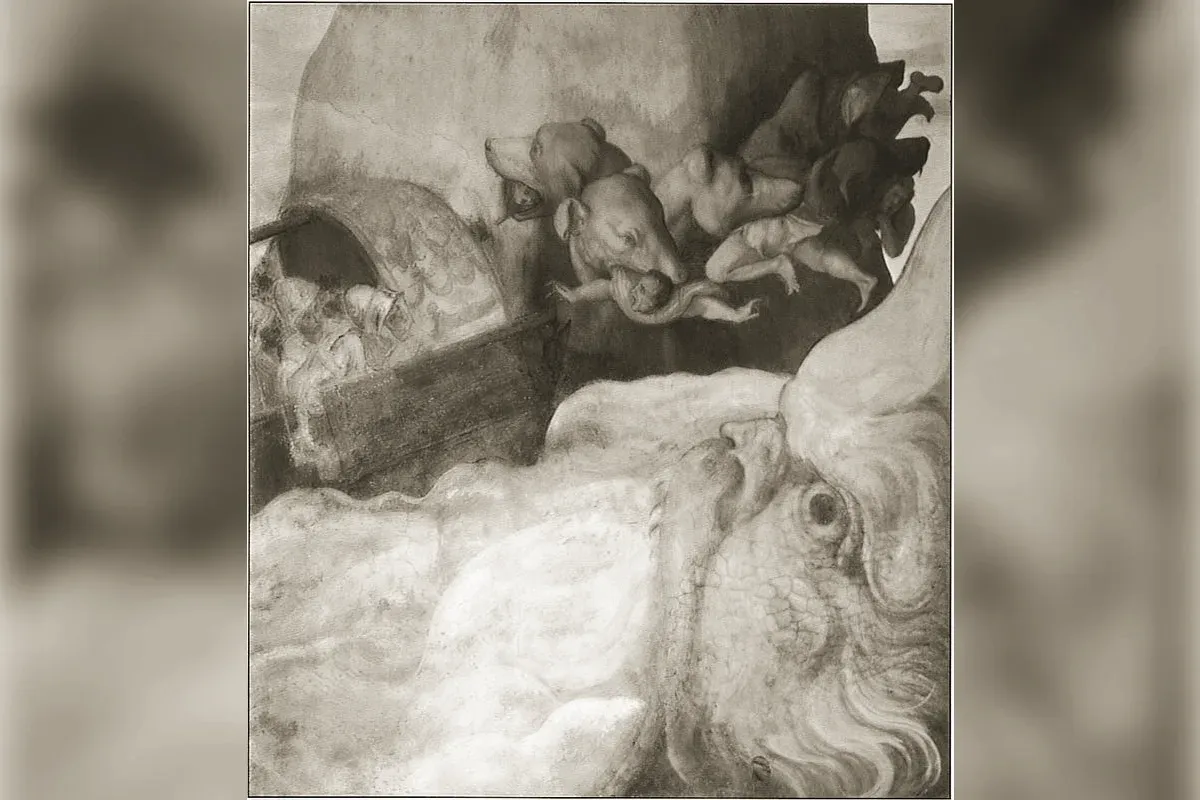
Charybdis is the whirlpool of Greek mythology that guards a narrow strait opposite the six-headed Scylla. Three times a day she sucks the sea down, three times she spews it back up, and no ship caught in that motion survives. In Homer she has no body, no face and no family — only an action. That makes her one of the strangest perils of the Odyssey, and one half of the most famous dilemma in Western culture.
A monster with no body
The most striking point about Charybdis, and the one most often forgotten, is that Homer never describes her physically. Scylla gets twelve feet, six necks, six heads and triple rows of teeth; Charybdis gets nothing of the kind. The poet calls her “divine Charybdis” (dîa Kharybdis) and gives her a will and a verb — to swallow, to spew — but no mouth and no jaws. The gaping-maw monster of modern illustrations is a later addition.
The silence is the point. Scylla is a predator: you can look at her, arm yourself against her, which is exactly what Odysseus does. Charybdis is a phenomenon, a power of the sea itself. You cannot fight a whirlpool. You can only decide not to go near it.
Circe’s sailing directions
Nearly everything we know about Charybdis comes from the instructions Circe gives Odysseus in Book XII (lines 101-110). Of the strait’s two rocks, she explains, one is tall and shelters Scylla; the other is lower, a bowshot away. On it grows a great wild fig tree in full leaf, and beneath it Charybdis sucks down the black water. Three times a day she sends it up, three times she gulps it down.
Circe adds two decisive details. If you are there when she swallows, not even the Earth-Shaker, Poseidon, could save your ship. And the advice: keep close to Scylla’s cliff and row hard, because it is better to mourn six companions than to lose them all. When Odysseus asks whether he might dodge Charybdis and still fend off Scylla, she calls him stubborn. Against this pair there is no victory, only the lesser evil.
The first passage: a cauldron and a naked sea floor
When the ship finally enters the strait (XII, 234-244), Homer shows Charybdis at work — still only through her effects. When she spews the water out, the sea seethes like a cauldron over a roaring fire and the spray rains down on the tops of both cliffs. When she swallows, the whole inside of the abyss lies open, the rock bellows around it, and far below the crew can see the sea floor, dark with sand. Pale fear grips them.
That fascination costs six lives. While everyone stares at Charybdis, Scylla strikes and carries off six men. The two perils work as a team: one draws the eye, the other kills.
Odysseus alone, hanging from the fig tree
Charybdis returns at the end of the same book, in an episode far less famous and far more dramatic (XII, 426-446). After the crew’s sacrilege against the cattle of Helios, Zeus strikes the ship with a thunderbolt and every man drowns. Odysseus lashes the mast and keel together and drifts through the night. At dawn the south wind carries him straight back to Charybdis — just as she is swallowing the sea.
He leaps for the great fig tree and hangs on like a bat, with nowhere to put his feet and no way to climb: the roots are too far below, the branches too far above. He waits, dangling over the abyss, for the whirlpool to give his raft back. Mast and keel reappear only at the hour, Homer says, when a judge rises from the assembly for his dinner after settling the young men’s quarrels. Odysseus drops into the water beside the timbers, paddles with his hands, and Zeus keeps Scylla from noticing him. Nine days later he washes up on the island of Calypso.
The fig tree, a mere landmark in Circe’s directions, becomes the hero’s lifeline: the one fixed point above a hole that swallows everything.
The Argonauts and Aeneas: steering clear
Later poets bring Charybdis back, but almost always to have her avoided.
- In Apollonius of Rhodes (Argonautica, IV, 786-963), Hera summons Thetis and shares her fear that the Argo will be seized by Scylla or swallowed by Charybdis. Thetis and the Nereids escort Jason’s ship past both, then carry it through the Planctae, the Wandering Rocks, tossing it from hand to hand. Homer’s peril becomes the backdrop for a divine rescue (see Jason and the Golden Fleece).
- In Virgil (Aeneid, III, 420-432), the seer Helenus warns Aeneas that “implacable Charybdis” holds the left side of the strait, three times drawing the waves into her depths and flinging them up to the stars, and tells him to sail around Sicily instead. Later (III, 555-569) the Trojans hear the strait roaring; Anchises recognizes “that Charybdis” Helenus foretold, and the fleet escapes by hard rowing.
- Ovid mentions her twice: through Medea, listing the dangers of the voyage (Metamorphoses, VII, 63), and in Book XIII (line 730), where “restless Charybdis” holds the left of the strait and swallows keels only to vomit them back.
From Homer to Virgil, the triple rhythm never changes. It is Charybdis’s signature.
A late backstory: the thief struck by lightning
Homer gives Charybdis no parents at all. A much later tradition, known chiefly from Servius’s commentary on the Aeneid (III, 420), invents a past for her: a woman of monstrous greed, she stole cattle from Heracles — usually understood as the herd of Geryon he was driving back from the far west (see the Labors of Heracles) — and Zeus struck her with a thunderbolt and hurled her into the sea, where she became the whirlpool. The same late tradition makes her a daughter of Poseidon and Gaia: sea and earth, the two elements the whirlpool brings together whenever it lays the sea floor bare.
The site’s family tree uses this parentage, flagged as late: it carries no Homeric authority.
From myth to the Strait of Messina
By the fifth century BC, geography had claimed Charybdis. Thucydides (IV, 24, 5) says the strait between Rhegium and Messana is “the so-called Charybdis” through which Odysseus is said to have sailed, and that its narrowness and the inrush of currents from the Tyrrhenian and Sicilian seas rightly made it dangerous. Strabo (I, 2, 36) defends Homer’s geography and notes that the poet says “three times” where the real phenomenon happens twice a day — a gap he puts down to poetic licence. Aristotle, in the Meteorology (Book II), even records a fable of Aesop: Charybdis drank the sea once and the mountains appeared, a second time and the islands appeared, and her last gulp will leave it dry.
The Strait of Messina does have powerful tidal currents that reverse several times a day and throw up eddies; one of them, on the Sicilian side, is locally called the Garofalo and has traditionally been identified with Charybdis, while Scylla lent her name to the Calabrian town of Scilla across the water. The monster is the mythic dress of a very real navigational hazard.
“Between Scylla and Charybdis”
English speakers say “between Scylla and Charybdis” for a choice between two dangers — roughly “between a rock and a hard place.” The classic Latin formulation is medieval: in the Alexandreis of Walter of Châtillon (12th century), the poet apostrophizes the fleeing Darius with Incidis in Scyllam cupiens vitare Charybdim — “you fall upon Scylla while trying to avoid Charybdis” (V, 301). The line became proverbial in the Renaissance, and it keeps Homer’s order: it is to escape Charybdis that Odysseus exposes himself to Scylla.
What the ancient sources say
- Homer (Odyssey, XII, 101-110, 234-244 and 426-446) establishes everything essential: the low rock, the fig tree, the triple rhythm, the exposed sea floor, Odysseus hanging above the abyss — without ever describing a body.
- Thucydides (IV, 24, 5) is the earliest secure witness to the Strait of Messina identification.
- Apollonius of Rhodes (IV) turns the passage into a danger averted by Thetis and the Nereids.
- Virgil (Aeneid, III) and Ovid (Metamorphoses, VII and XIII) keep the triple rhythm and place her on the left of the strait.
- Strabo (I, 2, 36) rationalizes the myth and discusses Homer’s “three times.”
- Servius (on Aeneid III, 420) preserves the late metamorphosis of the thief struck by lightning.
Further reading
Charybdis only makes sense as half of a pair: start with Scylla, then the Sirens, the other deadly stage Circe warns about. For the whole voyage, read the Odyssey summary and the profile of Odysseus. For the other crossing of the strait, see Jason and the Golden Fleece. For the full roster of Greek gods and monsters, return to the Greek mythology hub.
Ancient sources
- Homer, Odyssey, XII, 101-110 (Circe's description)
- Homer, Odyssey, XII, 234-244 (first passage)
- Homer, Odyssey, XII, 426-446 (Odysseus alone on the fig tree)
- Apollonius of Rhodes, Argonautica, IV, 786-963
- Virgil, Aeneid, III, 420-432 and 555-569
- Ovid, Metamorphoses, VII, 63 and XIII, 730
- Thucydides, History of the Peloponnesian War, IV, 24, 5
- Strabo, Geography, I, 2, 36
- Servius, Commentary on the Aeneid, III, 420
See also
Frequently asked questions
Is Charybdis a monster or a whirlpool?
Both, depending on the source. Homer calls her 'divine Charybdis' and gives her a will of her own, but describes only what she does — swallowing and spewing the sea — never a body or a mouth. The image of a monster with gaping jaws is a later invention; only a late tradition, preserved by Servius, gives her a human past.
Did Odysseus pass Charybdis twice?
Yes. The first time, with his whole crew, he hugs Scylla's side on Circe's advice and loses six men. The second time, alone on a makeshift raft after Zeus wrecks his ship, he drifts straight into Charybdis and survives only by clinging to the fig tree above her until she spews his mast and keel back up (Odyssey, XII, 426-446).
Where is Charybdis supposed to be?
From Thucydides onward, Greek writers placed Charybdis in the Strait of Messina, between Sicily and the toe of Italy, a passage notorious for its narrowness and clashing currents. Strong tidal streams still run there, and an eddy on the Sicilian side, locally called the Garofalo, has traditionally been identified with Homer's whirlpool.