Greek mythology · Gods & goddesses
Persephone, queen of the underworld and goddess of spring
In brief
Persephone, queen of the underworld and daughter of Demeter: abduction by Hades, pomegranate seeds, Eleusinian Mysteries, and her dual nature between death and spring renewal.
- underworld
- spring
- germination
- vegetation
- +6
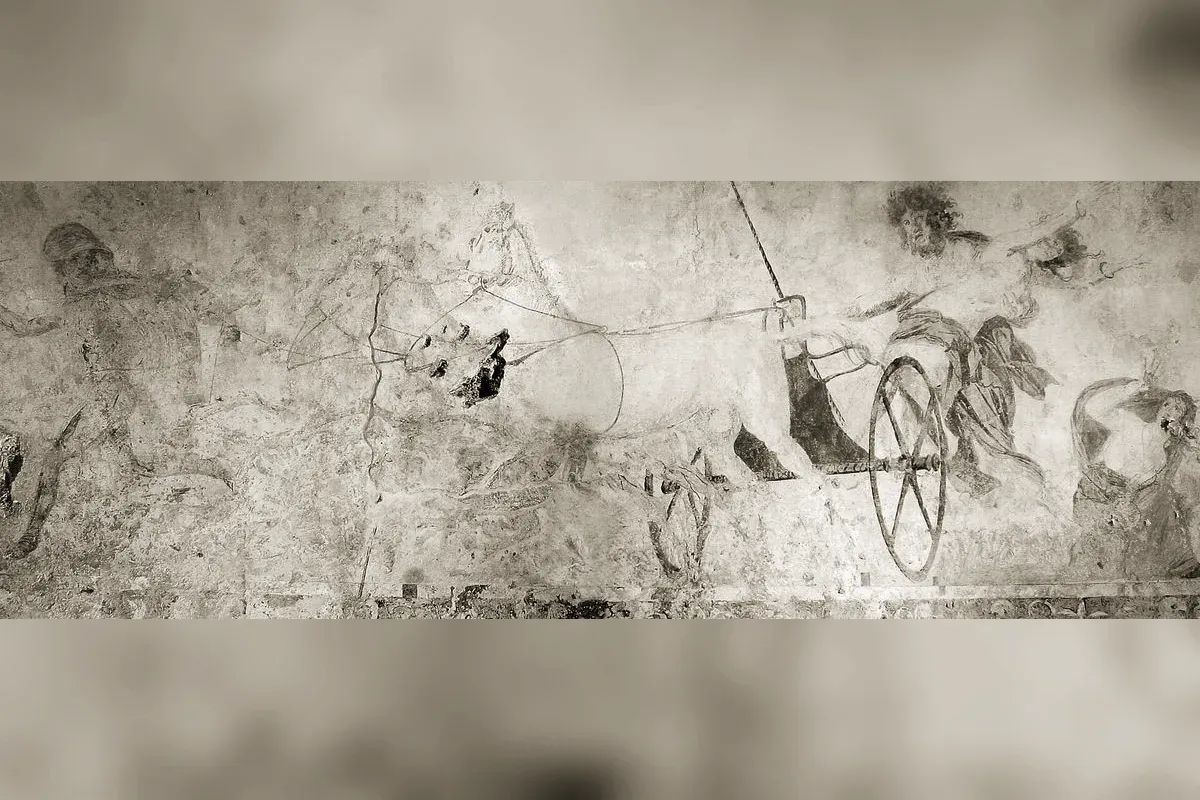
Persephone is one of the most layered figures in the Greek pantheon: simultaneously a victim of violent abduction and the sovereign queen of the dead, simultaneously a child of the light and a guardian of darkness. Daughter of Demeter and Zeus, she embodies the fundamental tension in nature between the cycles of death and life. Her myth is also the only explanation Greek mythology offers for the existence of the seasons.
Birth and youth: Kore, the Maiden
Before her abduction, Persephone bore the name Kore — simply “the Maiden.” She lived in the light alongside her mother Demeter, goddess of the harvest and of earth’s fertility. Their bond was the very symbol of wholeness: the nourishing mother of the Earth and her radiant daughter, guarantee of renewal.
Her lineage is clear in the oldest sources: daughter of Zeus and Demeter, she belongs by blood to the first generation of Olympians. But she does not dwell on Olympus like her divine siblings: she lives in meadows and flowering fields, inseparable from her mother.
The abduction by Hades
The rupture comes in the plain of Nysa — a location that varies across sources but is always synonymous with wild beauty and blooming meadows. Persephone is gathering flowers with her companions when she spots a narcissus of extraordinary beauty, planted there by Zeus himself at the request of Hades.
When she bends to pick it, the earth splits open. Hades bursts from his kingdom in his chariot and carries her off, despite her piercing cries. She calls on her father Zeus — but Zeus has consented to the union. No god intervenes. The earth closes again.
The Homeric Hymn to Demeter (7th–6th century BCE) is the fullest account of this event. It describes with rare emotional precision the terror of Kore, the rage and grief of Demeter, and the mother’s long wandering in search of her daughter.
The pomegranate seeds and the cosmic bargain
For nine days, Demeter roams the world torch in hand, neither eating nor drinking. It is Hecate, then Helios (the Sun), who finally reveal the abductor’s identity.
Her fury at Zeus is total: she abandons her role as goddess of the harvest. The earth turns barren. Seeds refuse to germinate. Humans die of hunger. The gods see their offerings vanish. Zeus, faced with catastrophe, sends Hermes to the underworld to bring Persephone back.
Hades agrees — but not without precaution. Before her departure, he offers Persephone a few pomegranate seeds. She eats six. This act, voluntary or not depending on the version, decides her fate: whoever consumes food in the kingdom of the dead is bound there for eternity.
The compromise negotiated by Zeus runs as follows: Persephone will spend six months with her mother (spring and summer, when Demeter, rejoicing, makes the earth bloom) and six months in the underworld (autumn and winter, when Demeter grieves and lets the earth sleep). Thus the seasons are born.
The number of seeds varies between sources: Ovid in the Metamorphoses (Book V) counts six; some versions give three or four. This precise, almost prosaic detail is essential: it turns a casual act into an irrevocable sentence.
Queen of the underworld: a genuine sovereignty
Once queen of the underworld, Persephone is not merely a resigned captive. Ancient texts grant her real authority and a personality distinct from her husband’s.
She can intercede with Hades — as she does in the myth of Orpheus and Eurydice, where the poet’s music wins Eurydice’s conditional release. She also receives heroes who descend alive into the underworld. As queen beside Hades she holds authority in the realm below; the texts, however, distribute the dead differently among the field of asphodel, the Isles of the Blessed, and Tartarus, without assigning her the same judicial role in every account.
Her epithets confirm this: Despoina (the Mistress), Soteira (the Saviour), Melinoia (she of the dark meadows) — titles that signal a fully-fledged goddess, not simply a trophy.
In Orphic belief, she also presides over souls undergoing reincarnation: it is she who grants or denies the return to a new cycle of life. Several Orphic gold tablets found in Greek tombs (4th–2nd century BCE) explicitly mention Persephone as the final interlocutor the soul must address.
Persephone and the Eleusinian Mysteries
The sanctuary at Eleusis, near Athens, was dedicated jointly to Demeter and Persephone. The Greater Eleusinian Mysteries — a secret initiatory cycle that lasted nearly two millennia — ritually re-enacted Persephone’s journey between the two worlds.
Initiates, after days of fasting and purification, underwent an intense nocturnal experience in the Telesterion (the hall of initiation). The precise content of the revelations remains unknown — the initiates’ silence was absolute — but the central promise of the mysteries was clearly tied to death and renewal: to follow Persephone’s path was to cross death and be reborn.
Cicero (1st century BCE) writes that the Eleusinian Mysteries had taught humanity “not only to live joyfully, but also to die with better hopes.”
Variants and interpretations
Several authors offer different readings of the myth:
- Hesiod (Theogony, Works and Days) mentions Persephone without developing the abduction: he emphasises her sovereign power in the underworld.
- The Homeric Hymn to Demeter is the most fully developed and emotionally rich version.
- Ovid (Metamorphoses, Book V) dramatises the abduction and specifies the exact number of seeds.
- In the Orphic tradition, Persephone is the mother of Dionysus Zagreus, child of the serpent-Zeus, who is devoured by the Titans — a radically different version that places Persephone at the centre of an alternative cosmogony.
- Some late sources suggest that the marriage with Hades eventually became peaceful, even agreeable for Persephone herself.
The tension between victim and sovereign is constitutive of the character: it does not resolve, it holds in equilibrium — like the cycle of the seasons itself.
Ancient sources
The foundational text is the Homeric Hymn to Demeter (approximately 480 lines, 7th–6th century BCE), which narrates the abduction, Demeter’s wandering, and the cosmic compromise. Hesiod (Theogony, lines 912–914) briefly mentions the union of Hades and Persephone. Ovid (Metamorphoses, V, 341–571) gives the most elaborate Latin version, including the episodes of Cyane and the transformation of Ascalaphus. Apollodorus (Library, I, 5) summarises the essential elements. The Orphic tablets (4th–2nd century BCE) reveal Persephone’s role in eschatological belief.
Further reading
For the full story of her abduction and the birth of the seasons, read The Abduction of Persephone. For the god who reigns alongside her over the underworld, see the page on Hades. For the goddess whose grief explains the seasons, read the page on Demeter. For the myth in which Persephone intercedes decisively for a human love, discover Orpheus and Eurydice. For the divine messenger who guides souls between worlds, see the page on Hermes.
Ancient sources
- Homeric Hymn to Demeter (no. 2)
- Hesiod, Theogony, lines 912-914
- Ovid, Metamorphoses, 5.341-571
- Apollodorus, Library, 1.5
See also
Related entries
Stories featuring this entity
Comparisons
Frequently asked questions
Why must Persephone return to the underworld every year?
Because she ate pomegranate seeds in the realm of the dead. According to sacred law, anyone who consumes food in Hades's kingdom is bound there forever. Zeus negotiated a compromise: Persephone spends six months in the underworld (autumn and winter) and six months with her mother Demeter (spring and summer).
Who is Kore?
Kore ('the Maiden' in Greek) is Persephone's name before her abduction. It designates Demeter's pure, spring-like daughter before she becomes queen of the underworld. In the Eleusinian Mysteries, both names were used together to signify the goddess's dual nature.
What role does Persephone play in the myth of Orpheus?
In the myth of Orpheus and Eurydice, it is Persephone, moved by the poet's music, who pleads with Hades to release Eurydice. Without her intercession, Orpheus's request would not have been granted. She represents the element of compassion and humanity within a kingdom that is otherwise impassive.