Greek mythology · Gods & goddesses
Triton, Greek sea god of the conch and son of Poseidon
In brief
Triton, son of Poseidon and Amphitrite: fish-tailed sea god whose conch calls back the waters, and the guide who frees the Argo from Lake Tritonis.
- waves and swell
- the deep sea
- calming and raising the waters
- conch shell trumpet
- +2
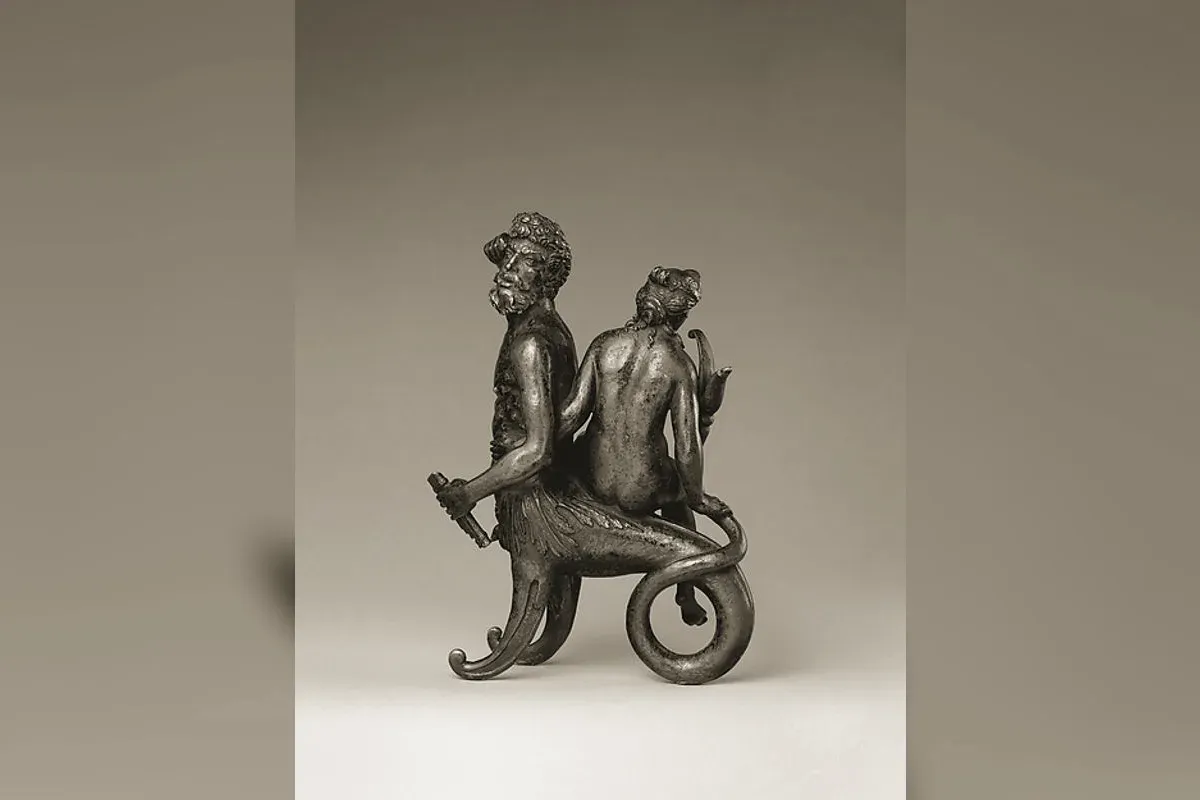
Triton is the son of Poseidon and Amphitrite: the only child the ruling couple of the sea gave to the sea itself. Man above, fish below, conch at his lips, he is the voice of the waters — the instrument by which the sea rises or settles. Hesiod, who grants him four lines, calls him a “terrible god.”
A god born on the sea floor
The Theogony is short and exact: from Poseidon the earth-shaker and Amphitrite comes “great Triton of the wide strength, who holds the depths of the sea and dwells beside his dear mother and his lordly father in a golden house — an awful god” (930-933).
Two details matter. The golden house puts Triton inside the royal household of the sea: he is a marine prince, not a wandering monster. And the adjective deinos, “dreadful, awe-inspiring,” rules out the decorative creature he becomes on later Roman mosaics. The earliest attested Triton is a power, not an ornament.
His mother Amphitrite, the Nereid who became queen of the sea, has no entry on Mythoblog yet — an acknowledged gap in the Greek cluster.
The conch, an instrument that cuts both ways
Triton’s attribute is a conch shell (kokhlos) pierced to serve as a trumpet, and its most famous use is Ovid’s.
In Metamorphoses 1, once the flood has done its work, Neptune lays down his trident and calls for Triton. The god, “his shoulders overgrown with clinging shellfish,” is ordered to sound his curved shell and call the waters back. The note carries to both shores of the world, beneath the rising and the setting sun; the rivers hear it and return to their beds (1.330-347).
The passage assigns Triton a plainly cosmic function: he does not raise an alarm, he executes the sea-king’s order across the whole extent of the waters. And since the same instrument can raise a swell, one shell serves both storm and calm. Triton is the sea’s sound register.
The Argonauts at Lake Tritonis
His fullest appearance comes in the quest for the Golden Fleece, in the last book of Apollonius of Rhodes’s Argonautica.
Driven by a storm, the Argo is flung onto the Libyan shoals of the Syrtes and then stranded in Lake Tritonis, a sheet of water with no visible outlet. The crew is finished. At that point Triton appears in the shape of a young man named Eurypylus and gives Euphemus, as a guest-gift, a clod of earth. Then the god resumes his true form — a fish tail split into two flukes — takes hold of the Argo’s keel and steers her out to open sea.
The clod is not a throwaway detail. Euphemus lets it fall into the water; it swells and becomes the island of Calliste, later Thera — the island whose colonists would one day found Cyrene in Libya. Pindar tells the same story in Pythian 4, written for a king of Cyrene: a gift from Triton binds the founding of the city to the oldest Greek heroes. The sea god underwrites a very real colonial claim.
The episode also shows a shape-shifting, knowing Triton, close in function to the old men of the sea such as Proteus or Phorcys: the god who knows the channels and can pull a ship out of a trap.
Lake Tritonis, Athena, and a disputed etymology
Herodotus describes this Libyan lake at length, along with the Ausean people who live around it. He reports that they hold an annual festival in which the girls fight each other with stones and staves in honour of a local goddess the Greeks call Athena, and that they say she is the daughter of Poseidon and Lake Tritonis (4.180).
Ancient writers readily connected this with Athena’s Homeric epithet Tritogeneia, “Trito-born.” The connection is attractive but unproven: other sources attach the word to a river Triton in Boeotia or Arcadia, and modern linguists have not settled it. What is certain is the essential point: as early as the classical period Greeks felt a link between the root Trit-, a body of water and Athena’s birth, without themselves knowing which link it was.
From one god to a species of Tritons
From the Hellenistic period Triton shares Silenus’s fate: his proper name turns into a common noun. Tritons in the plural form a tribe of sea hybrids, the loud escort of Poseidon and Amphitrite on sarcophagi and mosaics, frequently paired with Nereids.
Pausanias supplies the oddest testimony. At Tanagra in Boeotia it was said that a Triton preyed on cattle driven to the shore and on women who went down to purify themselves in the sea; the townspeople filled a vat with wine and set it on the beach, the creature drank itself insensible, and a Tanagran took his head off with an axe. Pausanias states that he saw the preserved body, along with a larger one at Rome, and describes it clinically: hair the green of marsh parsley, fine scales over the body, gills below the ears, human nostrils, a beast’s teeth, a dolphin’s tail (9.20-21).
The passage is valuable less for zoology than for method: a second-century traveller describing an object on display, not a story he was told.
Afterlife: fountains and a moon
The image of Triton blowing his shell has had a long second life. Bernini set him at the centre of the Fontana del Tritone on Piazza Barberini in Rome (1642-1643): crouched on four dolphins, the god raises the conch to his lips and the jet of water takes the place of the sound — the acoustic attribute becomes a piece of hydraulic engineering, and the motif spread through the monumental fountains of Europe.
The name eventually left the planet. Triton is the largest moon of Neptune, discovered in 1846, a few days after the planet itself. The astronomical descent reproduces the mythological one exactly.
Further reading
For the god who rules the sea and fathered him, see the entry on Poseidon and on Poseidon’s trident. For the expedition Triton hauls out of Lake Tritonis, read the account of Jason and the Golden Fleece and the entry on Jason. For the other great shape-shifter of the Greek sea, see the entry on Proteus. For the goddess Herodotus’s Libyans called a daughter of Lake Tritonis, see the entry on Athena.
Ancient sources
- Hesiod, Theogony, 930-933
- Apollonius of Rhodes, Argonautica, 4.1551-1622
- Pindar, Pythian 4.19-56
- Herodotus, Histories, 4.179-180
- Ovid, Metamorphoses, 1.330-347
- Pausanias, Description of Greece, 9.20.4; 9.21.1
See also
Related entries
Stories featuring this entity
Frequently asked questions
Who was Triton in Greek mythology?
Triton is the son of Poseidon and Amphitrite, born to the ruling couple of the sea. Hesiod places him with his parents in a golden palace on the sea floor and calls him a 'terrible god.' He has a man's torso and a fish's tail, and he carries a conch shell whose sound commands the waves.
What does Triton's conch shell do?
It works as a trumpet. In Ovid's account of the flood, Neptune orders Triton to blow it so the waters will withdraw: the note travels to both shores of the world and every river returns to its bed. The instrument cuts both ways — it can raise the swell as well as still it — and that is what makes Triton a power of the sea rather than a mere herald.
Why are there many Tritons rather than one?
From the Hellenistic period the proper name became a common noun, exactly as Silenus produced the Sileni. Tritons in the plural are a whole species of merman, the noisy escort of Poseidon and Amphitrite on sarcophagi and mosaics. Pausanias records two Tanagran tales of a nameless Triton raiding the shore until he was made drunk and beheaded, and claims to have seen two such bodies on display.