Greek mythology · Gods & goddesses
Proteus, the shape-shifting old man of the sea
In brief
Proteus, the Greek sea god who changes shape: Menelaus's ambush on Pharos, prophecy taken by force, and the Egyptian king who kept Helen safe.
- shape-shifting
- prophecy taken under duress
- herds of seals
- herd of seals
- +1
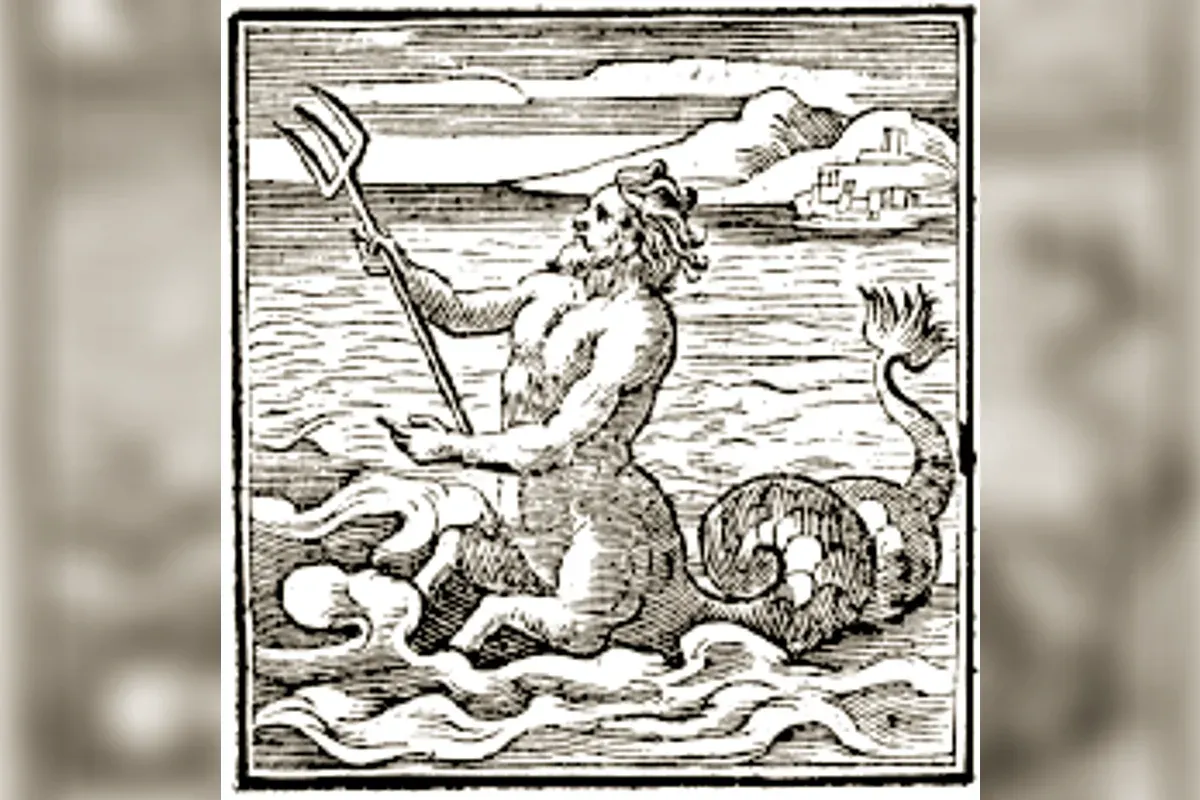
Proteus is the old man of the sea in his purest form: a god who knows everything and says nothing unless you hold him down. His weapon is not strength but transformation — lion, serpent, water, tree — and his myth turns on one blunt principle: truth has to be taken by force. From his name comes the English adjective protean, one of the few everyday words descended directly from a Greek god.
Poseidon’s servant
Homer introduces him in Odyssey 4 as “the unerring old man of the sea, Proteus of Egypt, who knows the depths of every sea” and who is the servant of Poseidon (4.384-386). No parentage is given; later sources make him a son of Poseidon or of Ocean, with no version prevailing.
He belongs to a functional rather than a genealogical family: the halioi gerontes, the old men of the sea, which also holds Nereus, Phorcys and Glaucus. All three traits are shared — great age, knowledge without error, and refusal to hand it over. These are gods from before the Olympians, who govern nothing and know everything.
The ambush on Pharos
The founding episode runs to two hundred lines of the Odyssey, and Menelaus tells it himself to Telemachus, who has come looking for news of his father.
Becalmed for twenty days on the island of Pharos off Egypt, Menelaus watches his provisions run out. Eidothea, Proteus’s daughter, takes pity and hands him the instructions for her father: when the sun stands at midday the old god comes out of the water, counts his seals off in fifties as a shepherd counts sheep, and lies down to sleep among them.
She flays four seals, scoops four beds in the sand and hides Menelaus and three of his men under the skins. Homer records, with a realism rare in epic, that the stench of the seals is unbearable, and that Eidothea has to hold ambrosia under each man’s nose to mask it.
At noon Proteus counts and lies down. The four men spring. Then the sequence begins: a maned lion, a serpent, a leopard, a huge boar, running water, a tall leafy tree. They hold on. The god returns to himself and asks, in effect: who told you?
What Proteus gives up
The extracted answer has three parts, and each one serves the architecture of the Odyssey.
First the practical fix: Menelaus is stuck because he skipped the hecatombs owed to the gods; he must sail back to Egypt and sacrifice on the Nile. Then the fate of the Greek commanders after the Trojan War: Ajax son of Oileus drowned for defying the gods, Agamemnon was murdered on his return by Aegisthus, and Odysseus is alive, held on an island by the nymph Calypso, without ship or crew.
That last item is the reason the episode exists: it is through Proteus’s mouth that the poem confirms to Telemachus, and to the audience, that Odysseus is still living.
Finally Proteus tells Menelaus that he will not die in Argos but be taken to the Elysian plain at the ends of the earth, because he has Helen for a wife and is therefore son-in-law to Zeus. It is one of the oldest descriptions of Elysium: no snow, no winter, no rain, only the breath of the West Wind coming off the Ocean.
A Greek pattern: seize the god who knows
The Pharos ambush is not an isolated scene but the fullest example of a recurring pattern.
Heracles grapples Nereus to make him name the road to the Hesperides, and the old god turns into water and fire. Peleus has to hold Thetis through her transformations — fire, water, lioness, cuttlefish — in order to marry her. Triton meets the Argonauts in mortal shape before resuming his own.
The pattern says something exact about Greek divination: divine knowledge is not a gift, it is a capture. Where an oracle is consulted with offerings, the old man of the sea has to be won hand to hand. Shape-shifting is not an offensive power — Proteus never attacks — but an escape strategy, and the myth rewards the one virtue that defeats it: not letting go.
Virgil: Proteus, Aristaeus and the death of Eurydice
Proteus’s second great scene is Latin, and its consequences for European literature are enormous.
In Georgics 4, Virgil tells how the herdsman Aristaeus, having lost every one of his bees, goes to his mother the nymph Cyrene, who sends him to capture Proteus. The god is taken asleep in a cave on the Carpathian sea, among his seals; he turns into fire, a wild beast, a river, and finally gives in.
What he reveals is the key to the poem: Aristaeus’s bees died as a punishment, because in pursuing Eurydice he drove her into the snake that killed her. And Virgil has Proteus himself narrate Orpheus’s descent to the underworld, the fatal backward glance and Eurydice’s second death.
In other words, the most famous version of the myth of Orpheus and Eurydice — the one that fixed the story for twenty centuries — is placed in the mouth of a sea god a herdsman had to tie down to make him talk. The device is not idle: it marks the story as a truth extorted, not a tale told for pleasure.
The king of Egypt: another Helen
There is a second Proteus, wholly distinct, and he relocates one of the greatest Greek stories.
Herodotus, in Book 2, reports what the priests of Memphis told him: Proteus was king of Egypt when Paris, blown off course with Helen, landed there. Informed of the abduction and of the theft of Menelaus’s treasure, the king refused to kill a foreigner but kept both the woman and the goods, and sent Paris away alone. Helen, then, was never at Troy; the Greeks besieged for ten years a city that could not have given her back. Herodotus adds that Homer knew this version and set it aside because it suited epic less well.
Euripides turned it, in 412 BC, into the tragedy Helen. The real Helen spent the war in Egypt beside the tomb of the now-dead Proteus, harassed by his son Theoclymenus, while an eidolon — a phantom of air moulded by Hera — went to Troy in her place. Menelaus, shipwrecked, discovers that he fought a war for an image.
The play is among the most vertiginous texts in Greek theatre, and the Egyptian Proteus is its foundation: a dead king whose tomb guarantees Helen’s innocence.
Afterlife: matter and a word
Ancient allegorists and the Renaissance turned Proteus into a philosophical figure — prime matter taking all forms, or the mind that escapes every definition. Ovid invokes him as the example of bodies that change, and Francis Bacon, in De sapientia veterum (1609), makes him the emblem of experimental science outright: constrain nature by force until it yields its true shape.
What survives in everyday English is the adjective protean — and an amphibian, the olm, given the scientific name Proteus anguinus in 1768 after the god who will not keep one shape.
Further reading
For the sea god he serves, see the entry on Poseidon; for the other old man of the sea in this cluster, Phorcys. For the story Virgil puts in his mouth, read Orpheus and Eurydice. For the woman Herodotus’s Proteus keeps in Egypt, see Helen of Troy and the account of the Trojan War. For the sea goddess who must be held through her transformations before she can be married, see Thetis.
Ancient sources
- Homer, Odyssey, 4.351-570
- Herodotus, Histories, 2.112-120
- Euripides, Helen, prologue and 1-67
- Virgil, Georgics, 4.387-529
- Ovid, Metamorphoses, 8.730-737; 11.221-256
See also
Frequently asked questions
Why does Proteus change shape?
Because he knows, and will not tell. In Greek myth the old sea gods hold unerring knowledge but surrender it only under compulsion, and shape-shifting is their defence. Lion, serpent, leopard, boar, running water, tall leafy tree — Proteus exhausts his forms, and when he returns to his own he is beaten and speaks.
How does Menelaus capture Proteus?
On the advice of Eidothea, the god's own daughter, Menelaus and three companions hide under freshly flayed sealskins among the herd Proteus comes ashore to count at noon on the island of Pharos. The god falls asleep; they seize him and hold on through every transformation. Beaten, he names the sacrifice owed on the Nile and reports the fate of the other Greek commanders.
Who is the Proteus of Herodotus and Euripides?
A different figure altogether: a king of Egypt reigning at Memphis. In Herodotus he receives Paris and Helen, keeps the woman and the stolen treasure, and sends the Trojan prince away empty-handed — so Helen spent the war in Egypt, not Troy. Euripides built his tragedy *Helen* on that version, in which only a phantom went to Troy while the real Helen waited by Proteus's tomb.