Greek mythology · Mythical objects
The Trident of Poseidon: weapon of the seas and symbol of oceanic power
In brief
The Trident of Poseidon in Greek mythology: forged by the Cyclopes, weapon and sceptre of the god of the seas, symbol of his dominion over waters, earthquakes, and horses.
- three sharp prongs
- forged by the Cyclopes (like the thunderbolt of Zeus)
- can trigger earthquakes when striking the ground
- can raise or calm storms according to the god's will
- +1
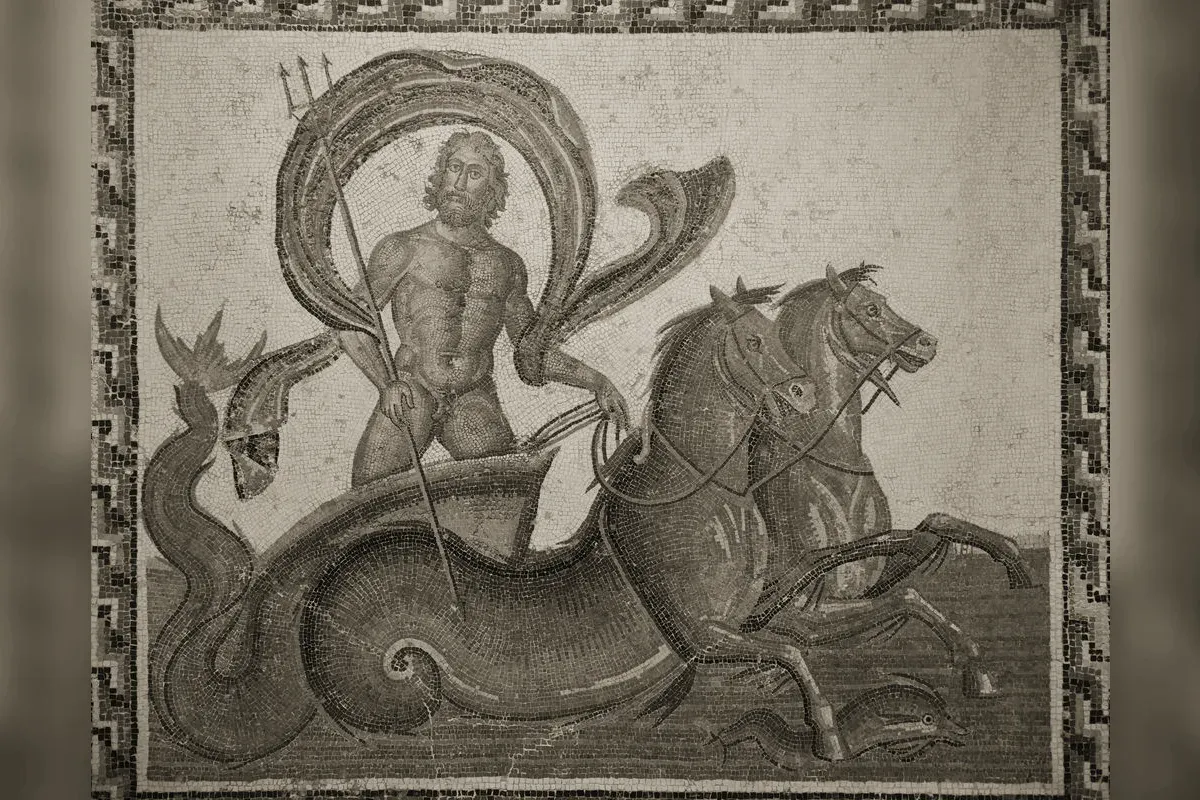
In the cosmic partition that Zeus, Poseidon, and Hades established after their victory over the Titans, each brother received an attribute that embodied his power: the thunderbolt for Zeus, the helmet of invisibility for Hades, and the trident for Poseidon. Of these three divine weapons, the trident is perhaps the most immediately recognisable, its three-pronged silhouette having become a universal icon of power over the seas. To understand the trident of Poseidon is to understand the multiple and formidable nature of a god who governs not only the oceans, but also earthquakes, horses, and freshwater springs.
The triaina: description and divine origin
The Greek word τρίαινα (triaina) refers precisely to a three-pronged fork — a fishing implement or agricultural tool in everyday use, but a divine attribute in the context of Poseidon. The three-pronged tool existed in Mediterranean culture long before Greek mythology; its adoption as the sea god’s symbol endowed it with both a practical dimension (fishing, mastery of water) and a symbolic one (triple dominion).
Like the thunderbolt of Zeus, the trident of Poseidon was forged by the Cyclopes — Brontes (Thunder), Steropes (Lightning), and Arges (Brightness) — upon their liberation by Zeus from Tartarus. The three Cyclopes gave each victorious brother a weapon corresponding to his future domain: Zeus received the thunderbolt to govern the sky, Poseidon received the trident to govern the seas, and Hades received the helmet Kyneë (which renders him invisible) to govern the underworld.
This triple attribution by the same divine smiths underscores the symbolic unity of the three brothers: they share the same divine origin, and their three weapons emerged from the same cosmic forge. Each attribute is a fragment of the total power Zeus would have wielded alone if he had not shared cosmic dominion with his brothers.
The three domains of the trident
The iconographic significance of the three prongs of the trident attracted various interpretations in antiquity and among modern commentators:
Poseidon’s three domains: the most widespread reading associates each prong with one of the god’s three great domains — the seas (with their storms and calms), earthquakes (Poseidon is the Ennosigaios, the Earthshaker), and springs and freshwaters (Poseidon is also master of springs).
The three states of the sea: churning surface, calm depths, and seabed — a more poetic reading that makes the trident a vertical map of the aquatic universe.
Dominion over three forms of water: sea, lake, river — the three forms of water Poseidon governed in distinct ways.
Whatever interpretation is adopted, the number three carries weight in Greek tradition: it evokes completeness, the integral mastery of a domain.
The trident as a cosmogonic tool
In Greek mythology, Poseidon’s trident is above all a tool for transforming the physical world. Unlike Zeus’s thunderbolt, which strikes from afar and from above, Poseidon’s trident acts in direct contact with the elements it dominates.
Poseidon strikes the ground with his trident to trigger earthquakes. This image recurs throughout the Iliad, where Homer describes Poseidon making mountains and sea tremble with a stroke of his trident when he is angered. The earthquake is not a metaphor: it is the god’s physical gesture as he fulfils his role of telluric sovereign.
Poseidon strikes a rock with his trident to make a spring of saltwater or a horse burst forth. The most famous legend of this action is the contest between Poseidon and Athena for possession of Athens: Poseidon struck the rock of the Acropolis with his trident and caused a spring of saltwater to gush forth — magnificent but of limited use for a city. Athena answered by causing an olive tree to grow, symbol of peace and prosperity. The gods judged Athena’s gift the more valuable, and the city took her name. Poseidon’s trident-blow on the Acropolis rock left a visible trace of his ambitions over Athens.
Poseidon strikes the sea’s surface to raise or calm storms. In the Odyssey, it is his fury at Odysseus — who had blinded his son the Cyclops Polyphemus — that unleashes the relentless storms delaying the hero’s return for ten years. The trident is the instrument of this maritime vengeance.
The trident in the Odyssey and the Trojan War
Two of the great Greek epics place Poseidon’s trident in a decisive role.
In the Odyssey, Poseidon is the great adversary of Odysseus. The sea-god’s wrath against the Ithacan hero, described in Book I, is the driving force behind the most dangerous obstacles of the return voyage. Poseidon raises storms, smashes Odysseus’s raft, and attempts to drown the hero multiple times — all through the power of his trident over the waters. His rivalry with Athena, who protects Odysseus, thus replays the ancient opposition of their respective gifts for Athens.
In the Trojan War, Poseidon took the side of the Greeks against Troy — partly to avenge the treachery of Troy’s king Laomedon, who had refused to pay him for helping build the city’s walls. During the battle, Poseidon intervened directly in supporting the Greek armies, changing form to encourage warriors and using his trident to create favourable sea conditions for the Greeks.
The trident and its divine parallel: comparison with the thunderbolt
A comparison between Poseidon’s trident and the thunderbolt of Zeus reveals the deep structure of the Olympian pantheon. Both weapons were forged by the same divine craftsmen, symbolise absolute sovereignty in their respective domains, and serve as signs of supreme authority. But their modes of action are opposed:
The thunderbolt strikes from above downward, from sky to earth — a weapon of distance and instant justice. The trident acts horizontally or downward, in direct contact with waters and earth — a weapon of direct engagement with the elements.
This difference is not incidental: it reflects the two modes of sovereignty embodied by Zeus and Poseidon. Zeus is the king who judges from afar, from Olympus, with the cold serenity of the one who holds absolute power. Poseidon is the lord who engages directly, who plunges into his elements and dominates them through the physical force of his weapon.
Cultural resonances and iconographic legacy
Poseidon’s trident is one of the most immediately recognisable divine weapons in all ancient iconography. On Greek vases, coins, sculptures, and mosaics from the Classical to the Roman period, Poseidon (and his Roman counterpart Neptune) invariably holds his trident, often accompanied by dolphins and seahorses.
In contemporary culture, the trident has become a generic symbol of power over the seas: it appears in the heraldry of many coastal states, in representations of fantastical sea creatures (from Triton in The Little Mermaid to characters in the DC/Marvel universe), and remains one of the most widely recognised mythological attributes among the general public.
In astronomy, Neptune — the most distant gas giant from the Sun — bears the name of the Roman god of the seas, and its astronomical symbol is precisely a trident.
Further reading
For the god who wields this attribute, read the page on Poseidon. For the parallel weapon forged by the same Cyclopes for the supreme god, see the page on the thunderbolt of Zeus. For Poseidon’s vengeance against Odysseus, read the narrative of the Odyssey. For Poseidon’s role in the Trojan War, consult the Trojan War narrative. For the rivalry between Poseidon and Athena and its outcome, read the page on Athena.
Ancient sources
- Hesiod, Theogony, lines 139-146
- Homer, Odyssey, 5.291-296
- Homer, Iliad, 12.27-33
- Apollodorus, Library, 1.2.1 and 3.14.1
- Pausanias, Description of Greece, 1.24.5
See also
Stories featuring this entity
Frequently asked questions
How did Poseidon obtain his trident?
Like the thunderbolt of Zeus and the helmet of invisibility of Hades, the trident was forged by the Cyclopes — Brontes, Steropes, and Arges — as an expression of gratitude after Zeus freed them from Tartarus where Cronus had imprisoned them. Each of the three brothers received a weapon symbolising his domain: Zeus the sky, Poseidon the seas, Hades the realm of the dead.
Can the trident cause earthquakes?
Yes. In Greek mythology, Poseidon is also called the Earthshaker (Enosigaios), and his trident is the tool with which he strikes the earth to make it tremble. When he is angered by a coastal city or by men who have offended his domain, he strikes the seabed or the shores with his trident, triggering earthquakes and tsunamis.
What is the difference between Poseidon's trident and Zeus's thunderbolt?
Both weapons were forged by the Cyclopes and symbolise absolute sovereignty within their respective domains. The thunderbolt of Zeus is a weapon of instant destruction and cosmic justice, striking from high above. The trident of Poseidon is primarily a tool of domination over liquid and telluric elements, acting horizontally or downward from the waters. Together they illustrate the cosmic partition between the two brothers.