Greek mythology · Heroes & mortals
Alcmene, mother of Heracles in Greek mythology
In brief
Alcmene, princess of Perseus's line: the night Zeus impersonates Amphitryon, Heracles's delayed birth, and her revenge on Eurystheus.
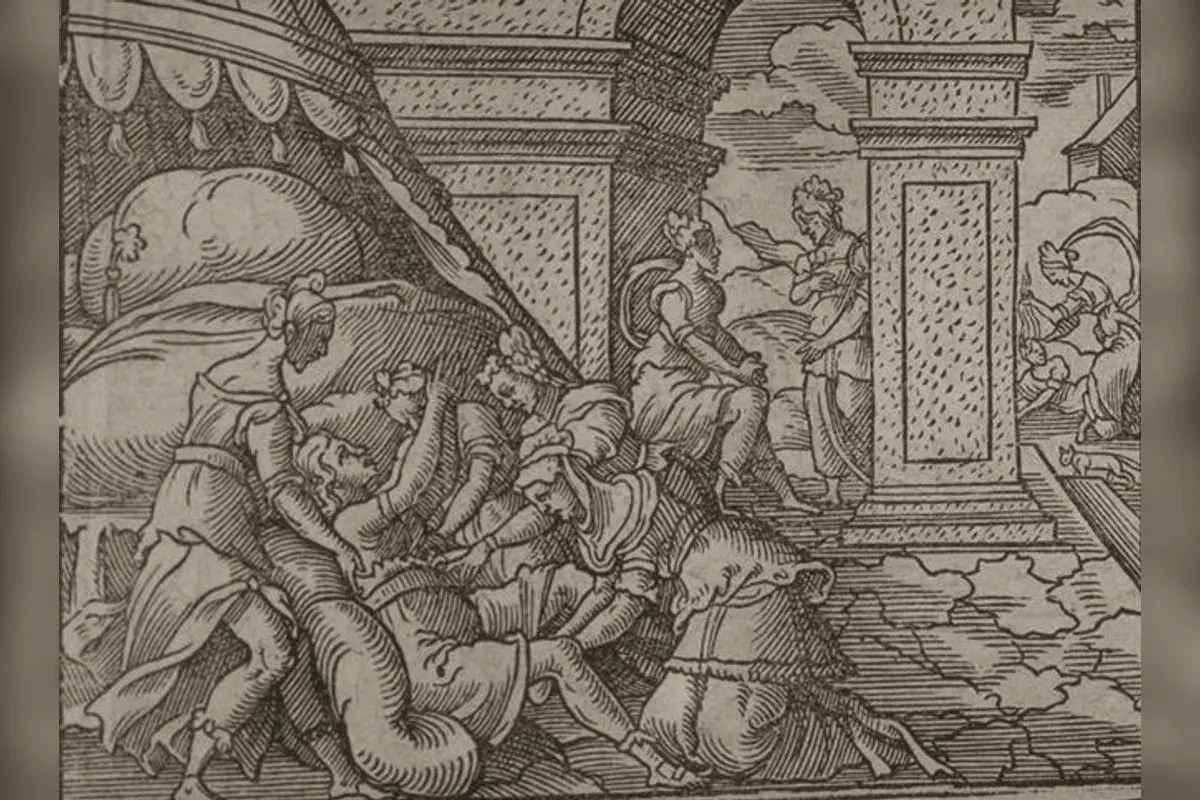
Alcmene is the mother of Heracles and a descendant of Perseus. Her story links two kinds of power: Zeus’s ability to assume a husband’s exact identity and Hera’s ability to manipulate the timing of a birth. Heracles’s entire career under Eurystheus begins with what happens around his mother’s labour.
A marriage made conditional
Alcmene is a daughter of Electryon, king of Mycenae. After her brothers die fighting the Teleboans, she refuses to consummate her marriage to Amphitryon until he avenges them. Amphitryon therefore leaves on campaign and wins the required victory.
Before he returns, Zeus takes his appearance, reports the campaign in convincing detail, and lengthens the night. The real Amphitryon arrives the following day and is puzzled when Alcmene says she has already heard his story. The seer Tiresias eventually explains the duplicate homecoming.
Ancient retellings vary in tone, but the narrative device leaves Alcmene no means of recognition: she receives someone who looks, speaks, and knows what only her husband should know. Zeus’s advantage is not persuasion but perfect impersonation.
One labour, two dynasties
Alcmene conceives Heracles by Zeus and Iphicles by Amphitryon. The boys are nearly twins, but Hera turns the delivery into a contest. Zeus declares that the descendant of Perseus born that day will rule the others, and Hera makes him bind the claim with an oath. She then hastens Eurystheus’s premature birth and delays Alcmene’s.
The child intended to rule is consequently made subject to the cousin born first. The Twelve Labors follow from this reversal. Greek epic makes the timing of Alcmene’s delivery, rather than Heracles’s strength, the decisive fact in the heroic balance of power.
A life after the hero’s childhood
Alcmene remains in the tradition long after the infant strangles Hera’s snakes. Some accounts marry her to Rhadamanthys after Amphitryon’s death. After Heracles dies and becomes a god, she accompanies his persecuted descendants into exile and finds protection with them at Athens.
When Eurystheus is finally defeated, several sources give Alcmene the last act of vengeance. She insists on his death or mutilates his severed head despite Athenian objections. The woman whose body was held motionless during the struggle over succession becomes the agent who closes it.
Her own death also acquired a miraculous ending. In one tradition Zeus removes her body and leaves a stone in the coffin, carrying her to the Isles of the Blessed. Like Heracles, Alcmene is ultimately allowed to cross the boundary that structured her life: the line between a mortal used by gods and a member of the divine family.
Ancient sources
- Homer, Iliad, 19.95-133
- Hesiod, Shield of Heracles, 1-56
- Apollodorus, Library, 2.4.5-11; 2.8.1
- Euripides, Children of Heracles
- Pausanias, Description of Greece, 1.41.1
See also
Stories featuring this entity
Frequently asked questions
Why does Alcmene bear two sons at once?
Because two fathers were involved on the same night. Zeus came first in Amphitryon's shape; the real Amphitryon returned shortly after. Alcmene therefore bore twins of different paternity — Heracles to Zeus and Iphicles to her husband. The pair becomes a running demonstration in the myths: the demigod strangles the serpents in the cradle while his brother screams.
What happened to Alcmene after Heracles?
She outlived him, and the tradition follows her. Persecuted by Eurystheus after her son's death, she took refuge with the Athenians, and when Eurystheus was finally captured she is said to have demanded his execution herself. Later accounts give her a translation to the Isles of the Blessed, or a marriage to Rhadamanthus among the dead.