Greek mythology · Heroes & mortals
Atalanta: the huntress, the Calydonian Boar and the golden apples
In brief
Atalanta is the great huntress of Greek mythology, devoted to Artemis and faster than any man. She draws first blood on the Calydonian Boar and will only marry a man who beats her in a footrace, which Hippomenes, or Melanion, manages with Aphrodite's golden apples.
- hunting
- running
- refusal of marriage
- bow and arrows
- +2
Atalanta is the great huntress of Greek mythology: a baby left to die at birth, brought up in the wild, devoted to Artemis and faster than any man. She wins fame in places Greek myth usually keeps closed to women — the hunt, the wrestling ground, perhaps even the deck of the Argo — and refuses to marry until a suitor beats her in a race by a trick. Her story is also a textbook case of ancient variants: the Greeks knew at least two Atalantas, whom tradition eventually merged into one.
Two Atalantas
Pseudo-Apollodorus flags the split himself (3.9.2). He tells the life of an Arcadian Atalanta, daughter of Iasus, then notes that Hesiod and others make her the daughter of Schoeneus, that Euripides gives her father as Maenalus, and that her husband is sometimes Melanion, sometimes Hippomenes.
- The Arcadian Atalanta is the huntress: exposed as a baby, a friend of Artemis, heroine of the Calydonian Boar hunt.
- The Boeotian Atalanta, the one in Hesiod’s Catalogue of Women, is the unbeatable runner who challenges her suitors.
Ovid tells the two episodes in two different books of the Metamorphoses, calling one “the Tegean girl” and the other “the daughter of Schoeneus”. Modern retellings have fused them into a single heroine, and that is how she is known today.
The bear’s child
According to Pseudo-Apollodorus, Iasus wanted a son. When a daughter was born, he had her exposed. A she-bear came and suckled her, and hunters later found her and raised her. The detail is not random: the bear is Artemis’s animal, and at Brauron in Attica, young girls “played the bear” in the goddess’s service before they were old enough to marry.
Atalanta grows up a virgin, armed, in the mountains. Two centaurs, Rhoecus and Hylaeus, try to rape her; she shoots them both (Apollodorus 3.9.2; Callimachus, Hymn to Artemis 221). Callimachus makes her one of Artemis’s favourite companions.
The Calydonian Boar
Oeneus, king of Calydon, offers the first fruits of his harvest to every god but forgets Artemis. The goddess sends a monstrous boar to ravage his land. Oeneus’s son Meleager gathers the best heroes in Greece, among them Theseus, Jason, Peleus and the Dioscuri. Atalanta turns up too. Several of the hunters refuse to hunt beside a woman; Meleager, who desires her, makes them (Apollodorus 1.8.2).
Atalanta draws first blood, with an arrow in the boar’s back. Amphiaraus then hits it in the eye, and Meleager finishes it off. He gives the hide to Atalanta; his uncles, his mother Althaea’s brothers, snatch it from her, outraged that a woman should take the prize. Meleager kills them. To avenge her brothers, Althaea throws into the fire the log on which her son’s life had depended since birth, and Meleager dies.
Homer knows the hunt and Meleager’s death, which Phoenix tells Achilles in Iliad 9, but does not name Atalanta (9.529-599). Her presence is attested from the sixth century on, notably on the François Vase of about 570 BC, where she hunts alongside Melanion. At Tegea in Arcadia, the pediment of the temple of Athena Alea showed the hunt, and the boar’s hide was put on display (Pausanias 8.45.6-7; 8.47.2). Meleager, incidentally, is the uncle of Diomedes, the hero of Troy.
Wrestling Peleus, sailing on the Argo
At the funeral games of Pelias, Atalanta wrestles Peleus, the future father of Achilles, and throws him (Apollodorus 3.9.2). The bout was a favourite of sixth-century vase painters, who show a muscular Atalanta in shorts squaring up to the hero.
Whether she sailed with the Argonauts was already in dispute in antiquity. Pseudo-Apollodorus includes her in the crew (1.9.16). Apollonius of Rhodes pointedly leaves her out. Jason sets off with a spear Atalanta gave him on Mount Maenalus; she wanted to come, but he stopped her, fearing “bitter quarrels over love” on board (Argonautica 1.769-773). For the full crew list, see Jason and the Golden Fleece.
The race and the golden apples
Once her father has found her again, Atalanta is pushed to marry. She sets a condition: any suitor must beat her in a race, and the loser dies. In Pseudo-Apollodorus she runs armed behind the suitor and kills him if she catches him. Many die.
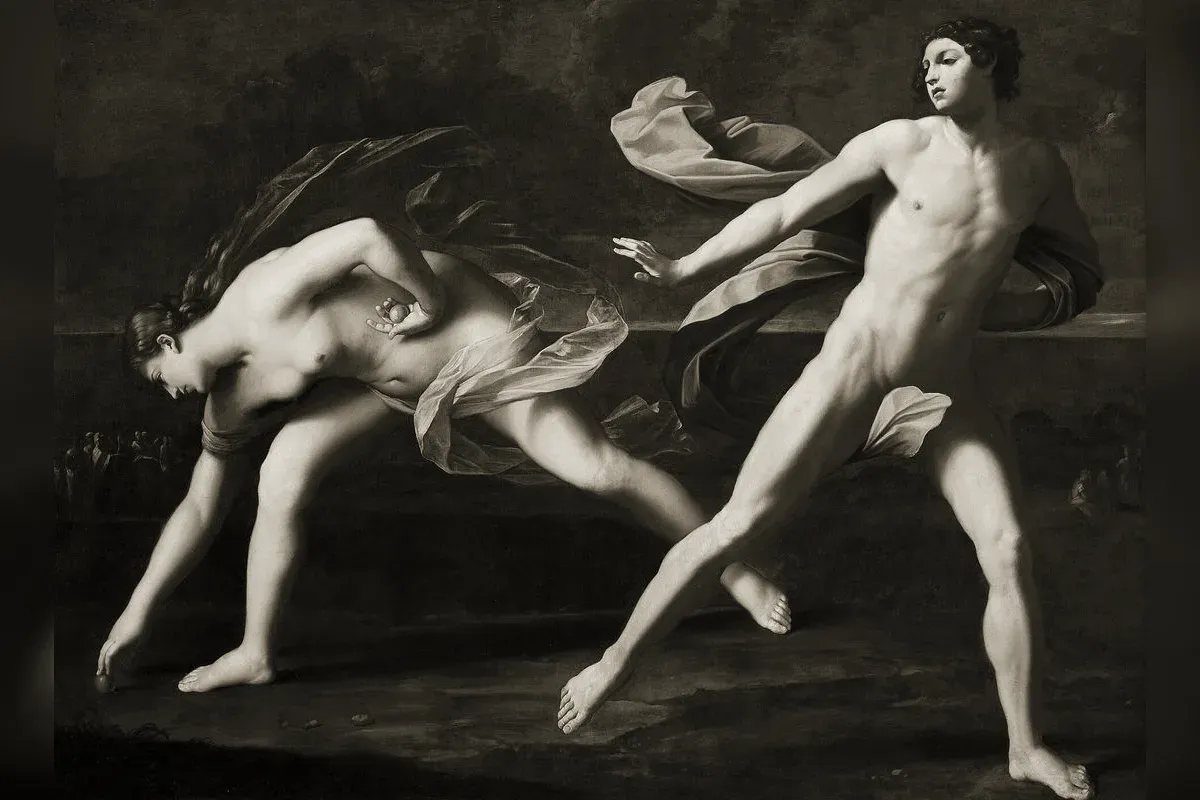
Hippomenes, whom Pseudo-Apollodorus calls Melanion, asks Aphrodite for help. The goddess gives him three golden apples, which in Ovid come from a tree in the field of Tamasus on Cyprus (Metamorphoses 10.644-651). During the race he throws them off the course one at a time; Atalanta stops to gather them up, and he wins. Ovid adds a psychological touch: even before the start, Atalanta pities the young man and is not sure she wants to beat him (10.609-637).
Turned into lions
The story ends badly. In Ovid, Hippomenes forgets to thank Venus, who takes her revenge by flooding him with desire just as the couple pass a shrine of Cybele. The lovers make love inside, and the outraged goddess turns them into lions and yokes them to her chariot (10.686-707). In Pseudo-Apollodorus the violated shrine belongs to Zeus. Hyginus adds a cruel twist: lions were believed not to mate with one another, so the transformation sentences the pair to chastity forever (Fabulae 185).
Mother of one of the Seven
Atalanta has a son, Parthenopaeus, whose name recalls his mother’s virginity (parthenos, “maiden”). His father is Melanion, Ares or Meleager, depending on the source. Parthenopaeus is one of the Seven who march on Thebes for Polynices. Aeschylus describes him as a very young warrior with a boy’s face, bearing on his shield the Sphinx devouring a Theban (Seven against Thebes 526-549).
Legacy
Later art mostly kept the race. Guido Reni made it one of his best-known paintings, Atalanta and Hippomenes (about 1618-1619), the two bodies crossing as she bends for an apple. Handel wrote an opera, Atalanta (1736), and Swinburne a verse drama, Atalanta in Calydon (1865). For many American readers the story came through Free to Be… You and Me (1972), which rewrote the ending: Atalanta and the young man cross the line together and go off to see the world before deciding anything about marriage.
Further reading
For the hunting goddess she serves and who sets the Calydonian hunt in motion, see Artemis; for the goddess who arms her rival with golden apples, Aphrodite. For the hero she beats at wrestling, see Peleus, and for the captain who will not take her aboard in Apollonius, Jason and the quest for the Golden Fleece. For the war at Thebes where her son dies, see Polynices, and for Meleager’s nephew who makes his name at Troy, Diomedes.
Ancient sources
- Hesiod, Catalogue of Women (fr. 72-76 Merkelbach-West)
- Theognis, Elegies, 1287-1294
- Callimachus, Hymn to Artemis, 215-224
- Apollonius of Rhodes, Argonautica, 1.769-773
- Apollodorus, Library, 1.8.2-3; 1.9.16; 3.9.2
- Ovid, Metamorphoses, 8.260-444; 10.560-707
- Hyginus, Fabulae, 70, 99 and 185
- Pausanias, Description of Greece, 8.45.6-7; 8.47.2
- Aeschylus, Seven against Thebes, 526-549
See also
Stories featuring this entity
Frequently asked questions
How did Hippomenes beat Atalanta in the race?
By cheating, with Aphrodite's help. The goddess gives him three golden apples, which in Ovid come from a tree in the field of Tamasus on Cyprus. During the race he rolls them off the track one at a time; Atalanta stops to pick each one up, and he crosses the line first. Ovid adds that she half wanted to lose, having already fallen for him.
Was Atalanta one of the Argonauts?
The ancient sources disagree. Pseudo-Apollodorus lists her among the crew of the Argo. Apollonius of Rhodes, author of the Argonautica, pointedly leaves her out: Jason carries a spear she gave him, because she wanted to sail with him, but he refused, afraid of the quarrels over love a woman would cause on board. Both traditions survived side by side.
Why were Atalanta and Hippomenes turned into lions?
For making love in a sanctuary. In Ovid, Hippomenes forgets to thank Venus, who takes revenge by filling him with desire as the couple pass a shrine of Cybele; the outraged goddess turns them into lions to pull her chariot. In Pseudo-Apollodorus the shrine belongs to Zeus. Hyginus adds that lions were thought not to mate with each other, so the punishment condemned the lovers to eternal chastity.