Greek mythology · Heroes & mortals
Diomedes: the Greek hero who wounded Ares and Aphrodite
In brief
Diomedes, son of Tydeus and king of Argos, is one of the finest Greek warriors of the Trojan War. With Athena at his side he becomes the only mortal in the Iliad to wound two gods, Aphrodite and then Ares. He later steals the Palladium with Odysseus and ends his days in Italy.
- courage in battle
- counsel in war
- night raids
- horses of the breed of Tros, taken from Aeneas
- +2
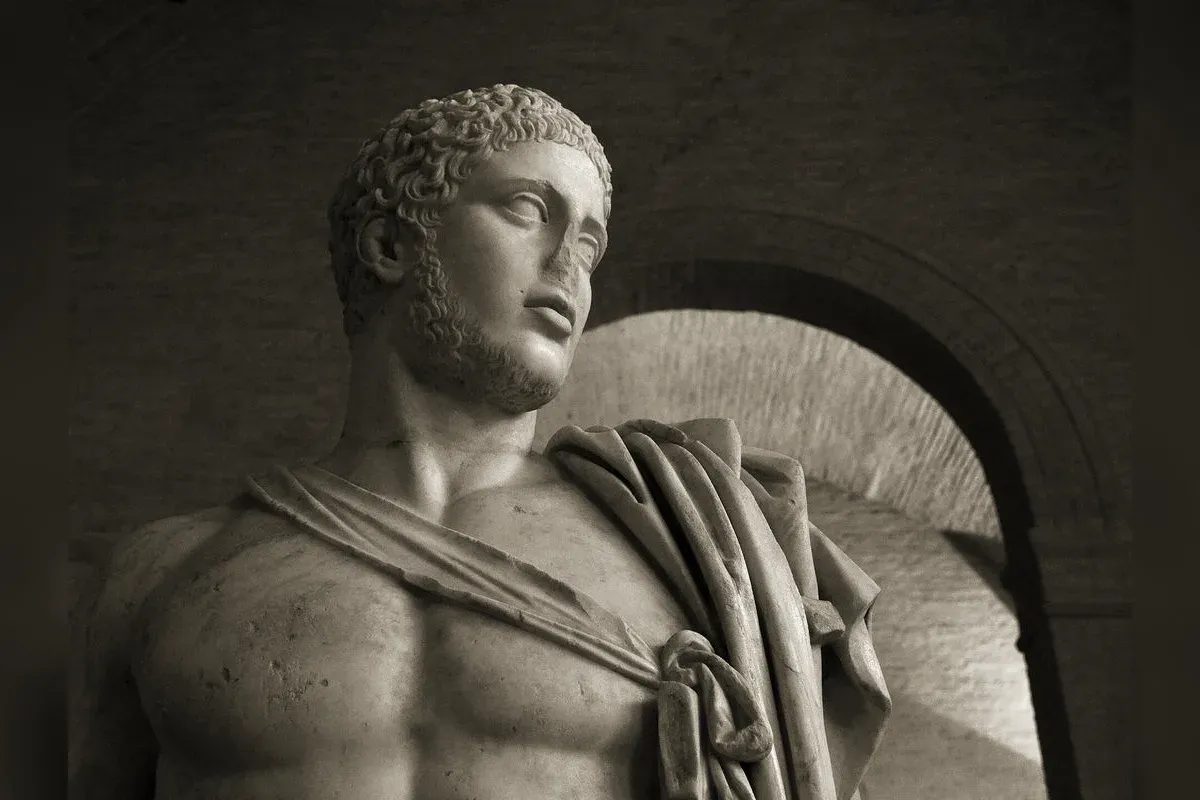
Diomedes, son of Tydeus, is one of the greatest Greek fighters at Troy and the youngest of the front-rank commanders: Nestor tells him he could be his youngest son (Iliad 9.57-58). He rules Argos and Tiryns and brings eighty ships (2.559-568). While Achilles sulks in his hut, it is Diomedes who carries the Greek army. Book 5 of the Iliad belongs to him entirely, and in it he does something no one else manages: he wounds two Olympian gods, Aphrodite and then Ares. As Athena’s favourite, he stands for a heroism without excess, one that knows exactly how far it can go.
The son of Tydeus
Diomedes is the son of Tydeus, a prince of Calydon exiled to Argos, and of Deipyle, daughter of King Adrastus. Tydeus is one of the Seven who march on Thebes to put Polynices back on the throne his brother Eteocles refuses to share. He dies horribly there. Mortally wounded by the Theban Melanippus, he has his enemy’s head brought to him and eats the brain; Athena, who was on her way with a drug to make him immortal, turns away in disgust (Apollodorus 3.6.8).
That story hangs over the son. In the Iliad, first Agamemnon and then Athena herself keep comparing Diomedes to his father, who was small but terrifying (4.370-400; 5.800-813). Diomedes holds his tongue in front of his king; it is his charioteer Sthenelus who answers back: “we claim to be far better than our fathers”, since the sons took Thebes where the fathers failed (4.404-410). Diomedes was indeed one of the Epigoni, the sons of the Seven who captured the city a generation later.
Through his grandfather Oeneus, king of Calydon, he is also the nephew of Meleager, hero of the boar hunt in which Atalanta made her name. And it was Oeneus who once hosted Bellerophon, a link that will matter at Troy.
Book 5: the man who wounds the gods
At the start of Book 5, Athena kindles a flame on his helmet and shield like the bright star of late summer and clears the mist from his eyes so he can tell gods from men. Her orders are exact: fight no immortal, except Aphrodite if she comes into the battle (5.124-132).
Hit in the shoulder by an arrow from Pandarus, Diomedes fights all the harder. He kills Pandarus, then smashes Aeneas’s hip with a boulder. Aphrodite, Aeneas’s mother, rushes in to carry her son away; Diomedes chases her down and slashes her wrist with his spear. Divine blood, ichor, flows for the first time in the poem, and the goddess drops Aeneas and screams (5.334-342). Diomedes shouts after her to go back to seducing feeble women and leave war to warriors. On Olympus her mother Dione comforts her, and remarks in passing that the man who fights the gods does not live long (5.406-409).
Next Diomedes goes after Apollo, who is shielding Aeneas. Three times he charges, three times the god throws him back, and on the fourth Apollo warns him: “Think, son of Tydeus, and give way! Do not set yourself equal to the gods” (5.432-442). Diomedes gives way. That is what separates him from Patroclus, who will try the walls three times against Apollo in Book 16 and die for it.
The end of the book reverses the ban. Seeing Ares cutting down Greeks, Athena takes the charioteer’s place in Diomedes’ chariot, and the oak axle groans under the goddess’s weight. She drives him straight at the war god. Diomedes stabs Ares low in the belly; the god roars like nine or ten thousand men and flees to Olympus (5.855-863), where Hebe bathes and tends him. To set this beaten Ares against the war gods of other traditions, see the comparison of war gods.
Glaucus and inherited friendship
In Book 6, Diomedes meets the Lycian Glaucus between the armies and asks who he is, so as not to risk fighting a god. Glaucus answers with the famous comparison between the generations of men and the leaves that the wind scatters and spring renews, then traces his descent back to Bellerophon.
Diomedes plants his spear in the ground. His grandfather Oeneus had entertained Bellerophon for twenty days and exchanged gifts with him, which makes the two warriors guest-friends by inheritance: they will not fight. They swap armour as a pledge, and Homer adds a dry joke. Zeus takes away Glaucus’s wits, so that he hands over golden armour worth a hundred oxen for bronze worth nine (6.212-236).
Night work with Odysseus
Diomedes and Odysseus form a recurring pair, strength and cunning. In Book 10, the Doloneia, they slip into the Trojan camp by night. They catch the Trojan spy Dolon, squeeze information out of him and kill him, then butcher the Thracian king Rhesus and twelve of his men in their sleep and drive off his white horses. The next day Paris puts an arrow through his foot and takes him out of the fighting (11.369-400); he returns at the funeral games of Patroclus and wins the chariot race (23.362-513).
Outside Homer, the pair reunite to meet the conditions for Troy’s fall. In the Little Iliad, Diomedes fetches Philoctetes and the bow of Heracles from Lemnos, then enters Troy with Odysseus to steal the Palladium, the statue of Athena that protects the city. A story preserved by late mythographers adds that on the way back, Odysseus tried to kill Diomedes to keep the glory for himself. Diomedes saw the sword flash in the moonlight, disarmed him and marched him back to camp with his hands tied, prodding him with the flat of his blade, which is supposedly where the proverb “the compulsion of Diomedes” comes from.
A quick homecoming, an Italian ending
Diomedes is one of the few commanders to get home fast: Nestor says he landed at Argos on the fourth day (Odyssey 3.180-182). But later poets make him pay for wounding Aphrodite. The goddess, or in other versions the vengeful Nauplius, drives his wife Aegialia into adultery, and Diomedes leaves Argos for Italy.
He settles in Daunia, in what is now Puglia, and founds Argyrippa, the historical Arpi. In the Aeneid, the Latins send to ask him to fight Aeneas; Diomedes refuses, since he has faced Aeneas at Troy and knows what he is worth, and describes how his companions were turned into birds (11.243-295). Ovid tells the transformation at length (14.457-511), and the ancients recognised these “birds of Diomedes” in the seabirds of the Diomedean islands, today’s Tremiti archipelago. Linnaeus remembered them when he gave the albatrosses the genus name Diomedea.
Even his end has variants. Pindar says Athena made him a god (Nemean 10.7): the goddess grants the son the immortality she withheld from the father. Strabo records cults of Diomedes along the Adriatic coast (5.1.9; 6.3.9).
Two men called Diomedes
The name also belongs to a completely unrelated figure: Diomedes king of Thrace, a son of Ares, whose mares ate human flesh. Heracles feeds him to his own animals in the eighth of his labours (Apollodorus 2.5.8).
Further reading
For the goddess who guides him and makes him all but unstoppable, see Athena. For the two gods he wounds in Book 5, see Aphrodite and Ares. For the meeting that turns a duel into a pact of hospitality, see Glaucus, and for his partner on night raids, Odysseus. For his father’s war at Thebes, see Polynices, and for the wider conflict, the Trojan War. The other great Achaean fighters have their own pages, from Ajax to Menelaus.
Ancient sources
- Homer, Iliad, 2.559-568; 4.365-418; 5; 6.119-236; 9.29-49; 10; 11.369-400; 23.362-513
- Homer, Odyssey, 3.180-182
- Proclus, Chrestomathy (summary of the Little Iliad)
- Pindar, Nemean 10.7
- Apollodorus, Library, 1.8.5-6; 3.6.8; 3.7.2; Epitome 5.8-13; 6.9
- Virgil, Aeneid, 11.225-295
- Ovid, Metamorphoses, 14.457-511
- Strabo, Geography, 5.1.9 and 6.3.9
See also
Stories featuring this entity
Comparisons
Frequently asked questions
How did Diomedes wound Ares?
With Athena driving his chariot. Early in Iliad 5 she clears his eyes so he can tell gods from men and forbids him to fight any immortal except Aphrodite. Late in the book, seeing Ares cut down Greeks, she lifts the ban herself: she pushes his charioteer out, takes the reins and steers Diomedes' spear into the god's belly. Ares bellows like ten thousand men and flees to Olympus.
Is Diomedes the same as the king with the man-eating mares?
No. Diomedes of Thrace, a son of Ares and king of the Bistones, fed his mares on human flesh; capturing them is the eighth labour of Heracles, who feeds the king to his own animals. The son of Tydeus who fights at Troy shares nothing with him but the name.
Why are albatrosses called Diomedea?
Because of a myth about Diomedes' companions. After the war, Diomedes settled in southern Italy, and his men were turned into seabirds, a story told by Virgil and Ovid. The ancients located these 'birds of Diomedes' on the islands off the Gargano coast, still called the Diomedean islands. When Linnaeus named the albatross genus, he borrowed the hero's name for it.