Greek mythology · Heroes & mortals
Icarus, son of Daedalus in Greek mythology
In brief
Icarus, son of Daedalus: the wings of feather and wax, the middle course he was told to hold, and the ploughman who barely looked up.
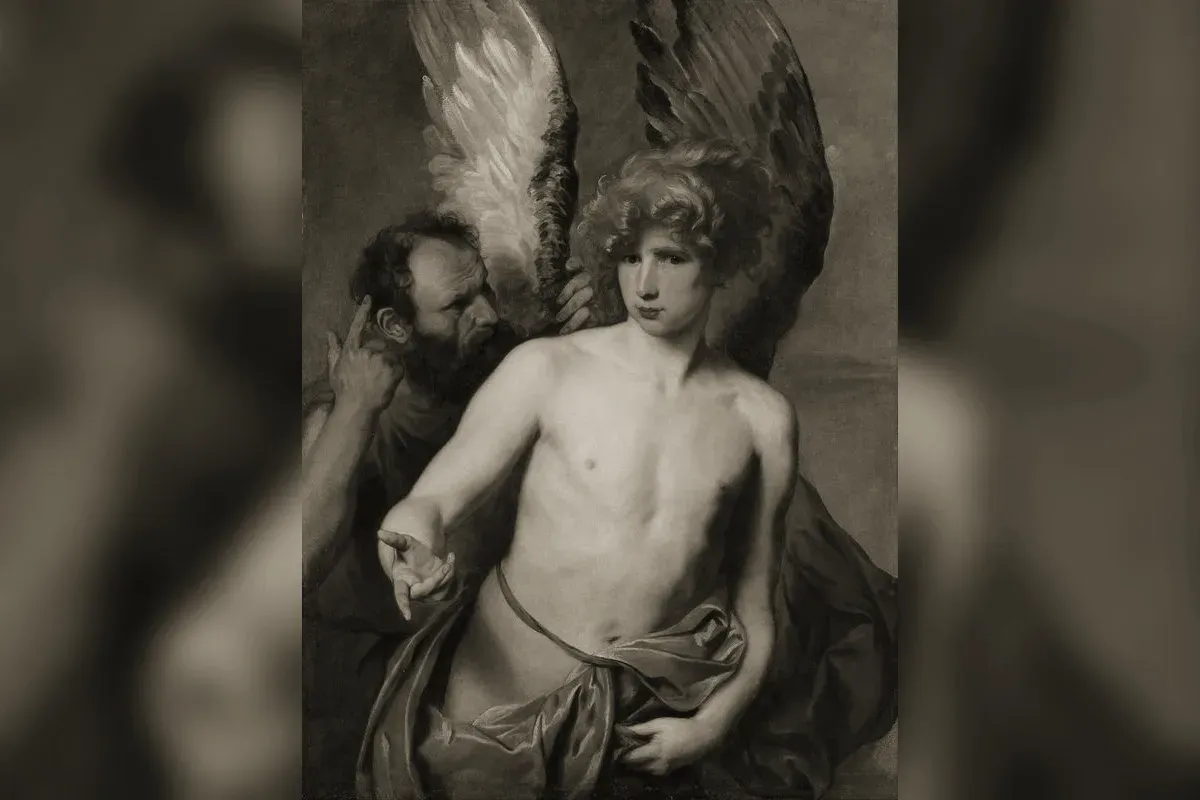
Icarus is the son of Daedalus who escapes Crete on wings his father built and drowns because he flew too high. The story is four hundred words long in Ovid and has outlasted almost every longer myth in the Greek repertoire.
Why they had to fly
Daedalus built the Labyrinth for Minos, then told Ariadne how Theseus could get out of it. Minos, discovering the betrayal, shut the architect and his son inside the building — or in a tower, depending on the source.
Escape by land or sea is impossible: Minos controls both. Ovid gives Daedalus the observation that decides everything — he may block the land and the sea, but the sky is open — and the flight becomes not a marvel but the only remaining exit.
He arranges feathers in ascending order of size, like the graduated pipes of a shepherd’s flute, binds the middle with thread and the base with wax, and curves the whole into the shape of a real wing.
The instruction
The warning Daedalus gives is a specific piece of engineering, not a proverb. Fly the middle course: too low and the sea spray will weigh down the feathers, too high and the sun will soften the wax.
Ovid describes the lesson with the boy getting in the way — Icarus playing with the feathers, thumbing the wax, not understanding that he is handling the thing his life depends on — and the father’s hands shaking as he fits the wings to his son’s shoulders and kisses him, knowing they will not do this twice.
Seen from below
The detail that has kept the story alive is not the fall but the witnesses.
Ovid puts an angler with a quivering rod, a shepherd leaning on his crook, and a ploughman at his handle, and has each of them look up, see two figures moving through the air, and conclude that they must be gods. Three men at work in the fields, briefly certain they are seeing something divine, while what is actually passing overhead is a fugitive craftsman and a boy who has ten minutes to live.
The boy begins to enjoy it, leaves his father’s track, and climbs. The wax softens. He beats bare arms, catches no air, and calls his father’s name until the water closes over it. Daedalus, calling back and getting nothing, looks down and sees feathers on the sea.
The names left behind
He recovers the body and buries it, and the sea becomes the Icarian Sea, the island the Icaria that still carries the name in the eastern Aegean. Pausanias records a variant in which it is Heracles, passing by, who finds and buries him — for which Daedalus later made him a statue.
The myth’s afterlife has mostly followed Ovid’s witnesses rather than his hero. Bruegel’s Landscape with the Fall of Icarus fills the canvas with the ploughman and puts two white legs disappearing into the water in a bottom corner, easy to miss. Auden built Musée des Beaux Arts on that painting: how everything turns away quite leisurely from the disaster, and the expensive delicate ship that had somewhere to get to sailed calmly on.
Ancient sources
- Ovid, Metamorphoses, 8.183-235
- Apollodorus, Epitome, 1.12-13
- Pausanias, Description of Greece, 9.11.4-5
- Diodorus Siculus, 4.77
- Diodorus Siculus, Library of History, Book 4
See also
Related entries
Frequently asked questions
Who saw Icarus fall?
Ovid puts three witnesses in the fields: an angler with a quivering rod, a shepherd leaning on his crook, and a ploughman at his handle. Each looks up, sees two figures moving through the air, and concludes they must be gods. Three men at work, briefly certain they are seeing something divine, while what is actually passing overhead is a fugitive craftsman and a boy with ten minutes to live.
Why is Bruegel's painting so often quoted?
Because it takes Ovid's witnesses rather than his hero as the subject. Landscape with the Fall of Icarus fills the canvas with the ploughman and puts two white legs disappearing into the water in a bottom corner, easy to miss entirely. Auden built Musée des Beaux Arts on that painting: how everything turns away quite leisurely from the disaster, and the expensive delicate ship sailed calmly on.