Greek mythology · Heroes & mortals
Pygmalion and Galatea: the sculptor who fell in love with his statue
In brief
Pygmalion is a sculptor of Cyprus who, repelled by the women around him, carves an ivory statue and falls in love with it; at Venus' festival he prays, and the statue warms to life under his kisses. The story comes from Ovid's Metamorphoses, Book 10; the name Galatea was only given to her in modern times.
- sculpture and ivory carving
- love for a crafted image
- devotion to Aphrodite (Venus) on Cyprus
- the ivory statue
- +2
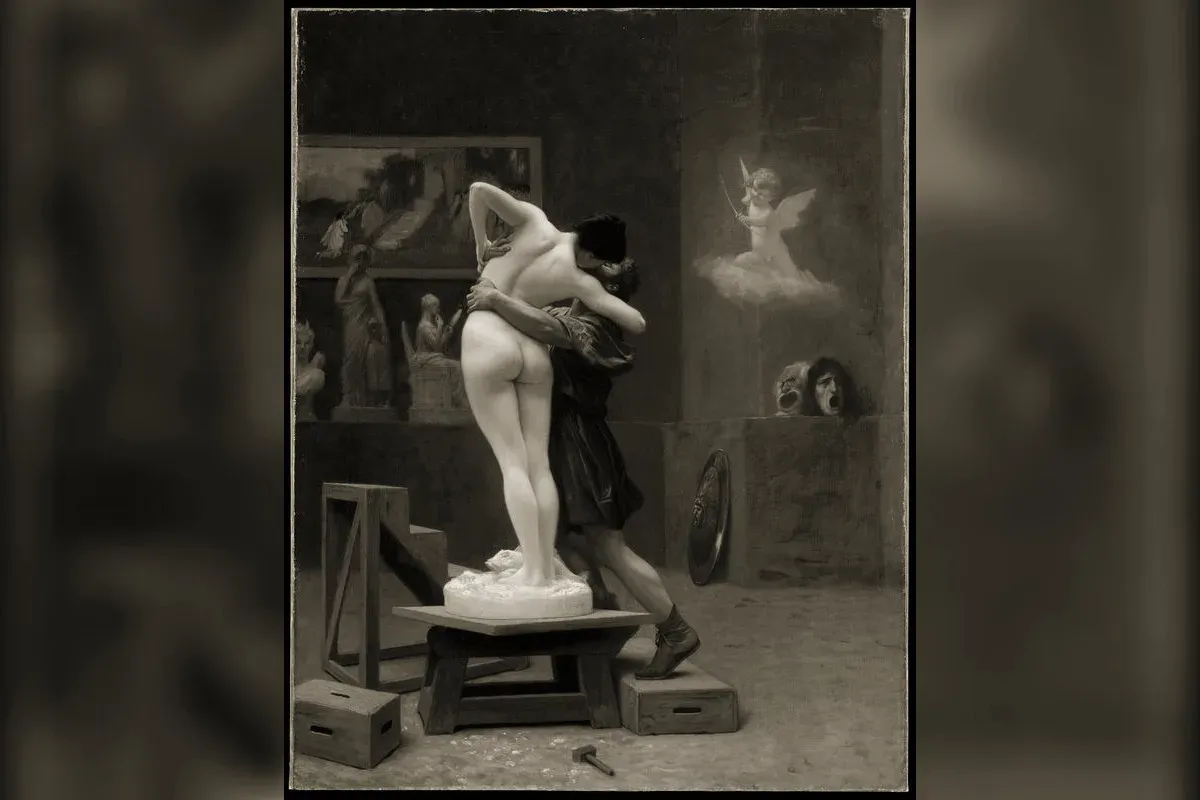
Pygmalion is the sculptor of Cyprus who falls in love with the ivory statue he has carved, until Aphrodite — Venus, in the Latin telling — turns it into a living woman. Almost everything people know about the Pygmalion myth comes from a single passage of Ovid’s Metamorphoses (10.243-297), where the story is sung by Orpheus. It is one of Ovid’s rare happy endings: an image becomes a body, and that body founds a royal line.
A sculptor who turned away from women
In Ovid, Pygmalion is not a king or a warrior but a Cypriot artist who lives “without a wife, unmarried”. The reason is spelled out. Just before his story, Orpheus tells of the Propoetides, women of Amathus who dared to deny that Venus was a goddess (10.238-242). In her anger she made them the first women to sell their bodies; and as their shame drained away and their blood hardened, they turned to flint. Disgusted by what he has seen — the “vices that nature gave in abundance to the female mind” — Pygmalion chooses to live alone.
The frame matters. Orpheus is singing after losing Eurydice for the second time, and he too has withdrawn from the love of women. He announces songs about boys loved by gods and girls punished for forbidden passions. Pygmalion, the man who retreats from the world to love a work of art, is in a sense the singer’s own reflection. For the background to that song, see the story of Orpheus and Eurydice.
The ivory maiden
Pygmalion carves, in “snow-white ivory”, a woman more beautiful than any woman born, and falls in love with what he has made. Ovid dwells on the illusion: art so well hides its art that the figure seems alive, held back from moving only by modesty.
What follows is close to comedy. Pygmalion runs his hands over the statue to check whether it is flesh, kisses it and imagines the kisses returned, worries he will bruise it when he holds it. He brings the presents girls like — shells, polished pebbles, little birds, flowers, lilies, painted balls, drops of amber wept by the Heliades’ trees. He dresses her, puts rings on her fingers and necklaces round her throat, lays her on coverlets dyed with Tyrian purple and calls her the companion of his bed.
Venus’ festival and the miracle
On the feast of Venus, the most celebrated in all Cyprus, heifers with gilded horns are sacrificed and incense smokes on the altars. Pygmalion makes his offering and prays, hesitantly: “If you gods can give anything, let my wife be…” — and, not daring to say “the ivory maiden”, he asks for one “like my ivory one”. Venus, attending her own festival, understands what he means: the altar flame flares up three times and leaps into the air.
Back home, he kisses the statue, and she seems warm. Under his fingers the ivory softens, the way wax from Mount Hymettus softens in the sun and yields to the thumb. He feels a pulse in her veins. She blushes at his kisses and, lifting her eyes shyly to the light, sees the sky and her lover at the same moment. The transformation reverses the Propoetides’ fate: there, women hardened into stone; here, hard material softens into a woman.
From a statue to Adonis: the line of Paphos
Venus attends the marriage she has made possible. When the moon has filled nine times, a child is born: Paphos, from whom, Ovid says, “the island takes its name” — really the city of Paphos, Aphrodite’s great sanctuary (10.297). In Ovid, Paphos is a daughter, and from her is born Cinyras (10.298-299).
Book 10 then unspools an increasingly dark family history. Cinyras is the father of Myrrha, who conceives an incestuous passion for him and is turned into the myrrh tree; from that union comes Adonis, whom Venus will love and lose (10.298-739). Pygmalion’s happy story is therefore the prelude to the tragedy that produces Aphrodite’s mortal lover: the goddess who answered the great-grandfather’s prayer will mourn the great-grandson.
Before Ovid: the king who loved a statue of Aphrodite
Ovid did not invent Pygmalion, but he reshaped him almost entirely. The earlier Greek tradition survives only in quotations by Christian writers attacking pagan images.
- Clement of Alexandria (Protrepticus, 4.57.3), citing the Hellenistic historian Philostephanus of Cyrene and his work on Cyprus, says that Pygmalion of Cyprus fell in love with an ivory statue of Aphrodite, a nude figure, and had intercourse with it.
- Arnobius (Against the Pagans, 6.22), drawing on the same source, makes Pygmalion a king of Cyprus who loved a statue of Venus as though it were a woman.
The differences are striking. For Philostephanus the statue is the goddess herself, and the tale is an example of sacrilegious desire for a cult image — a motif also found in Pliny the Elder’s young man who fell for Praxiteles’ Aphrodite of Cnidus (Natural History, 36.21). Nothing suggests the statue comes alive. Ovid turns the king into an artist, the idol into an ideal woman, and the transgression into rewarded piety.
Two traditions about Pygmalion’s children
Ancient authors give Pygmalion different descendants, and the two versions do not line up:
- in Ovid, Pygmalion is the father of Paphos, who is the mother of Cinyras;
- in Apollodorus (Library, 3.14.3), Cinyras comes to Cyprus from Cilicia, founds the city of Paphos himself, and marries Metharme, daughter of Pygmalion king of Cyprus; their children include Oxyporus and Adonis.
Either way, Pygmalion stands at the head of the dynasty of Cinyras and so of Adonis. But Apollodorus knows nothing of the statue and makes Pygmalion a plain Cypriot king — Cinyras’ father-in-law rather than his grandfather.
Not to be confused with Pygmalion of Tyre
A completely separate Pygmalion belongs to the legend of Carthage. In the Aeneid (1.346-364), Venus tells Aeneas that Dido fled Tyre because her brother Pygmalion, a cruel and greedy king, had murdered her husband Sychaeus at the altar. The shared, probably Phoenician, name ties both figures to the Levantine and Cypriot world, but no ancient text treats them as the same man.
Galatea: a modern name
The name Galatea, now inseparable from the statue, appears in no ancient source. It is a post-classical addition that spread in the eighteenth century, above all through Rousseau’s lyric scene Pygmalion. It echoes the sea nymph Galatea — whose name evokes milk (Greek gala) and so the whiteness of ivory — courted by the Cyclops Polyphemus in Book 13 of the Metamorphoses, an entirely different figure.
Readings and legacy
Pygmalion pairs naturally with Narcissus, whose story Ovid tells in Book 3: both fall in love with an image. Narcissus wastes away because he can never hold his reflection (see the myth of Narcissus); Pygmalion’s wish is granted because he honours Venus instead of scorning love.
The story also speaks to other ancient tales of artificial beings: Pandora, the first woman, shaped by Hephaestus on Zeus’ orders, and the statues of Daedalus, said to be so lifelike they could walk. Yet Pandora is a trap set for all mankind, while the ivory maiden is a gift to one man.
Modern culture recast the myth as a story about shaping another person. George Bernard Shaw’s Pygmalion (1913) has a phonetics professor remake a Cockney flower seller, and became the musical My Fair Lady. Victorian theatre had already staged W. S. Gilbert’s comedy Pygmalion and Galatea (1871), and in psychology the “Pygmalion effect” described by Rosenthal and Jacobson (1968) names the way expectations can shape performance.
What the ancient sources say
- Philostephanus of Cyrene (3rd century BCE), known through Clement of Alexandria and Arnobius: a Cypriot king in love with a statue of Aphrodite, with no transformation.
- Ovid, Metamorphoses, 10.238-297: the canonical story — the Propoetides, the ivory statue, Venus’ festival, the statue brought to life, the birth of Paphos.
- Ovid, Metamorphoses, 10.298-739: Pygmalion’s descendants down to Myrrha and Adonis.
- Apollodorus, Library, 3.14.3: Metharme, daughter of King Pygmalion, marries Cinyras.
- Virgil, Aeneid, 1.346-364: the Tyrian namesake, Dido’s brother.
Further reading
For the goddess who answers the sculptor’s prayer and rules at Paphos, read the page on Aphrodite, then on her son Eros. For the poet who sings the tale, see Orpheus and the story of Orpheus and Eurydice. For Ovid’s other great love of an image, read the myth of Narcissus; for the woman made by the gods, the myth of Pandora. For the wider cluster, return to the Greek mythology hub.
Ancient sources
- Ovid, Metamorphoses, 10.238-242 (the Propoetides)
- Ovid, Metamorphoses, 10.243-297 (Pygmalion and the statue)
- Ovid, Metamorphoses, 10.298-299 and 10.503-739 (Cinyras, Myrrha, Adonis)
- Philostephanus of Cyrene, Cypriaca, quoted in Clement of Alexandria, Protrepticus, 4.57.3
- Arnobius, Against the Pagans, 6.22
- Apollodorus, Library, 3.14.3
- Virgil, Aeneid, 1.346-364 (Pygmalion of Tyre, Dido's brother)
See also
Frequently asked questions
Is Galatea the statue's name in the original myth?
No. In Ovid the ivory woman is never named — she is simply 'the maiden' or 'the bride'. The name Galatea is post-classical and became standard in the eighteenth century, most famously through Jean-Jacques Rousseau's lyric scene Pygmalion (written 1762, staged 1770). She should not be confused with the sea nymph Galatea, loved by the Cyclops Polyphemus.
Why is the play My Fair Lady linked to Pygmalion?
My Fair Lady is the musical adaptation of George Bernard Shaw's comedy Pygmalion (1913), in which a phonetics professor, Henry Higgins, turns the flower seller Eliza Doolittle into a society lady. Shaw borrowed the myth's idea of a creator shaping his ideal — but gave his 'statue' a will of her own.
What is the Pygmalion effect?
A term from educational psychology, popularized by Robert Rosenthal and Lenore Jacobson in 1968: teachers' expectations of their pupils can influence how well those pupils perform. The label is a modern metaphor drawn from the myth — the sculptor 'brings to life' what he imagines — not an ancient idea.