Greek mythology · Mythical objects
The Thunderbolt of Zeus: divine weapon and symbol of supreme power
In brief
The Thunderbolt of Zeus in Greek mythology: forged by the Cyclopes, weapon of the Titanomachy, and the ultimate symbol of Zeus's supreme sovereignty over gods and mortals.
- triple or winged zigzag form according to iconography
- forged by the Cyclopes
- symbol of absolute sovereignty
- weapon of deadly precision
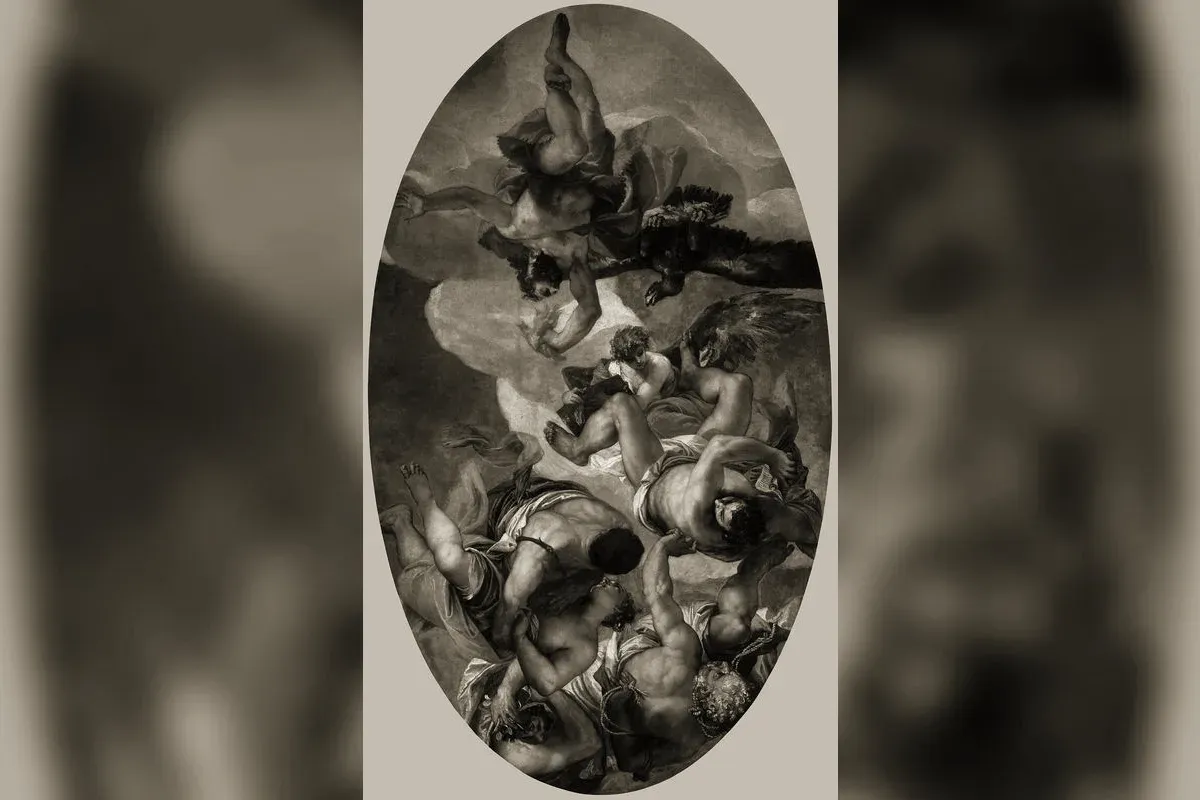
Of all the divine attributes in Greek mythology, none rivals the thunderbolt of Zeus in symbolic power. Known as the keraunos in Ancient Greek, it is far more than an iconographic emblem: it is the weapon that decided the war against the Titans, the instrument of divine justice, and the visible sign of the absolute sovereignty of the king of Olympus. To understand the thunderbolt of Zeus is to understand the very architecture of power in the Greek cosmos.
The keraunos: description and iconographic forms
In ancient sources, the thunderbolt of Zeus — the keraunos — is described alternately as a triple projectile and as a winged zigzag weapon evoking the lightning flash. Archaic iconography, particularly on black-figure vases of the sixth century BCE, often depicts it as a symmetrical torch with two flaming ends. From the Classical period onward, it takes the more familiar form of an elongated bundle of flames, sometimes fitted with wings that underscore its speed and celestial nature.
On Hellenistic coins and sculptures, Zeus invariably holds the thunderbolt in his right hand — the hand of action and authority. The eagle, his sacred animal, frequently accompanies the scene, symbolising the swiftness with which divine will descends upon the mortal world. Some ancient interpreters associated the three prongs of the keraunos with the three realms of the cosmos: sky, earth, and the underworld, making the thunderbolt a metaphor for Zeus’s universal dominion over the three spheres shared with his brothers Poseidon and Hades.
Forged by the Cyclopes: the origin of the weapon
The birth of the thunderbolt is inseparable from a foundational act of liberation. In Hesiod’s Theogony, the Cyclopes — Brontes (Thunder), Steropes (Lightning), and Arges (Brightness) — had been cast into Tartarus by their father Uranus, then kept in that abyss by Cronus. Zeus, after overthrowing his father, made the deliberate choice to free them. In gratitude, the Cyclopes placed their skill as cosmic smiths in the service of the new lord of the gods.
They presented him with the thunderbolt: a weapon without equal, capable of striking at a distance and igniting everything it touched. It is no coincidence that Hephaestus, the god of the divine forge, is also associated in certain later variants with the crafting or maintenance of the thunderbolt — in Greek mythology the forge is the one domain where the raw energy of cosmic fire can be tamed and given shape. The Cyclopes, beings of singular vision and prodigious strength, embody precisely this mastery of primordial fire that no ordinary human or divine hand could match.
The Titanomachy: the thunderbolt as decisive weapon
It was during the Titanomachy, the ten-year war between the Olympian gods and the Titans, that the thunderbolt first revealed its full power. Hesiod describes with striking intensity the moment Zeus unleashes his weapon:
“Zeus no longer held back his strength; his heart filled with vigour, and he released his full might. From the sky and from Olympus he struck without pause: lightning bolts flew from his mighty hand, thick with thunder and flame, spinning in a sacred torrent.”
The keraunos does not merely strike the bodies of the Titans: it sets the primordial chaos ablaze, boils the waters of Ocean, and shakes the Earth to its foundations. Zeus’s victory is not only military — it is the triumph of cosmic order over original chaos, and the thunderbolt is its instrument. After the Titans’ defeat, the vanquished are hurled into Tartarus, and Zeus now rules over a stabilised cosmos, with the thunderbolt as his sceptre of fire.
Instrument of divine justice: the famous punishments
Once sovereignty was established, the thunderbolt became the pre-eminent tool of divine justice — and of its excesses. Several mythological figures, mortal and divine alike, felt its force.
Prometheus was perhaps the most complex of its victims. The Titan had stolen fire from the gods to give it to mankind, openly defying Zeus’s authority. Though it is an eagle rather than the thunderbolt that tortures him eternally on his rock, it is Zeus who decrees that punishment — the stolen fire is turned against its thief in a perverse form. The thunderbolt remains here in the background, the constant threat behind the sentence. For the full story of his transgression and suffering, see the page on Prometheus.
Semele, mother of Dionysus, perished consumed by divine lightning. Deceived by a jealous Hera, she asked to see Zeus in his full divine glory. Zeus, bound by his oath, had no choice but to reveal himself — and the blaze of his thunderbolt reduced Semele to ashes. Yet Zeus saved the child she carried by sewing him into his own thigh, giving birth to Dionysus, the twice-born god.
Asclepius, god of medicine and son of Apollo, was struck down for daring to resurrect the dead. In crossing the boundary between the living and the dead, he encroached on divine prerogatives and threatened the natural order Zeus had instituted. The thunderbolt restored the cosmic boundary between mortals and immortals.
Phaethon, son of Helios the sun god, once took hold of the solar chariot and lost control. The horses bolted, the chariot swooped too low, scorching the earth and its peoples. Zeus was forced to intervene with his thunderbolt to bring down the reckless youth and avert universal catastrophe — a paradigmatic example of the thunderbolt as guardian of the cosmic order.
During the Gigantomachy — the war against the Giants — the thunderbolt of Zeus again played a decisive role, alongside the other Olympians and the hero Heracles, whose presence was required by prophecy to defeat the monsters born of Earth.
The thunderbolt and the Trojan War
During the Trojan War, the thunderbolt operates less as a direct weapon than as a sign of supreme authority. Zeus sends lightning flashes to ratify his decisions or warn gods who have overstepped. In the Iliad, he repeatedly threatens gods who engage in the conflict against his will with his thunderbolt or with being hurled from Olympus. This deterrent function may be the most revealing: Zeus need not strike; the mere invocation of the keraunos suffices to remind every god who holds absolute power.
Symbolic reach and parallels in other mythologies
The thunderbolt as the badge of the supreme deity is a near-universal motif. In Vedic India, Indra, king of the gods, wields the vajra — a thunderbolt also forged by a divine craftsman (Tvashtri) and used to slay the cosmic serpent Vritra. In Scandinavia, Thor wields Mjolnir, his thunder-hammer, to protect gods and humans against the giants of chaos — a role structurally parallel to Zeus’s in the Gigantomachy. Among the Slavs, Perun is the god of thunder and lightning, adversary of the chthonic serpent, guardian of celestial order. These parallels are not coincidental: they reflect a shared Proto-Indo-European heritage in which the sky god armed with the thunderbolt embodies divine sovereignty against the forces of chaos.
The thunderbolt as invisible sceptre
In the Greek representation of power, the sceptre (skêptron) gives material form to the authority of a king or god. Zeus possesses a classical sceptre, but his true mark of sovereignty is the thunderbolt. It is simultaneously weapon, royal insignia, and final verdict. When Zeus deliberates on Olympus, the other gods listen not merely out of admiration, but because behind every word looms the shadow of the keraunos. The thunderbolt transforms divine speech into cosmic law: it guarantees that the Olympian order is not a suggestion but a necessity inscribed in the very structure of the universe.
Further reading
To place the thunderbolt in the context of the founding Olympian victory, read the full account of the Titanomachy. To understand the figure who wields it, consult the page on Zeus. For the divine smith associated with the mastery of celestial fire, read the page on Hephaestus. For the most symbolically charged victim of the thunderbolt’s verdict — fire stolen and returned in full — see the page on Prometheus. For Semele’s death and the birth of the twice-born god who emerged from it, explore the page on Dionysus. For the wider role of the thunderbolt as instrument of royal deterrence, read about the Trojan War.
Ancient sources
- Hesiod, Theogony, lines 139-146, 501-506 and 687-712
- Homer, Iliad, 8
- Apollodorus, Library, 1.2.1 and 3.4.3
- Pindar, Olympian, 1
See also
Stories featuring this entity
Frequently asked questions
How did Zeus obtain the thunderbolt?
According to Hesiod's Theogony, the Cyclopes — Brontes (Thunder), Steropes (Lightning), and Arges (Brightness) — forged the thunderbolt for Zeus as a token of gratitude, after Zeus freed them from Tartarus where Cronus had imprisoned them. This decisive gift enabled Zeus to defeat the Titans in the Titanomachy.
Can the thunderbolt of Zeus strike gods as well?
Yes. Although the Olympians are immortal, Zeus's thunderbolt can wound or punish them. In the Iliad, Zeus reminds the gods that he could grab one by the foot and hurl him from Olympus with his thunderbolt. Hephaestus himself was cast from heaven — in one version by an angry Zeus. The thunderbolt symbolizes above all the threat of ultimate divine sanction.
Which mortals were struck by the thunderbolt of Zeus?
Among the most famous: Semele, mother of Dionysus, consumed when she asked to see Zeus in his full divine glory; Asclepius, god of medicine, struck down for resurrecting the dead and encroaching on divine prerogatives; Phaethon, son of Helios, blasted when he lost control of the sun chariot and threatened to burn the earth; and the Giants during the Gigantomachy.