Norse mythology · Gods & goddesses
Skadi, Norse giantess and goddess of skiing and the hunt
In brief
Skadi is a mountain giantess who became a goddess of the Aesir through a legal settlement. Demanding compensation for her father Thjazi, she is allowed to pick a husband among the gods while seeing only their feet, and lands on Njord instead of Baldr. A hunter on skis with a bow, she is also the one who fixes the dripping serpent above the bound Loki.
- skiing and snowshoes
- bow hunting
- mountains and winter
- vengeance and wergild
- +3
Who is Skadi?
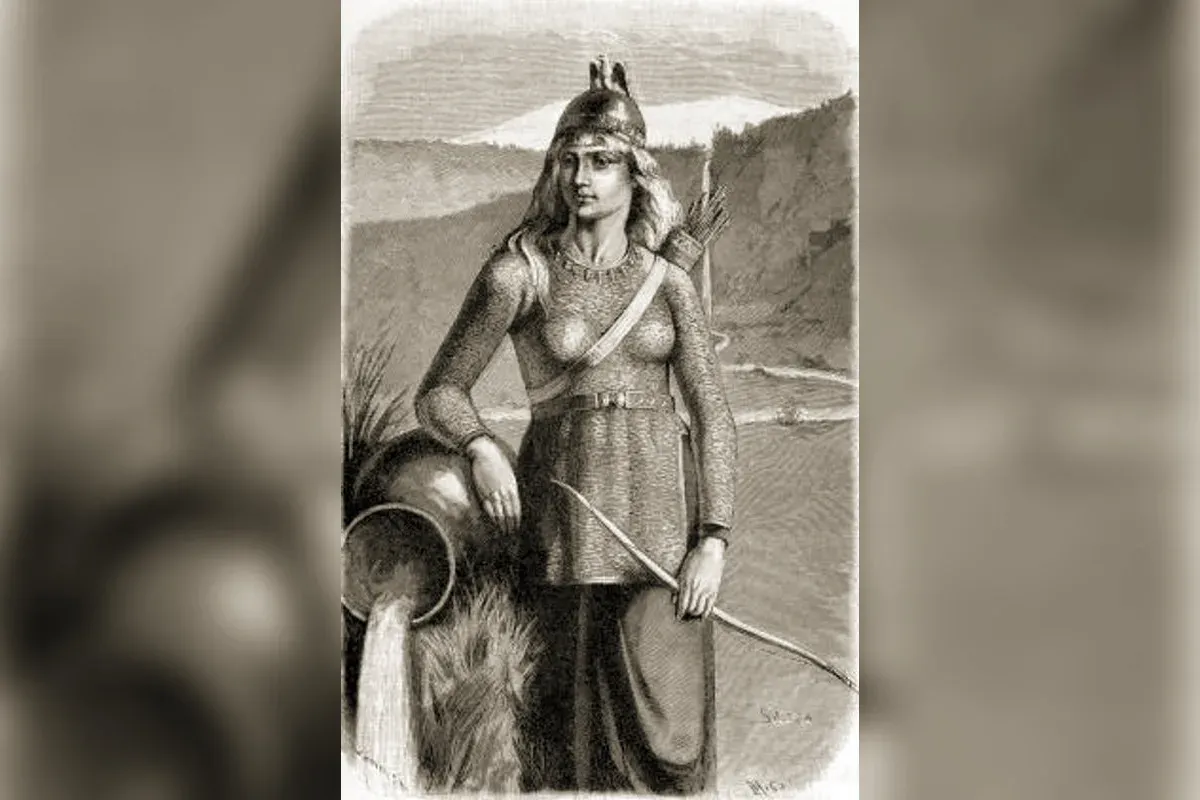
Skadi is a mountain giantess turned goddess, associated with skis, the bow and winter. Daughter of the jötunn Thjazi, she enters Norse mythology neither by divine birth nor by seduction but by a legal claim: she comes down on Asgard in armour to demand the wergild owed for her father, whom the gods have killed.
She is the only figure in the corpus who wins by negotiation what no giant wins by force — a place among the Aesir. And she is the one who, at the very end, carries out the cruellest part of Loki’s punishment.
The wergild for Thjazi
Her story begins inside someone else’s myth. The giant Thjazi, in eagle form, forced Loki to hand over Idunn and her apples of youth; when the gods get the goddess back, they set the walls of Asgard ablaze and the pursuing eagle’s wings catch fire. Thjazi falls and dies.
Skadi then takes up helmet, mail and weapons and comes alone to Asgard to avenge her father. The gods do not fight her. They offer a settlement — the Icelandic legal procedure for compounding a killing — on three terms:
- Skadi will choose a husband among the Aesir, but will see only their feet;
- the gods must make her laugh, which in her grief she believes impossible;
- Odin — or the Aesir collectively, depending on the passage — takes Thjazi’s eyes and throws them into the sky, where they become two stars.
That third clause is the forgotten part of the bargain and the most generous: the slain father is given a place in the heavens.
The choice of feet, and the laugh
Skadi walks down the line of gods and points to the finest pair of feet, convinced they must belong to Baldr, purest and brightest of the Aesir. They belong to Njord, god of sea and wealth — a Vanir, not even an Aesir by birth.
The laugh remains. Loki supplies it, by the crudest device in the whole Edda: he ties one end of a cord to a goat’s beard and the other to his own testicles, and pulls. Goat and god shriek in chorus until Loki collapses into Skadi’s lap. She laughs. The settlement is complete.
The scene is not mere slapstick. It shows Loki’s structural role exactly: he caused Thjazi’s death, he produces the laugh that extinguishes the feud, and he will be Skadi’s final target. The giantess’s entire arc runs through him.
Thrymheim against Noatun: a marriage that cannot work
The household of Skadi and Njord is one of the few places where Norse myth deals with a purely domestic problem — two beings who cannot love each other well because they cannot live in the same landscape.
They agree to alternate: nine nights at Thrymheim, the mountain hall inherited from Thjazi, then nine nights at Noatun, “ship-enclosure”, on the shore. Gylfaginning quotes both complaints in verse, and they answer each other precisely.
Njord says the mountains are hateful to him; after the song of swans the howling of wolves is unbearable. Skadi cannot sleep by the sea: the gull wakes her every morning as it comes in off the water.
They part. Skadi goes back up into the mountains, where Gylfaginning shows her crossing the snow on skis, bow in hand, hunting wild game. That picture is the source of her epithet öndurguð, “ski goddess” — one of very few Norse deities defined by a means of travel.
Vengeance on Loki
Skadi does not forgive. In Lokasenna, as Loki insults the gods one after another, it is she who makes the most specific threat: he will be bound to a rock with the entrails of his own son. Loki answers by reminding her that he was “first and last” in the attack that cost Thjazi his life.
The threat comes true. After the death of Baldr, the gods catch Loki and chain him in a cave with the guts of his son Narfi, turned to iron. Skadi performs the final act: she fixes a venomous serpent above the bound god’s face, and its poison drips without end. Loki’s wife Sigyn catches the venom in a bowl; each time she turns aside to empty it the drops strike his face, and his convulsions shake the earth.
The wergild had been accepted and the laugh had closed the case. But Skadi waits three myths to settle the account — and settles it with her own hands.
Variant: Skadi as Odin’s wife
Another tradition, preserved in Snorri’s Ynglinga saga, does not stop at the separation: after Njord, Skadi marries Odin and bears him many sons, among them Saeming, named as an ancestor of the kings of Norway. Snorri’s source here is the Háleygjatal, a genealogical poem composed in the late tenth century by the skald Eyvindr skáldaspillir for Earl Hákon of Hlaðir.
This is a different kind of text from the myth: dynastic genealogy, designed to hook a line of Norwegian earls onto divine ancestry. It is valuable all the same, because it proves Skadi was prestigious enough in the tenth-century North to serve as the root of a princely house — which sits badly with any image of her as a merely defeated giantess.
What the ancient sources say
The full account of the settlement, the laugh and the failed marriage comes from Snorri Sturluson’s Gylfaginning (23) and Skáldskaparmál (1-2), c. 1220; the latter ties the episode explicitly to the abduction of Idunn.
The Poetic Edda is terser and older. Grímnismál (11) places Thrymheim among the divine dwellings and notes that Skadi holds it after her father. Lokasenna (49-52) preserves the harshest exchange between her and Loki. Hárbarðsljóð mentions her in passing, a sign that she belonged to the common stock of knowledge.
Finally, Ynglinga saga and Háleygjatal keep the dynastic tradition that joins her to Odin. Between the armed giantess of the myth and the royal ancestress of the court poem stands the same figure, reworked for two different purposes: explaining a cosmic quarrel, then legitimising a human power.
Further reading
For the shoreline husband she picks without meaning to, read the page on Njord. For the goddess whose abduction brings about Thjazi’s death and the whole affair, see Idunn. For the god she laughs at and later condemns, consult Loki, and for the one she believed she was pointing at, Baldr. The story in which her vengeance is carried out is told in the death of Baldr, and the stronghold whose burning walls killed her father is described on the page for Asgard.
Ancient sources
- Snorri Sturluson, Prose Edda — Gylfaginning, 23 and 50
- Snorri Sturluson, Prose Edda — Skáldskaparmál, 1-2 (Thjazi's wergild)
- Poetic Edda — Grímnismál, 11 (Thrymheim)
- Poetic Edda — Lokasenna, 49-52
- Poetic Edda — Hárbarðsljóð, 19
- Snorri Sturluson, Ynglinga saga, 8
- Eyvindr skáldaspillir, Háleygjatal (late 10th century)
See also
Related entries
Stories featuring this entity
Frequently asked questions
Is Skadi a goddess or a giantess?
Both, and that is what makes her unusual. Skadi is born a giantess, daughter of the jötunn Thjazi, and keeps his mountain hall of Thrymheim. But by winning an Aesir husband as compensation for his killing she is counted among the goddesses of Asgard: Grímnismál lists her among the divine dwellers and skalds invoke her as a goddess. She is the clearest case in Norse myth of a giant absorbed into the pantheon without ever stopping being a giant.
Why did Skadi choose her husband by his feet?
It was a condition the gods imposed in the settlement: she could pick a husband among them, but would see nothing of them except their feet. Skadi chose the finest pair, certain they belonged to Baldr, the most radiant of the Aesir. They turned out to be Njord's, the sea god's — clean and well kept by salt water, as commentators have often pointed out.
Why did Skadi and Njord separate?
Because neither could live in the other's country. They agreed to spend nine nights at Thrymheim in the mountains, then another nine at Noatun by the shore. Njord could not bear the howling of wolves after the song of swans; Skadi could not sleep for the screeching of gulls at dawn. They parted, and Skadi went back to hunt on skis in her father's mountains.