Egyptian mythology · Creatures
Apis, the living bull of Memphis and herald of Ptah
In brief
Apis is a living bull, recognised by his markings and worshipped at Memphis as the herald of the god Ptah. He is neither statue nor symbol but a real animal, one at a time, mummified at death and buried in the galleries of the Serapeum at Saqqara. As Osiris-Apis he became the direct ancestor of the Graeco-Egyptian god Serapis.
What is Apis?
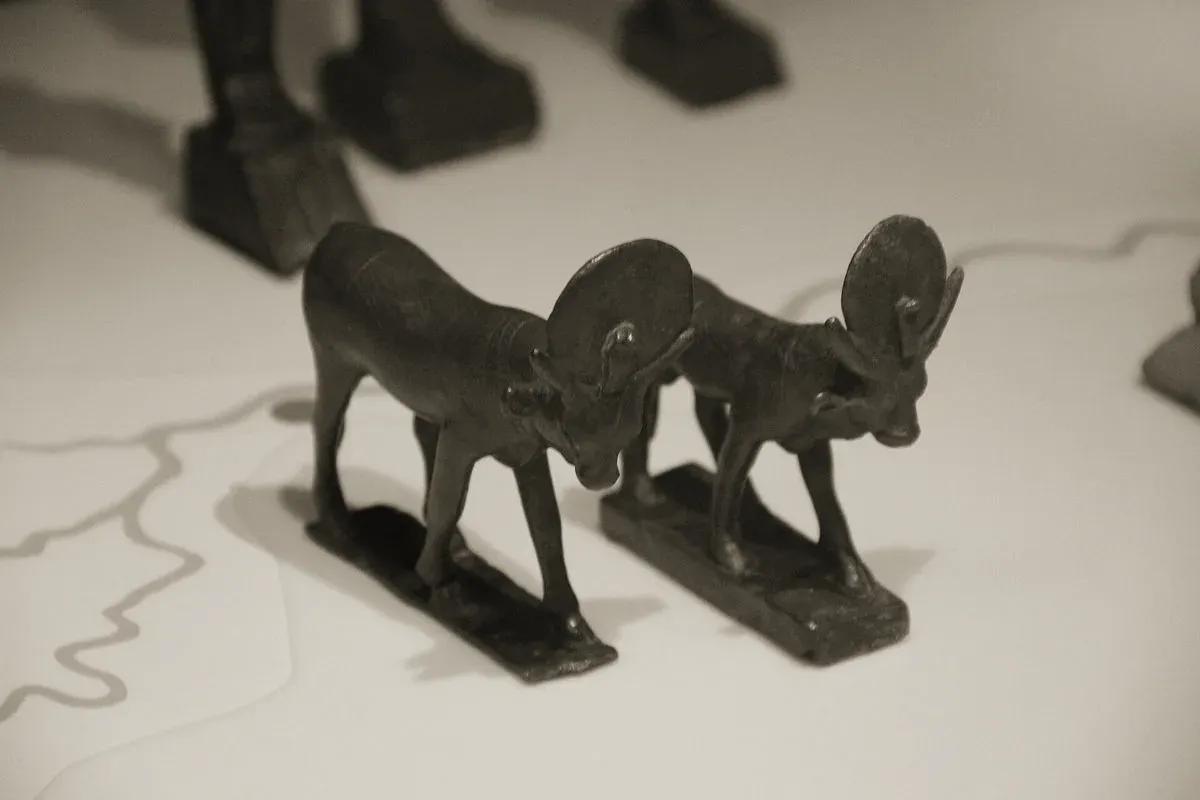
Apis is a living bull, worshipped at Memphis as the herald of the creator god Ptah. He is neither a mythical figure nor a statue: he is an actual animal, unique in each generation, recognised by his markings, housed inside the temple precinct, cared for by dedicated staff, and mummified at death with royal honours.
That physical reality makes him a special case in the Egyptian pantheon. Most gods manifest through an image the ritual brings to life; Apis breathes. When he dies the god does not disappear — the next bull simply has to be found.
The body a god appears in
The animal’s official title says it plainly: “the living Apis, herald of Ptah”. The Egyptian word rendered here as herald denotes the one who announces, who carries a master’s word. Apis is therefore not Ptah but his mouthpiece — the mobile, visible part of a god whose statue stays shut inside its shrine.
That function makes him an oracle. Classical authors describe how his movements were read: which chamber he chose to enter, whether he accepted or refused food from a visitor’s hand. Pliny the Elder reports that a refusal counted as an evil omen. A god who moves under his own power gives divination material no statue can supply.
The cult is old. The Palermo Stone, royal annals carved in the Old Kingdom but covering earlier dynasties, already records the “running of Apis”, a ceremony in which the bull crossed a ritual space: the rite predates most surviving religious texts.
A birth, not an election
The principle of selection matters. A new Apis is not appointed by a college of priests; he is recognised by a set of markings present from birth.
Herodotus, in book III of the Histories, gives the most famous list: a black calf with a white square on its forehead, the outline of an eagle on its back, double hairs in the tail and a scarab beneath the tongue. Other authors and the Egyptian sources vary in detail, but the logic never changes — the divinity announces itself, and people merely read the signs.
His mother is part of the system. Plutarch reports the belief that the cow conceived by a beam of moonlight rather than by a bull; she in turn became an object of cult, assimilated to Isis. Archaeologists found at Saqqara a separate catacomb reserved for the mothers of Apis, proof that this theology of conception had a material — and expensive — translation.
Dying as Osiris
At death the bull changes name. He becomes Osiris-Apis — Osorapis in later pronunciation — and receives funerary treatment of the highest rank: a long embalming, performed on calcite mummification beds, several of which survive, followed by procession and public mourning.
He is then buried in the Serapeum at Saqqara, a complex of galleries cut into the limestone, where dozens of granite sarcophagi weighing many tonnes apiece have been cleared. Around the burials, hundreds of votive stelae left by private individuals date each interment by reign and regnal year: incidentally, the Serapeum provides Egyptology with one of its best chronological anchors for the Late Period.
The site lay buried until 1851, when Auguste Mariette, following a passage in Strabo that mentions an avenue of sphinxes drowned in sand, uncovered the entrance. The excavation is among the most spectacular of the nineteenth century.
What the ancient sources say
Apis is one of the rare subjects where Greek accounts and Egyptian documents contradict each other head-on, which makes him an instructive case.
Herodotus relates (III, 27-29) that Cambyses, the Persian conqueror of Egypt, stabbed the bull in the thigh out of contempt for local religion, killing it and drawing madness upon himself. The story fits the portrait of an impious ruler the historian builds across the whole book.
The Serapeum documents complicate that account. An Apis that had lived through the conquest was buried during Cambyses’ reign, and a monument made in the king’s name shows him honouring the bull. This does not settle every detail of Herodotus’ story, but it conflicts with his chronology and with his unqualified portrait of a ruler hostile to the cult.
The same caution applies to the bull’s lifespan. Pliny the Elder states that he was ritually drowned once a fixed number of years had passed. The Serapeum stelae record bulls dying at different ages, but that evidence alone neither documents nor conclusively disproves such a maximum-age rule.
From the stall to the Mediterranean: the making of Serapis
It was the dead Apis, not the living one, who stood behind one of the most widespread gods of the Hellenistic Mediterranean. Under the early Ptolemies, the cult of Osiris-Apis was promoted at Alexandria as that of Serapis. His familiar image — a bearded enthroned man wearing a kalathos, sometimes accompanied by Cerberus — draws heavily on Greek iconography, while the god’s name and funerary roots point back to Egyptian Osiris-Apis.
The Alexandrian form made Serapis intelligible within both Greek and Egyptian religious settings, although the precise process by which his cult and image developed remains debated. His Alexandrian sanctuary became one of the most famous in the ancient world. Behind that international career stood the much older funerary cult of the Apis bulls of Memphis.
Further reading
For the god whose herald he is, read the page on Ptah. For the deity he becomes after death, see Osiris and the Osiris myth. For the goddess his mother is assimilated to, see Isis. For the Memphite funerary domain in which he is buried, read Sokar and the Duat, and for the great god of embalming, Anubis.
Ancient sources
- Palermo Stone (mention of the 'running of Apis')
- Herodotus, Histories, III, 27-29
- Strabo, Geography, XVII, 1
- Pliny the Elder, Natural History, VIII
- Plutarch, On Isis and Osiris
- Votive stelae and sarcophagi of the Serapeum at Saqqara
See also
Stories featuring this entity
Frequently asked questions
Was Apis a god or an animal?
Both at once, which is what makes him unusual. Apis is a real bull, born of a cow, housed and fed at Memphis, ageing and dying like any other bovine; yet he is held to be the living herald of Ptah, the body through which the god becomes visible. Egypt is not worshipping an image of a god here: it is worshipping one specific animal, one at a time, identified at birth.
How was a new Apis identified?
By markings on his hide. Herodotus describes a black calf with a white square on the forehead, the shape of an eagle on the back, double hairs in the tail and a scarab under the tongue. Egyptian lists vary in the details, but the principle holds: the bull is not chosen by priests, he is recognised from signs he already carries, which rules out arbitrary appointment.
Did Cambyses really kill the Apis bull?
Herodotus says he stabbed it in the thigh out of contempt for Egyptian religion, and that madness followed. The Serapeum tells another story: an Apis was buried during the Persian king's reign with full honours and with his titles on the monument. The Greek account fits the portrait of an impious tyrant that Herodotus is building; the Egyptian evidence does not support it.