Egyptian mythology · Gods & goddesses
Sokar, falcon god of the Memphite necropolis and Rosetau
In brief
Sokar is the funerary god of Memphis, a mummiform falcon who rules Rosetau, the underground domain of the necropolis. His festival in the month of Khoiak, when the *henu* barque was dragged on a sledge, is one of the oldest in Egypt, and his fusion with Ptah and then Osiris produced the most widespread funerary figure of the Late Period.
- necropolis and underground domain
- Rosetau, the passage into the beyond
- workshops and funerary metalwork
- regeneration of the dead
- +4
Who is Sokar?
Sokar is the funerary god of Memphis, shown as a mummiform man with a falcon’s head, master of the underground domain the texts call Rosetau. He weighs no hearts and presides over no tribunal: his competence is a place, the strip of desert, sand and galleries where the city of Ptah buries its dead and makes their equipment.
He is among the oldest attested gods of Egypt, and his festival among the most durable. His gradual fusion with Ptah and then with Osiris produced, by the Late Period, the most frequently reproduced funerary figure in the country.
A falcon that does not fly
Sokar’s iconography is a deliberate paradox. He wears the head of the falcon, the bird of sky and daylight, normally the animal of Horus and of solar kingship. His body, however, is entirely wrapped in bandages like a mummy: Sokar’s falcon is a bird held still.
The image states his position exactly. Sokar belongs to the world below, yet keeps there the power of what can rise. That is why texts give him the epithet of “the great god with outspread wings” even though no representation shows him in flight.
Rosetau, the passage
The name Rosetau — literally the mouth of the corridors or passages — first designates the Memphite necropolis around Giza and Saqqara, and then, by extension, the gateway of the underworld itself. Sokar is its “lord”.
The Book of Two Ways, the map of the beyond painted on the floors of Middle Kingdom coffins, places Rosetau on the dead man’s route and describes it as an alarming sector, ringed with fire, where passage is not guaranteed. Sokar’s domain is not a place to settle in, as the Field of Reeds is: it is a dangerous corridor to be crossed, the part of the Duat where one can get stuck.
The fourth and fifth hours of the night
The Book of Amduat, carved in the royal tombs of the Valley of the Kings, describes the sun’s night journey hour by hour. Two hours belong to Sokar, and they break the rhythm of the book.
At the fourth hour the water disappears. The solar barque reaches a region of sand where it can no longer float: the texts show it turned into a serpent and hauled along slanting corridors closed by doors. At the fifth hour the heart of the domain is reached — a dark oval cavern, capped by a mound of sand, in which falcon-headed Sokar grasps the wings of a serpent. Above the mound a scarab reaches towards the summit; below it lies the lake of fire.
This is the hardest passage of the night, and it is not decoration: it states that regeneration requires crossing a place where movement stops. Even the sun has to be towed.
The Sokar festival and the henu barque
Sokar owns a cult object unique in Egypt: the henu barque, a boat with a raised prow ending in an antelope head, mounted not on water but on a sledge.
At the god’s great festival, celebrated in the month of Khoiak, this barque was dragged in procession around the walls of the sanctuary. The calendars and reliefs of Medinet Habu preserve the sequence under Ramesses III: the procession, participants wearing strings of onions round their necks, the crowds. The feast fell a few days before the raising of the djed pillar that closed the month, so that the mysteries of Sokar and those of Osiris ended up forming a single ritual sequence: first the burial, then the raising.
It is one of the best-attested celebrations in Egyptian history, mentioned as early as the Old Kingdom and still alive in Graeco-Roman times.
Ptah-Sokar-Osiris: three gods, one statuette
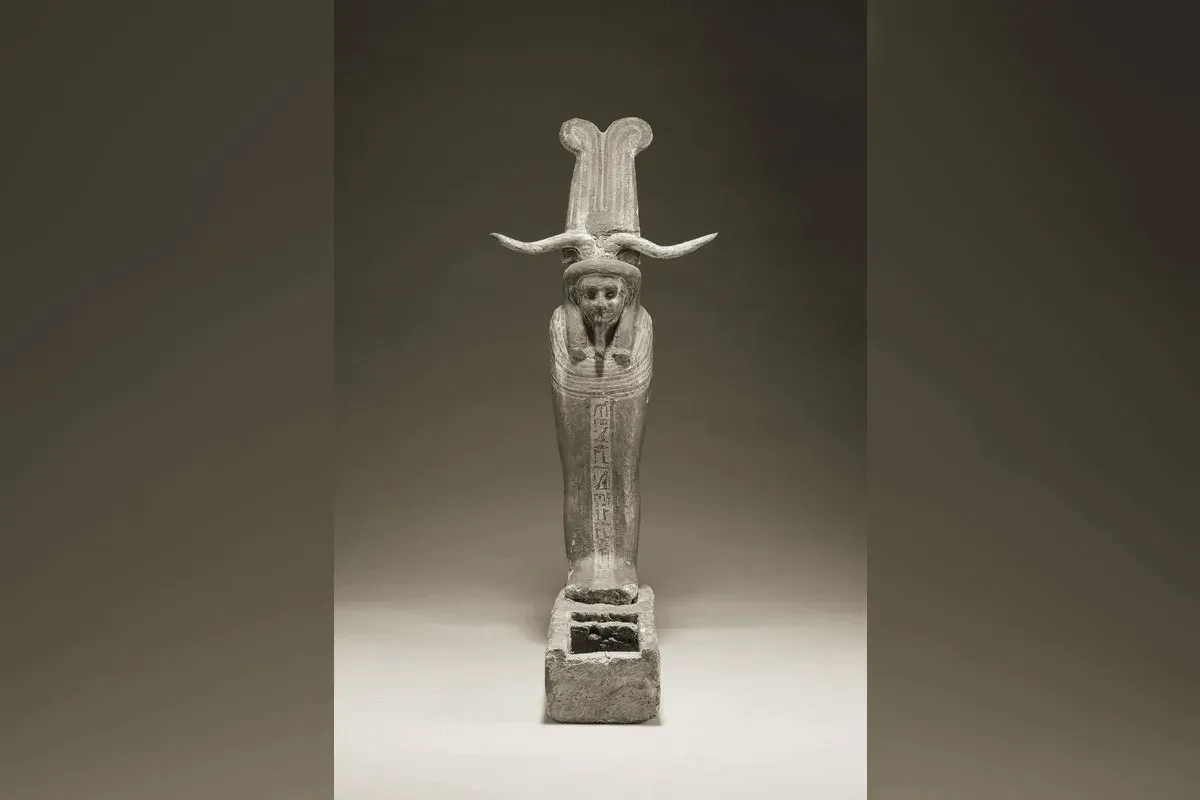
The proximity of the Memphite cults produced an early Ptah-Sokar: the craftsman creator and the master of the underground workshops share both a territory and a technical competence. Once Osiris had established himself as the great god of the dead, the fusion widened into Ptah-Sokar-Osiris.
The composite is no theologian’s abstraction: it has an object. Late Period tombs contain painted wooden statuettes by the thousand, a mummiform figure standing on a base, frequently hollowed out to hold a papyrus roll or a grain figurine. In a single item the owner gets the god who conceives, the god who guards the necropolis, and the god who rises again.
A god defined without a genealogy
The oldest sources do not define Sokar through a stable father, mother, wife or child. Later local traditions could associate him with other deities, but no single family structure became central to his identity. He was integrated into the wider system above all through syncretism, joined to Ptah and then to Osiris rather than through a canonical descent.
This emphasis follows from what he is. Sokar is less a narrative character than a local function, defined by a competence and a territory. Anubis is close to him in funerary role, although the two gods developed differently.
Sokar and Saqqara
It is often stated that the name Saqqara, the great necropolis of Memphis, derives from Sokar. The connection is attractive and remains possible, but it is not demonstrated: other proposals trace the place name to a local tribe, the Beni Saqqar. It is better presented as a widespread hypothesis than as an established fact.
What is certain is that god and place never parted. From the First Dynasty to the Ptolemies, the same belt of desert carried the workshops, the galleries and the processions of which Sokar was master.
Further reading
For the Memphite creator he merges with first, read the page on Ptah, and for the third term of the composite, Osiris together with the Osiris myth. For the territory he governs, see the Duat, and for the destination one hopes to reach after crossing it, the Field of Reeds. For the other great god of the embalmers, see Anubis, and for the ordeal that decides the fate of the dead, the judgment of the dead.
Ancient sources
- Pyramid Texts
- Coffin Texts (Book of Two Ways, Rosetau)
- Book of Amduat, fourth and fifth hours
- Festival calendars of Medinet Habu (festival of Sokar)
- Late Period Ptah-Sokar-Osiris figures
See also
Stories featuring this entity
Comparisons
Frequently asked questions
What is Sokar the god of?
Sokar is the god of the Memphite necropolis and of the underground domain called Rosetau. He does not judge the dead or rule them as Osiris does: his competence is a place, the belt of sand, shadow and galleries where the city of Ptah buries its dead and manufactures their equipment. He is a threshold god, patron of workshops as much as keeper of caverns.
What is the henu barque?
It is Sokar's own cult object: a boat with a raised prow ending in an antelope head, set not on water but on a sledge. At the Sokar festival in the month of Khoiak it was dragged in procession around the sanctuary walls. A boat that rolls over sand instead of floating states the nature of the god's domain by itself — this is navigation underground.
Why are so many mummies buried with a Ptah-Sokar-Osiris figure?
Because the composite covers the entire funerary cycle in a single object. Ptah conceives, Sokar guards the necropolis and its workshops, Osiris raises the dead. The painted wooden statuettes, produced in vast numbers in the Late Period, often have a cavity holding a papyrus roll or a grain figurine, so the owner was buried with creation, burial and resurrection stacked into one image.