Egyptian mythology · Gods & goddesses
Khnum, the ram god who shapes humans on his potter's wheel
In brief
Khnum is the ram-headed god of Elephantine, at Egypt's southern border. He shapes each child's body and its ka on a potter's wheel, and he releases the Nile flood from the caverns of the First Cataract. His triad pairs him with Satis and their daughter Anuket.
- modelling of bodies and of the ka
- Nile inundation and the waters of the cataract
- fertility and childbirth
- craftsman's creation of living beings
- +4
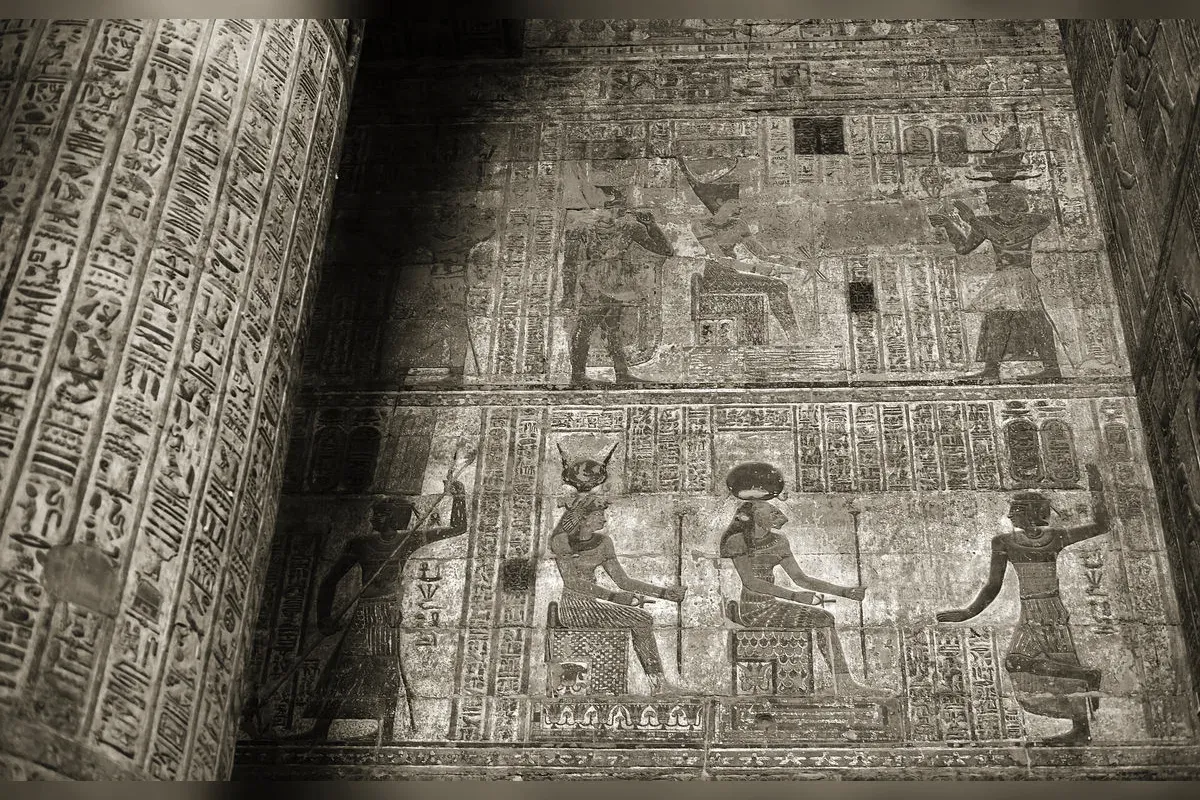
Who is Khnum?
Khnum is the ram-headed god of Elephantine, the island that marks Egypt’s southern frontier at the First Cataract. Two functions define him, and they answer each other: he models living beings on a potter’s wheel, and he commands the Nile inundation. Making a body, raising a river — both are a matter of fitting matter and water together to produce life. Where Ptah creates by thinking and naming, Khnum creates with his hands.
The potter who makes children
The image of Khnum at the wheel is among the most concrete in Egyptian religion. The god sits before his turning disc; on it stand two identical small figures, the child to be born and its ka, the vital force that doubles it and will outlive it. He does not merely grant life, he manufactures in series — every birth passes through his workshop.
The best preserved scene belongs to the divine birth cycle of Hatshepsut, carved at Deir el-Bahari: Khnum turns the future queen and her ka while the frog goddess Heqet, patron of childbirth, holds out the ankh sign of life to them. The same programme was repeated at Luxor temple for Amenhotep III. The point is political as much as theological: if the god shaped the sovereign with his own hands, that sovereign’s legitimacy is no longer arguable.
Texts push the image down to anatomy. The great hymns carved at Esna list what Khnum formed: skin stretched over bone, blood circulating in the vessels, breath in the airways, the spine that holds the whole together. What we read there is a theology of creation that doubles, in its way, as a treatise on the body.
Master of the inundation
Egypt depends on an annual flood, and that flood arrives from the south. The place where it is seen first is the First Cataract at Aswan — which is to say, Khnum’s home. Theology follows geography: the god is said to guard the caverns from which the water issues, beneath the rocks of the island of Bigeh, and to hold the bolts that release it at the right moment.
For this reason Elephantine housed a nilometer, a graduated stair cut into the bank that allowed the rising water to be measured, harvests to be forecast and taxes to be assessed. Sanctuary and measuring instrument shared one island: the cult of Khnum was also an administration.
The same stretch of river held, on neighbouring Bigeh, the Abaton, one of the claimed tombs of Osiris, and at Philae the great temple of Isis. Egypt’s southern border thus concentrated, within a few hundred metres, the source of the water and the grave of the dead god.
The triad of Elephantine
At Elephantine Khnum forms a family of three. His wife is Satis, goddess of the cataract, crowned with the white crown flanked by antelope horns, who personifies the surge of the waters; their daughter is Anuket, recognisable by her tall plumed crown, mistress of the Nubian stretch downstream.
The set reads as divinised geography: the god who holds the water back, the goddess who launches it, the one who escorts it northward. As with Ptah’s Memphite triad, the divine family here articulates functions rather than telling a story — Egyptian mythology often prefers structure to narrative.
At Esna, in Upper Egypt, Khnum takes another configuration. There he rules as Khnum-Ra, a solar creator, alongside Neith, herself a creator in that temple’s texts. The building juxtaposes two complete cosmogonies, one by the potter’s wheel and one by the speech of a goddess risen from Nun — and feels no need to choose between them.
The Famine Stela: seven years without a flood
On a boulder on Sehel Island near Aswan, a Ptolemaic inscription stages an event set two millennia earlier, under King Djoser. The text is written in the royal first person.
For seven years running, the flood failed. Granaries stand empty, neighbours rob one another, children weep, old men sit on the ground. The king questions his minister Imhotep — the architect of the step pyramid, whom later tradition made a son of Ptah — about the origin of the river. Imhotep consults the sacred archives and reports that the inundation issues from two caverns at Elephantine, under Khnum’s authority. The king goes to the temple, sleeps there, and the god appears to him in a dream promising the waters’ return. Djoser then issues a decree: the revenues of the whole cataract region will henceforth go to Khnum’s estate.
The ending gives the game away. The stela is not a historical memory but a title deed, drafted by the priesthood of Elephantine and propped up by a royal decree supposedly two thousand years old. The device is the same as on the Shabaka Stone, where the Memphite clergy backdated its theology — in Egypt, a text’s presumed antiquity was the strongest argument available.
The priests of Khnum and the Judean temple of Elephantine
Elephantine has yielded one of the most striking dossiers in ancient religious history. A garrison of Judean mercenaries, stationed on the island in the service of the Persian kings, maintained a temple to Yahu a few paces from the sanctuary of Khnum.
The Aramaic papyri found on the site tell what followed. In 410 BC, taking advantage of the satrap’s absence, the priests of Khnum came to an understanding with the Persian commander Vidranga to have the Judean temple razed: doors burnt, stone columns thrown down, vessels of gold and silver carried off. Three years later a certain Yedaniah, head of the community, wrote to Bagohi, governor of Judah, asking permission to rebuild — and it is that petition that has come down to us.
Historians still debate the cause of the quarrel. The most commonly proposed explanation invokes the Passover sacrifice of a lamb, hard to tolerate beside the sanctuary of a ram god; others see an ordinary dispute over land aggravated by Persian politics. Either way the file offers something rare: a neighbourhood conflict between two ancient cults, documented by the plaintiffs themselves.
What the ancient sources say
Khnum appears as early as the Pyramid Texts, where he figures as a god of the southern frontier. His stature as a universal creator develops mainly in the New Kingdom and then expands in the Greco-Roman period: the walls of the temple of Esna, published in the twentieth century, preserve hymns that make him the craftsman of every creature, animals and foreign peoples included, each modelled to its own form.
The divine birth cycle at Deir el-Bahari supplies the standard iconography, and the Famine Stela the great narrative. The Aramaic papyri of Elephantine, finally, illuminate the cult from an unusual angle: administrative conflict. There an Egyptian priesthood acts not as a mythological entity but as a local power, with its own interests and alliances.
Further reading
For the pantheon’s other great craftsman creator, compare the page on Ptah. For the goddess who shares the temple of Esna with him, read Neith. For the Theban ram god with whom he is often confused, see Amun. For the Heliopolitan account that the cosmogonies of Esna and Elephantine answer, read the Egyptian creation myth and the comparison of creation myths. For the other god of the Nile waters, see Sobek.
Ancient sources
- Pyramid Texts
- Divine birth cycle of Hatshepsut, Deir el-Bahari
- Famine Stela, Sehel Island
- Hymns to Khnum, temple of Esna
- Aramaic papyri of Elephantine (petition of Yedaniah, 407 BC)
See also
Stories featuring this entity
Frequently asked questions
What is Khnum the god of?
Khnum is the god who manufactures bodies. Egyptians show him seated at a potter's wheel, raising the unborn child on it and, on the same wheel, its ka — the share of vital force that will accompany it into the afterlife. He is also lord of the inundation: from Elephantine, at the First Cataract, he releases or withholds the water that keeps the country alive.
Why does Khnum have a ram's head?
The ram was an animal of generative power in Egypt, and Khnum wears the head of the oldest breed, with long horizontal wavy horns, distinct from the curled-horn ram of Amun. A phonetic closeness between the word for ram and the word for the ba, one component of the person, reinforced the link: the ram of the cataract was also read as the ba of the great gods.
What is the Famine Stela?
It is an inscription carved on a boulder on Sehel Island near Aswan in the Ptolemaic period, but staged two thousand years earlier under King Djoser. The text recounts seven years of failed inundation, Imhotep's inquiry into the river's source, Khnum's appearance to the king in a dream, and the grant of the cataract region's revenues to the temple of Elephantine. It is priestly propaganda dressed as a royal archive.