Egyptian mythology · Gods & goddesses
Wadjet, cobra goddess of Buto and uraeus of the pharaoh
In brief
Wadjet is the cobra goddess of Buto in the Delta and the patron of Lower Egypt. She is the one who rears on the pharaoh's brow as the uraeus and spits fire at his enemies. With the vulture goddess Nekhbet she forms the Two Ladies, whose joint name makes up one of the five titles of the royal titulary.
- protection of the king
- sovereignty over Lower Egypt
- defensive fire and venom
- protection of the infant Horus
- +4
Who is Wadjet?
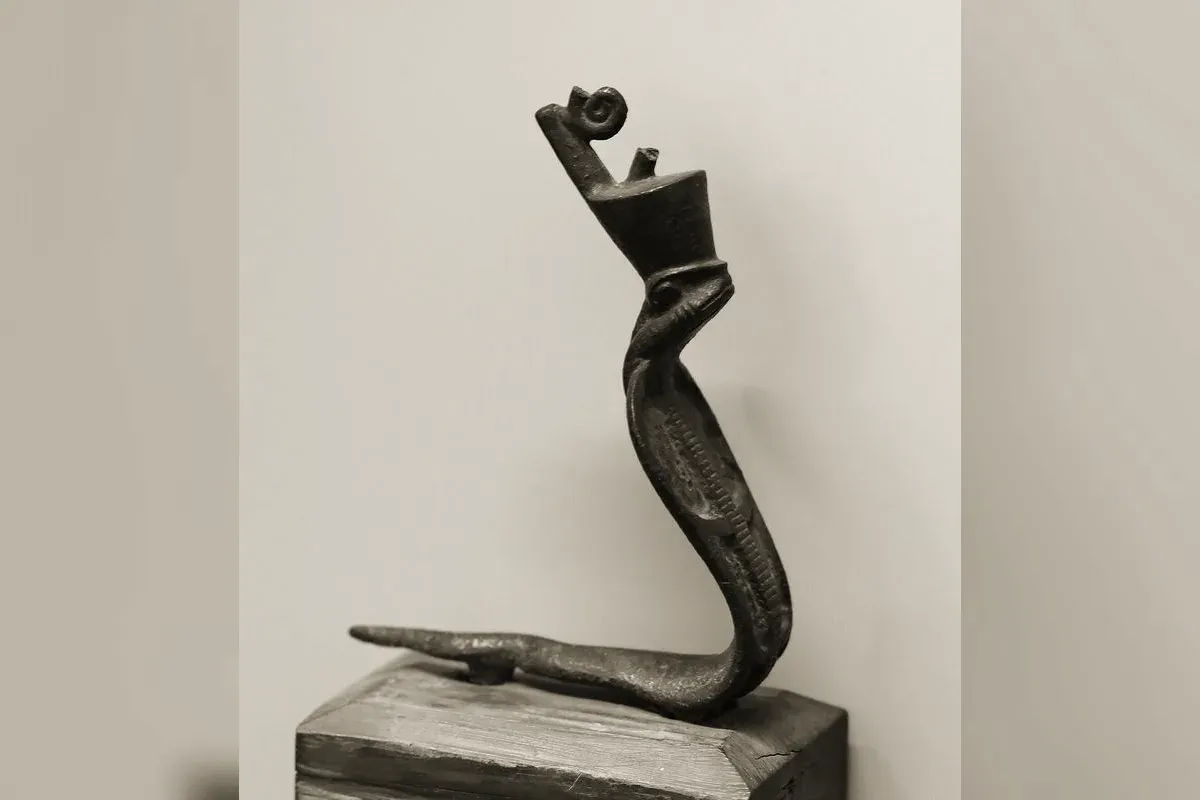
Wadjet is the cobra goddess of the Delta, mistress of the city of Buto and the appointed protector of Lower Egypt. She is the figure rearing on the pharaoh’s brow as the uraeus, ready to spit fire at whoever comes near. With the vulture goddess Nekhbet, patron of Upper Egypt, she forms the Two Ladies whose joint name makes up one of the king’s five official titles.
Her name, wȝḏyt, means “the green one”: the colour of papyrus, the emblematic plant of the northern marshes. Wadjet is, quite literally, the goddess of the green country — and the serpent that lives in it.
Buto, Pe and Dep
Wadjet’s sanctuary is Per-Wadjet, “the house of Wadjet”, which the Greeks called Buto and which archaeology identifies with Tell el-Farain, in the north-western Delta. The site in fact joins two twin settlements, Pe and Dep, each with its own shrine.
Those names matter well beyond local geography. The Pyramid Texts invoke the “Souls of Pe”, mythical royal ancestors of Lower Egypt, called upon in coronation and funerary rites. In Egyptian memory Buto works as the capital of the North before unification, the symbolic counterpart of Nekheb in the South. Wadjet is not one local goddess among many: she is the northern half of the country in divine form.
The uraeus: a goddess stationed on the king’s brow
The single most reproduced image of ancient Egypt — the cobra rearing on the crown — is a theological fact before it is a decorative motif.
The Egyptian word is iaret, “she who rears up”, rendered in Greek as ouraios. The serpent is shown in striking position, hood spread, at the highest and most forward point of the royal body. Texts give her a precise job: she sees the enemy before the king does and burns him before he can act. She is called “the flame” or “the burning one”.
That logic explains Wadjet’s place among the Eye of Ra goddesses. The solar eye, detached from the god and sent into battle, is regularly described as a serpent of fire; the texts speak of her as the “daughter of Re” — not at the end of a told birth, but because the eye proceeds from the god and acts on his behalf. Wadjet shares that position with Sekhmet, Bastet, Hathor and Tefnut: five faces of one protective, dangerous energy issuing from Ra.
Nurse of Horus in the marshes
Wadjet has a narrative role the uraeus alone would never suggest: she protects the infant Horus.
After the murder of Osiris, Isis hides her son in the papyrus thickets of the Delta, at a place called Akh-bity — the Chemmis of Greek authors. That is Wadjet’s territory, and the goddess watches over the child while his mother goes in search of food. Spells against venom and bites draw heavily on the episode: to treat a stung child is to repeat the act by which the Delta goddesses saved Horus.
The paradox is complete and fully owned by the Egyptians: the serpent goddess is the one invoked against poison. Venom, like the fire of the uraeus, is dangerous only to the enemy.
The Two Ladies
The nebty title, “he of the Two Ladies”, appears in the royal titulary from the earliest dynasties and holds its place down to Roman times. It names not symbols but two specific goddesses: Wadjet of Buto and Nekhbet of Nekheb, modern el-Kab, in Upper Egypt.
The pairing repeats at divine level the founding structure of Egyptian kingship: two lands, two crowns, two sanctuaries, one king. Wadjet wears the Red Crown of the North, Nekhbet the White Crown of the South; joined on the royal brow, vulture and cobra assert that the union holds. On some New Kingdom crowns the two heads appear side by side.
It is also why Wadjet, unlike most deities, never needed a great myth: her presence is written into the machinery of state.
What the ancient sources say
Herodotus gives Buto some of his most detailed Egyptian pages, under the goddess’s Greek name, which he renders as Leto. He describes (Histories, II, 155) the sanctuary and a monolithic shrine cut from a single block of stone, whose dimensions he supplies, and notes that the oracle of Buto passed for the most truthful in Egypt — the very one that, elsewhere in his account, hands kings prophecies they try to outmanoeuvre.
He then reports (II, 156) the Egyptian version told to him: Leto, entrusted with the child by Isis, hides him on the island of Chemmis, which he calls floating, and saves him from Typhon. Herodotus dutifully translates the names — Apollo for Horus, Artemis for Bastet, Demeter for Isis, Typhon for Seth — but the episode he relays is precisely that of the goddess of Buto sheltering Horus in the marshes.
He notes finally (II, 55) that Buto ranks among the country’s great oracular sites. That Greek testimony confirms what Egyptian sources imply: by the Late Period Wadjet is no longer only a royal insignia, she is a power people consult.
Further reading
For the child god she shelters in the marshes and whose brow she later crowns, read the page on Horus, together with the Osiris myth that sets up the episode. For the mother who hides him at Chemmis, see Isis. To tell the goddess apart from the amulet she resembles, see the page on the Eye of Horus. For the other faces of the Eye of Ra, read Sekhmet and Bastet.
Ancient sources
- Pyramid Texts (royal uraeus, Souls of Pe)
- Coffin Texts
- Book of the Dead, protective spells
- Herodotus, Histories, II, 55; 155-156
- Metternich Stela (magic against venom)
See also
Related entries
Stories featuring this entity
Frequently asked questions
What does the rearing cobra on a pharaoh's crown stand for?
It is Wadjet herself, in the form of the uraeus (*iaret*, 'she who rears up'). Set on the king's brow, the goddess occupies the exact point from which she sees enemies coming, and the texts credit her with spitting fire at them. The emblem is therefore not royal ornament: it is a deity on duty, stationed on the ruler's head as on a rampart.
Are Wadjet and the wedjat eye the same thing?
No, despite how close the transcriptions look. Wadjet is *wȝḏyt*, 'the green one', the cobra goddess of Buto; the wedjat eye is *wḏȝt*, 'the sound one', the healed eye of Horus. Two different Egyptian words for two different religious realities — though both sit on the side of protection, which keeps the confusion alive.
Who are the Two Ladies of the royal titulary?
Wadjet, the cobra of Buto for Lower Egypt, and Nekhbet, the vulture of Nekheb (el-Kab) for Upper Egypt. Their pairing gives its name to the *nebty* title, 'he of the Two Ladies', one of the five official names of the pharaoh from the earliest dynasties onward. To name both goddesses is to state that the king rules both halves of the country.