Egyptian mythology · Gods & goddesses
Nekhbet, vulture goddess of Upper Egypt and the Two Ladies
In brief
Nekhbet is the vulture goddess of Nekheb, modern el-Kab, and the patron of Upper Egypt. She hovers above the king with the *shen* ring closed in her talons, and with the cobra Wadjet she forms the Two Ladies whose joint name makes up one of the five titles of the royal titulary.
- sovereignty over Upper Egypt
- protection of the king and of the White Crown
- royal motherhood and divine suckling
- protection in childbirth
- +4
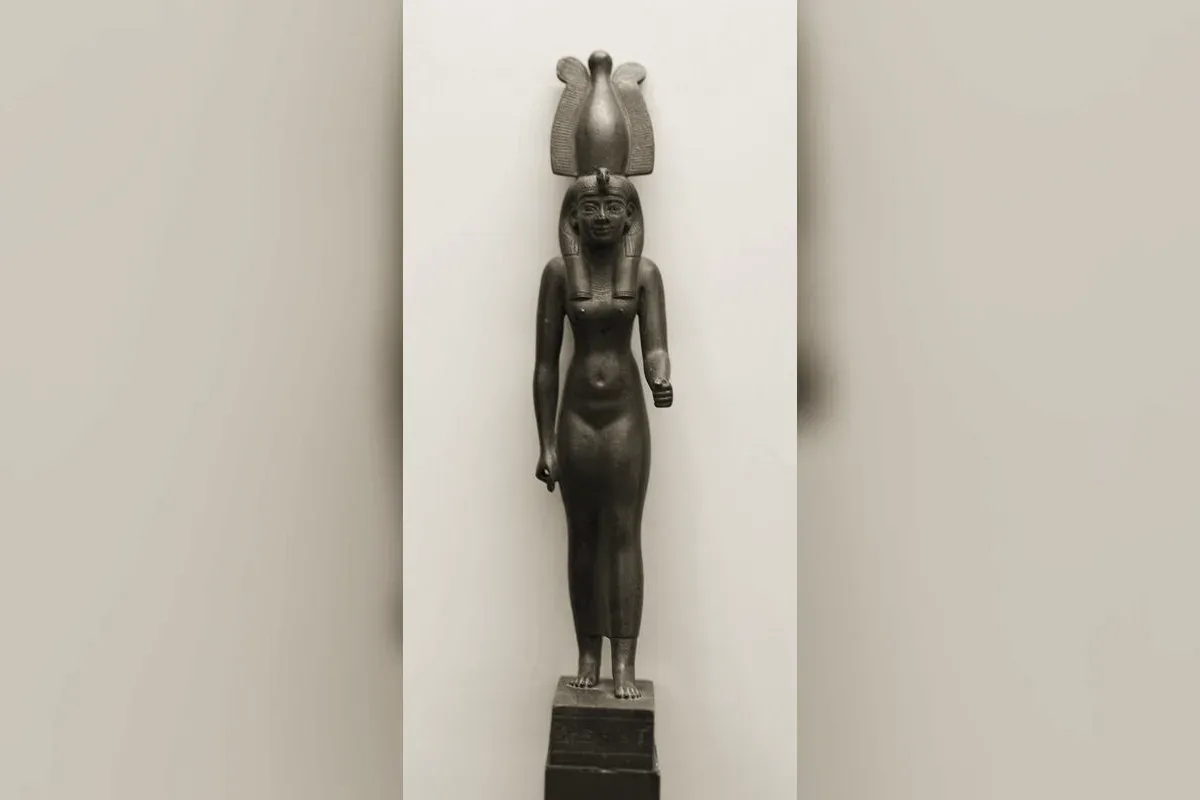
Who is Nekhbet?
Nekhbet is the vulture goddess of the town of Nekheb, modern el-Kab, and the appointed patron of Upper Egypt. She is shown hovering above the pharaoh, wings spread, the shen ring gripped in her talons. With the cobra Wadjet, mistress of the Delta, she forms the Two Ladies whose joint name makes up one of the king’s five official titles.
Her name says nothing more than “she of Nekheb”. She is a deity of territory, and that is exactly what makes her indispensable: in a country founded on the union of two halves, it takes two goddesses before unity can be stated at all.
The vulture is the sign for “mother”
The choice of bird surprises modern readers, who associate vultures with carrion. Egyptians saw something else entirely. The hieroglyph of the Egyptian vulture writes the ordinary word mwt, “mother” — the same word that gives the Theban goddess Mut her name.
A vulture hovering above the king is therefore not a threat: it is brooding. Temple corridor ceilings are covered with these wide-winged silhouettes, lined up along the processional route so that the ruler walks permanently under maternal cover. In the talons, the shen ring — a rope knotted into a loop — signifies what is encircled, and so kept safe.
The vulture headdress worn by great royal wives follows the same logic: the queen puts on the bird to signal that she occupies the place of the divine mother. On the funerary mask of Tutankhamun, a vulture head and a cobra head sit side by side on the king’s brow.
The Two Ladies, or unity in two persons
The nebty title, “he of the Two Ladies”, appears in the royal titulary from the earliest dynasties and holds its place down to Roman times. It names no abstract symbols but two specific, located goddesses: Nekhbet of Nekheb in the south, Wadjet of Buto in the north.
The formula rewards a pause. A king of Egypt might simply have called himself “king of the land”; instead he chose to state, inside his own official name, that the land is double and holds together only because two distinct powers agree to guarantee it. Nekhbet carries the White Crown, Wadjet the Red Crown; combined, they make the pschent, the double crown only the pharaoh wears — and which Mut is the one goddess regularly shown wearing.
The same reasoning governs other official pairings. Late divine lists attach both goddesses to Hapi, god of the inundation, as regional consorts, one for each half of the country: the fertility of the river, too, is presented as two reconciled copies of itself.
Nekheb and Nekhen, a capital older than Egypt
Nekhbet’s sanctuary stands at el-Kab, on the right bank of the Nile roughly a hundred kilometres south of Luxor. The site is among the oldest in the country, facing Nekhen across the river — Hierakonpolis to the Greeks — the town from which, in all likelihood, the kings who unified Egypt at the end of the fourth millennium set out.
Nekhbet is therefore no provincial deity promoted by accident. She is the goddess of the cradle of kingship, which explains both her presence in the titulary from the very beginning and her stability across three thousand years.
El-Kab still preserves a colossal mudbrick enclosure, a square several hundred metres to a side, wrapped around the temple area. The neighbouring cliffs hold the tombs of early New Kingdom notables, among them Ahmose son of Ibana, a naval officer whose autobiography, carved on the tomb wall, remains one of the principal sources for the war against the Hyksos.
What the ancient sources say
Nekhbet appears as early as the Pyramid Texts, where she protects and suckles the dead king; the Coffin Texts continue that role of divine nurse. The surviving epithets are grand — “father of fathers, mother of mothers” — but none of them tells a story: like many tutelary deities, Nekhbet is rich in formulae and poor in narrative.
Most of her documentation is consequently epigraphic and iconographic: the Nebty names borne by every king, the vultures on temple ceilings, the reliefs of el-Kab reworked down to Ptolemaic times.
Greek and Roman authors know her mainly under her translation. Strabo, describing the Nile valley in book XVII of his Geography, mentions the city of Eileithyiaspolis — the city of Eileithyia — that is, Nekheb. Equating her with the Greek goddess of childbirth keeps Nekhbet’s obstetric function and drops the sovereign: a clean example of what Greek interpretationes illuminate and what they erase.
A goddess with no myth, yet present everywhere
No text recounts Nekhbet’s birth; no episode shows her fighting, travelling or suffering. She takes no part in the Osiris myth or in the great solar narratives. Her modern fame suffers accordingly: she is far less known than Isis or Hathor.
What she measures instead is something myths do not say: how a state religion manufactures legitimacy. For three thousand years no king could pronounce his full name without naming, in the same breath, a vulture goddess of Upper Egypt and a cobra goddess of the Delta. Theology needed no story for that. A title, repeated on every monument, was enough.
Further reading
For the other half of the Two Ladies, read the page on Wadjet. For the inundation god whom late lists pair with her, see Hapi. For the goddess who shares her bird and her maternal function, see Mut. For royal protection in other forms, read Horus and Isis, and for the order she underwrites, the page on Maat.
Ancient sources
- Pyramid Texts
- Coffin Texts
- Royal titulary, the Nebty name ('he of the Two Ladies')
- Inscriptions of the temple of Nekhbet at el-Kab
- Strabo, Geography, XVII
See also
Related entries
Frequently asked questions
Why is Nekhbet shown as a vulture?
Because for Egyptians the vulture is the animal of motherhood: the hieroglyph that writes the word *mut*, 'mother', is that very bird. There is nothing morbid in the choice. A vulture hovering above the king with wings spread wide says literally that a mother covers him, and the iconography almost always adds the *shen* ring in her talons, the sign of what is encircled and therefore guarded.
What is the difference between Nekhbet and Wadjet?
Geography, first of all. Nekhbet is the vulture of Nekheb in Upper Egypt, tied to the White Crown of the South; Wadjet is the cobra of Buto in the Delta, tied to the Red Crown of the North. Their functions overlap — protecting the king, embodying one half of the country — but they are never interchangeable: their whole point is that there are two of them.
Where can you still see Nekhbet's temple?
At el-Kab, on the east bank of the Nile about a hundred kilometres south of Luxor. The site keeps a colossal mudbrick enclosure wall several hundred metres to a side, and the nearby cliffs hold early New Kingdom rock tombs, including that of Ahmose son of Ibana, whose autobiography is a key source on the war against the Hyksos. The goddess's town doubles as an archive.