Greek mythology · Creatures
Typhon, the monster who challenged Zeus in Greek mythology
In brief
Typhon in Greek mythology: father of monsters, last son of Gaia, the storm-giant who nearly toppled Zeus in the Typhonomachy, and prisoner beneath Mount Etna.
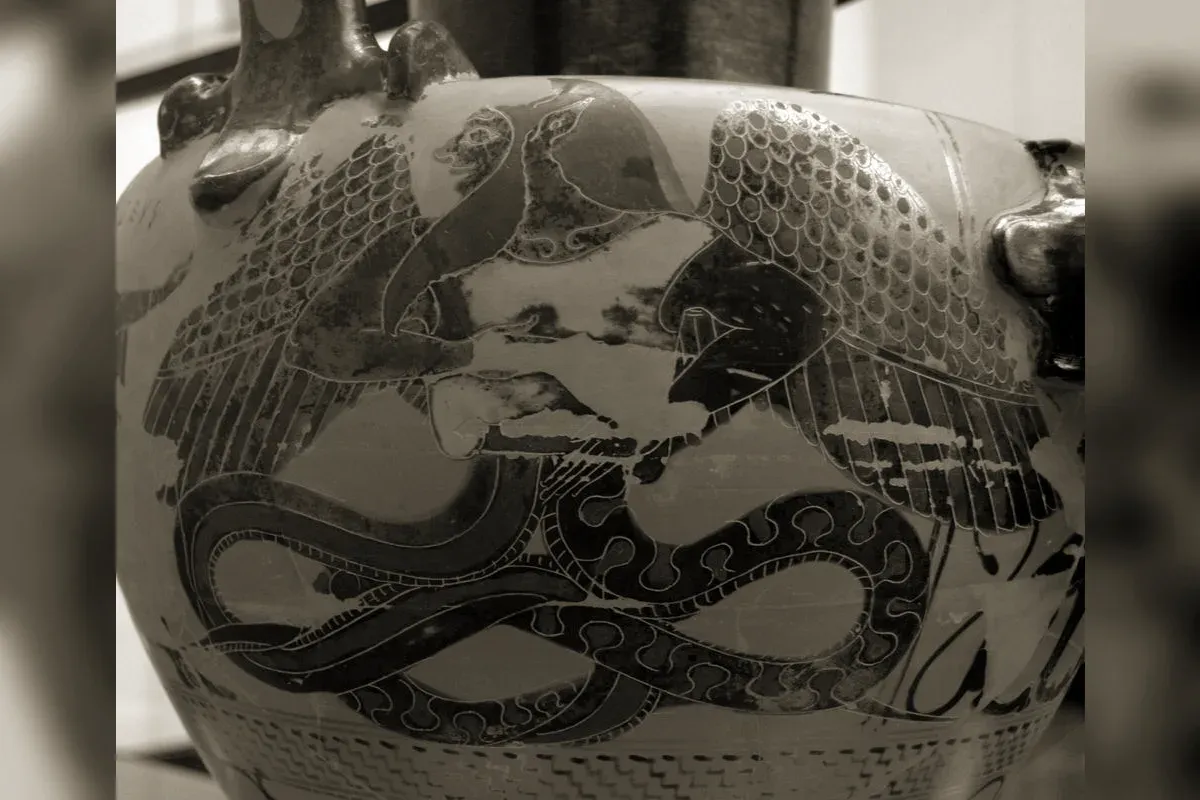
Typhon is the ultimate monster of Greek mythology: the adversary that even Zeus, king of the gods, nearly failed to defeat. Born of the Earth herself to avenge the powers crushed by Olympus, he embodies the last revolt of primordial chaos against divine order. From his union with Echidna descends almost the entire monstrous bestiary of Greece — which makes him not one monster among many, but the very wellspring of monstrousness.
A child of Earth and Abyss
According to Hesiod’s Theogony, Typhon is the last offspring of Gaia, the Earth, joined with Tartarus, the primordial abyss. His birth is no accident: it follows Zeus’s victory over the Titans in the Titanomachy and, in other traditions, the failure of the Gigantomachy. Enraged at seeing her offspring chained in the depths, Gaia brings forth a creature conceived for a single purpose: to dethrone the new lord of the sky.
This genealogy places Typhon in the lineage of telluric, chthonic forces — those that precede the gods and threaten to swallow them. He is no mere beast: he is the final insurrection of primordial matter against Olympian civilization.
A body of terror
Hesiod’s description of Typhon is among the most terrifying in Greek literature. The monster is so vast that his head brushes the stars, and his outstretched arms reach from the eastern to the western edge of the world. From his shoulders spring a hundred dragon heads, their eyes flashing fire. Each speaks a different voice: sometimes a language the gods can understand, sometimes the bellow of a bull, the roar of a lion, the baying of hounds, or a hiss that echoes through the mountains.
From the waist down he has no human legs but immense coiled viper-loops, hissing. Winged and scaled, he hurls flaming boulders and raises storms. His mere appearance, Hesiod says, might have made him ruler of mortals and immortals alike, had Zeus not acted in time.
The Typhonomachy: the duel for the cosmos
The battle between Zeus and Typhon, the Typhonomachy, is the last great cosmic confrontation of Greek mythology. In Hesiod, Zeus sees the danger, seizes his thunderbolt, and strikes without pause. The battle sets earth, sea, and sky ablaze: the waters boil, and Tartarus itself trembles beneath the blows. Zeus finally blasts the monster and casts him into the abyss.
But a second tradition, transmitted by Apollodorus, tells a far more dramatic story. In the first assault, Typhon manages to disarm Zeus: he wrenches away the god’s adamantine sickle and cuts out the sinews of his hands and feet. Helpless, the king of the gods is hidden in a Cilician cave, his sinews concealed in a bearskin and guarded by the she-dragon Delphyne. It is Hermes, aided by Pan (or Aegipan), who steals the sinews back and restores them to Zeus. Recovered, the god renews the offensive, overwhelms Typhon with lightning, and drives him across Greece as far as Sicily.
This version, in which the lord of Olympus is briefly defeated and mutilated, underscores the gravity of the threat: never was divine order so close to collapse.
Etna, the monster’s prison
Typhon’s defeat does not kill him; it imprisons him. Zeus crushes him beneath Mount Etna in Sicily or, in other sources, buries him in the volcanic Phlegraean Fields. For the Greeks, the volcano’s eruptions, rumblings, and lava flows are the writhing of Typhon, still alive beneath the mountain, breathing out the fire of his inextinguishable rage.
This aetiology makes Typhon far more than a narrative character: he becomes the mythic explanation of a real and frightening natural phenomenon. The defeated monster is not annihilated but contained — just as the Titans are held in Tartarus, chthonic power lies coiled beneath the Olympian order it still threatens.
The father of monsters
Typhon’s most enduring legacy is not his battle but his fatherhood. From his union with Echidna, the half-woman, half-serpent viper, descends the bulk of the Greek bestiary. Born of this pair, according to Hesiod and the mythographers, are:
- Orthrus, Geryon’s two-headed watchdog, named first by Hesiod;
- Cerberus, the many-headed hound that guards the Underworld;
- the Lernaean Hydra, with her immortal venom, slain by Heracles;
- the Chimera, the fire-breathing hybrid;
- the Sphinx, the riddling monster of Thebes;
- the Nemean Lion and, in some versions, the Caucasian eagle that devours Prometheus.
This progeny makes Typhon the genealogical root of Greek monstrousness. The heroes who triumph over these creatures — Heracles, Bellerophon, Oedipus — are each, in truth, fighting a fragment of Typhon. To defeat a monster is to extend Zeus’s victory over chaos.
Symbolic reading
Typhon distills a central idea of Greek thought: the order of the world (kosmos) is never guaranteed. It rests on a victory that must be defended endlessly against the forces of disorder. The hundred-voiced monster, a jumble of every animal cry, figures primordial confusion — the exact opposite of logos, the articulate speech that distinguishes gods and civilized men.
His name has even survived to our own day: the typhoon, the devastating tropical storm, preserves the memory of the creature of hurricane and fire. Defeated and buried, he still rumbles — a reminder that chaos is never finally subdued, only contained.
Ancient sources
- Hesiod, Theogony, lines 820–880
- Apollodorus, Library, I, 6
- Pindar, Pythian I
- Aeschylus, Prometheus Bound
- Nonnus, Dionysiaca, I–II
See also
Related entries
- Gaia, the primordial Earth and mother of the Greek gods
- Tartarus: the primordial abyss and Titan prison in Greek mythology
- Orthrus, the two-headed dog of Geryon in Greek mythology
- Cerberus, guardian of the Underworld in Greek mythology
- The Lernaean Hydra, the many-headed serpent of Greek mythology
- The Chimera, fire-breathing hybrid monster of Greek mythology
- The Sphinx of Greek Mythology: the creature with the fatal riddle
- Nemean lion: the invulnerable beast of Heracles' first labor
- Ladon: the dragon guarding the golden apples of the Hesperides
- Echidna, mother of monsters in Greek mythology
Frequently asked questions
Who is Typhon in Greek mythology?
Typhon is the most formidable of all Greek monsters, the last child of Gaia and Tartarus, born to avenge the defeated Titans and Giants. A creature with a hundred dragon heads, he attempts to overthrow Zeus and seize the throne of the cosmos. Defeated, he becomes, with Echidna, the father of most of the famous monsters of Greek myth.
Why did Typhon fight Zeus?
According to Hesiod, Gaia bore Typhon after the Titans lost the Titanomachy and the Giants were crushed, to punish Zeus for subduing her offspring. The battle, called the Typhonomachy, is therefore the last assault of the primordial, chthonic forces against the newly established Olympian order — the final serious threat to Zeus's reign.
How did Zeus defeat Typhon?
After an initial clash in which, according to Apollodorus, Typhon tears out his sinews, Zeus recovers his strength, overwhelms the monster with a barrage of thunderbolts, and pursues him until he crushes him. He buries him beneath Mount Etna in Sicily: in Greek tradition, the volcano's eruptions and rumblings are the fury of Typhon, still alive beneath the mountain.