Greek mythology · Gods & goddesses
Epimetheus, the Titan of afterthought who took Pandora in
In brief
Epimetheus, brother of Prometheus: the Titan who thinks too late, accepts Pandora in Hesiod and leaves humanity unequipped in Plato.
- hindsight
- the allotment of gifts to living creatures
- the human condition
- Pandora's jar (in later tradition)
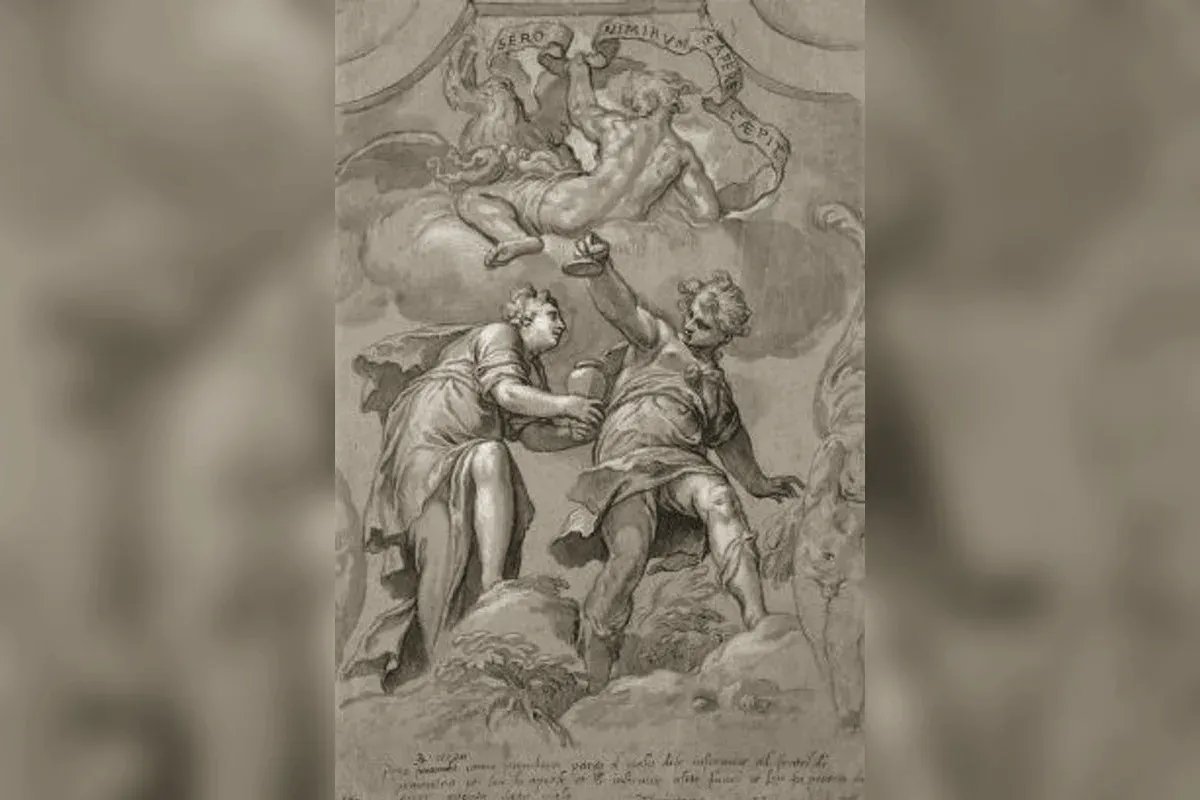
Epimetheus is the Titan whose name means “the one who thinks too late”. A son of Iapetus and brother of Prometheus and Atlas, he is defined in the surviving literary accounts by one decision: he accepted Pandora despite his brother’s warning. Hesiod uses that lapse to explain why human beings labour, age and die; Plato, several centuries later, turns the same figure into the accidental origin of human crafts.
A name that is an argument
Archaic Greek has no single word for improvidence, so it manufactures one by reversing Promêtheus. Where pro- puts thought in front of action, epi- puts it behind. Epimetheus is, quite literally, the brother who arrives after the fact.
Hesiod pins on him the adjective hamartinoos, “of the mind that misses its mark” (Works and Days 85-89) — built on the verb that later Greek would use for sin. The point is not dullness. Epimetheus understands perfectly well; he simply understands once the damage is done. The poet spells it out: he took the gift, “and only when the evil was already his did he see it”.
That symmetry of names is probably older than any story told about them, and it accounts for an oddity in the record: Epimetheus has almost no myth of his own. He exists so that Prometheus can have an opposite.
Family: the fourth son of Iapetus
The Theogony places him in a set of four brothers born to the Titan Iapetus and the Oceanid Clymene (507-511): Atlas, Menoetius, Prometheus and Epimetheus. Together they are the figures Zeus has to neutralise after the Titanomachy before the Olympian settlement can hold.
Each brother is dealt with differently. Menoetius is blasted with a thunderbolt and thrown into Erebus. Atlas holds up the sky at the western edge of the world. Prometheus is bound to a pillar with an eagle at his liver. Epimetheus alone is not punished — he is used. Hesiod introduces him as the one “who from the first was a disaster to men who eat bread” (Theogony 512): not a victim of Zeus, but the channel through which Zeus reaches humankind.
Apollodorus supplies the link that Hesiod leaves out. Epimetheus and Pandora have a daughter, Pyrrha, who marries Deucalion, the son of Prometheus (1.2.3; 1.7.2). The feuding brothers are therefore joint grandfathers of the one couple that survives the flood, and post-diluvian humanity descends equally from foresight and from hindsight.
Prometheus’ warning
The whole character turns on some fifteen lines of the Works and Days.
After the theft of fire, Zeus resolves to give men “an evil they will love”. Hephaestus moulds a girl out of earth and water; Athena teaches her weaving; Aphrodite pours grace and aching desire over her; Hermes fits her with “a dog’s mind and a thievish temper”. She is called Pandora, “all-gift”, because every Olympian contributed something.
Prometheus had seen this coming and warned his brother never to accept a gift from Zeus, but to send it back. Epimetheus forgot the warning. Hermes then brought Pandora to him, and he accepted her.
What follows is the myth of Pandora: the jar opened, the evils scattered, Hope caught under the rim. But the architecture of Hesiod’s story deserves attention. Before Pandora opens the jar, Epimetheus has already ignored an explicit warning. The poet builds a chain in which every link is a misjudgement: Prometheus cheats Zeus, Zeus retaliates with a gift, Epimetheus accepts it, Pandora opens it.
Plato’s rewrite: the founding oversight
In the Protagoras (320d-322a) the sophist tells Socrates a wholly different version, and the divergence is instructive.
At the beginning, the gods shape the mortal species and hand Prometheus and Epimetheus the job of equipping them. Epimetheus asks to make the distribution by himself, with his brother inspecting afterwards. He does it like a competent administrator: he offsets weakness with speed, small size with flight or burrowing, cold with thick hair, and calibrates fertility so that prey species are not eaten out of existence.
Then he reaches humankind and finds the stores empty. Man is left “naked, unshod, unbedded and unarmed”. Only at that point does Prometheus steal fire and technical skill from Hephaestus and Athena — the episode told in Prometheus and the theft of fire.
The shift matters. In Hesiod, the mistake of Epimetheus lets evil into the world. In Plato, it makes civilisation necessary: had he provisioned humans adequately, they would have had a sufficient nature and never needed arts at all. Protagoras then presses the point further — craft alone does not make a city, so Zeus must distribute justice and political sense to everyone. The myth has become an argument that every citizen can be taught virtue.
What the figure is for
Epimetheus is one of the few Greek figures who exists purely as an idea given a body, and the ancients knew it.
His narrative job is to be the latch. In a story where humankind might still slip out of divine punishment, someone has to open the door. That someone cannot be a god, or Zeus would carry direct responsibility; it cannot be a mortal, or the fault would be one man’s rather than the species’. It has to be a Titan: divine by birth, turned toward mortals by sympathy.
His moral job is subtler. Greek culture prizes mêtis, the cunning intelligence that anticipates. Epimetheus is its exact privation, and the myth implies that this privation is not one man’s flaw but part of being human: nobody foresees everything, and some mistakes cannot be walked back. Hesiod stresses that Epimetheus had been warned. His failing is the failing of anyone who receives sound advice and understands it only after the damage.
Afterlife of a name
He passes through antiquity without worship. Hyginus barely lists him (Fabulae 142); vase painters preferred Pandora and Hephaestus. He resurfaces when Renaissance humanists rediscover the Protagoras, and again in German letters: Goethe’s unfinished drama Pandora (1808) centres on an aged Epimetheus contemplating what his choice cost him.
The adjective “Epimethean” is still used for a stance that responds only after the harm, as against the “Promethean” that anticipates and transforms. The pair has had a long career in debates about technology, where the question the Protagoras poses — is the human animal permanently under-equipped, obliged to build itself artificial organs? — has lost none of its bite.
Further reading
For the forward-looking brother he mirrors, see the entry on Prometheus; for the father of all four punished Titans, Iapetus; and for the brother sentenced to carry the sky, Atlas. The gift he accepted is told in full in the myth of Pandora, and the episode that provokes it in Prometheus and the theft of fire. For the war that settles the fate of his generation, read the Titanomachy.
Ancient sources
- Hesiod, Theogony, 507-516 and 570-593
- Hesiod, Works and Days, 42-105
- Plato, Protagoras, 320d-322a
- Apollodorus, Library, 1.2.3 and 1.7.2
- Hyginus, Fabulae, 142
See also
Frequently asked questions
What is Epimetheus the god of?
Epimetheus is not assigned a divine province in the cited literary sources. He is a second-generation Titan, son of Iapetus and brother of Prometheus, Atlas and Menoetius. In Hesiod, his defining act is accepting Pandora despite Prometheus' warning not to accept a gift from Zeus.
How are Prometheus and Epimetheus opposites?
Their names are a matched pair built on the same root: pro-metheus thinks before acting, epi-metheus thinks after. Hesiod calls him hamartinoos, 'of the mind that misses its mark'. He is not stupid — he grasps everything, but always one moment too late, which in a myth about irreversible choices is the worse failing.
Why does Plato make Epimetheus responsible for human technology?
In the Protagoras, Epimetheus talks his brother into letting him hand out the natural endowments alone. He spends claws, speed, fur and fertility on the animals, then reaches humankind with nothing left in stock. Prometheus steals fire and craft only to repair that shortfall, so in Plato's telling technology is the consequence of an oversight rather than of a crime.