Greek mythology · Origins
Prometheus and the Theft of Fire: the punished benefactor
In brief
The myth of Prometheus: the Titan who steals fire from the gods for humankind, tricks Zeus at the sacrifice, and endures eternal torment in the Caucasus.
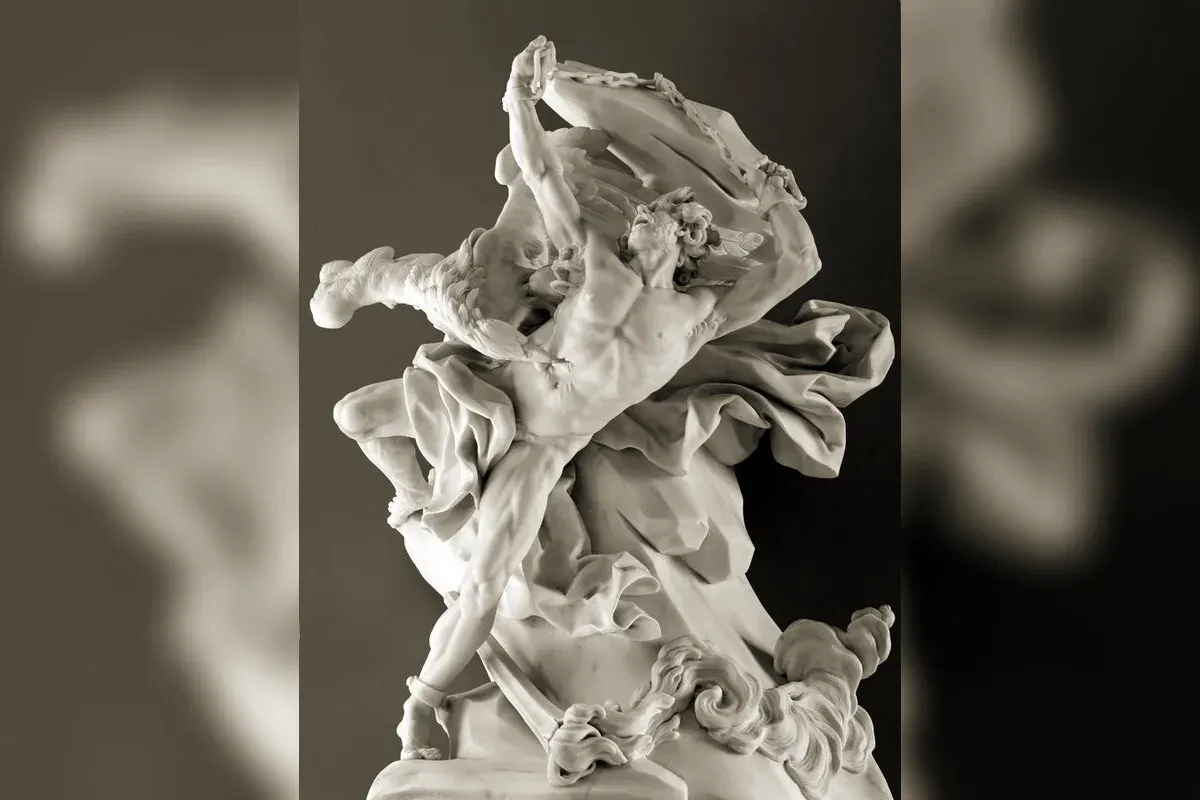
Prometheus is the great benefactor of humankind in Greek mythology: a Titan who chooses the side of mortals against the gods, brings them fire stolen from Olympus, and pays for it with eternal torment. His very name, Prometheus, means “the forethinker,” “the one who thinks ahead.” Told by Hesiod, then magnified in Prometheus Bound, a tragedy traditionally attributed to Aeschylus, his myth poses a question that runs through all of Western culture: how far can human intelligence defy the established order, and at what cost?
A Titan on the side of humankind
Prometheus belongs to the generation of the Titans, son of Iapetus, yet he did not fight Zeus during the Titanomachy: he even sided with the Olympians, which at first earned their trust. This is what makes his path singular — he is not a defeated enemy, but an intimate who turns away.
In a tradition reported notably by the Library attributed to Apollodorus, Prometheus is also the shaper of humanity: he molds the first humans from earth and water. That creation does not appear in Hesiod’s account, where Prometheus protects mortals rather than creating them. Depending on the version, Prometheus takes them under his care against gods who are indifferent, even hostile.
The trick at Mecone: deceiving Zeus
The conflict breaks out at a sacrificial division at Mecone, where it must be settled, once and for all, which portion of the sacrificed animal goes to the gods and which to humans. Prometheus, charged with the arbitration, sets a trap.
He divides an ox into two deceptive portions:
- on one side, the nourishing meat and entrails, concealed beneath the animal’s repellent stomach;
- on the other, the bare bones, covered with a layer of glistening, appetizing fat.
He invites Zeus to choose. The king of the gods, taking the portion that looks finer, ends up with the bones. According to Hesiod, Zeus is not fooled and sees through the trick — but he deliberately chooses the bones so as to have a pretext for his wrath. Ever since, humans burn the bones and fat for the gods and keep the meat: the myth thus explains the Greek ritual of sacrifice.
Zeus deprives humankind of fire
Furious at being defied, Zeus takes revenge on Prometheus’s protégés: he deprives mortals of fire. Without fire, there is no cooking, no metalwork, no warmth or craft: humanity is condemned to an animal life, raw and cold.
Here Prometheus commits his decisive transgression. He steals a spark of the divine fire — from the forge of Hephaestus or from the chariot of the Sun, depending on the version — and hides it in the hollow stalk of a fennel, a plant whose pith burns slowly. He thus carries fire down to earth and returns it to humankind. With it come the arts, the crafts, and the promise of civilization.
The torment of the Caucasus
Zeus’s punishment is terrible and twofold. Against humanity, he sends Pandora, the first woman, bearer of the jar from which all the world’s evils will escape — a story you can follow in the myth of Pandora.
Against Prometheus himself, the punishment is physical and unending. Zeus has him chained to a rock in the Caucasus, at the edge of the world. Each day an eagle comes to devour his liver; each night the organ grows back, so that the torture resumes without end. The torment of Prometheus becomes the very image of suffering without escape, inflicted on the one who gave too much to humankind.
The deliverance by Heracles
The torment, however, is not eternal. Generations later, the hero Heracles, in the course of his wanderings, reaches the Caucasus. He shoots the eagle with an arrow and breaks Prometheus’s chains.
His release is also the fruit of a bargain: Prometheus holds a secret that Zeus dreads — the prophecy that a son born of the goddess Thetis would be mightier than his father. By revealing this knowledge, Prometheus allows Zeus to avoid his own downfall (Thetis will be married to a mortal, and their son will be Achilles). The reconciliation seals the passage from open revolt to an order in which even Zeus must come to terms with the Titan’s forethought.
What the ancient sources change
In Hesiod (Theogony, Works and Days), Prometheus is above all a trickster whose daring brings misfortune upon humankind: the poet dwells on Pandora and on the price of transgression, in a tone wary of progress.
Aeschylus, in Prometheus Bound, reverses the perspective: his Titan becomes a hero of resistance, a benefactor unjustly tortured by a tyrannical Zeus. It is he who gave humans not only fire but writing, number, medicine, and astronomy — all the arts that lift them out of animality.
Plato, in the Protagoras, offers a rationalized version: Prometheus steals fire and technical skill because his brother Epimetheus, “the one who thinks afterward,” had exhausted all the qualities by distributing them to the animals and forgot humankind. The theft of fire repairs this original oversight.
The meaning of the myth
Far beyond Greece, Prometheus has become the symbol of rebellious intelligence and of progress wrested from the gods. Romanticism made him the figure of the revolted genius; Mary Shelley subtitled her Frankenstein “the Modern Prometheus”; science itself sometimes thinks of itself as Promethean. The myth poses a tension never resolved: every human advance is at once a gift and a transgression, a light and a debt.
Further reading
To place Prometheus within the birth of the Greek world, read the Greek creation myth. For the war of the gods he lived through without fighting Zeus, see the Titanomachy. For the punishment sent to humankind in answer to the theft of fire, read the myth of Pandora. For the hero who delivers him from his torment, consult the page on Heracles. For the god whose forge supplies the stolen fire, see the page on Hephaestus. For the two enforcers who drag him to the rock in Aeschylus’s tragedy, Kratos and Bia, and for their sister Victory, see Nike.
Story beats
- 01Prometheus shapes humankind and takes their side
- 02The trick at Mecone: Zeus deceived over the sacrificial portions
- 03Zeus deprives mortals of fire
- 04Prometheus steals fire in a fennel stalk
- 05The torment in the Caucasus: the eagle and the regrowing liver
- 06The deliverance by Heracles
Ancient sources
- Hesiod, Theogony
- Hesiod, Works and Days
- Aeschylus, Prometheus Bound
- Plato, Protagoras
See also
Frequently asked questions
Why did Prometheus steal fire?
After siding with humankind at the sacrificial division at Mecone, Prometheus watched Zeus deprive them of fire in revenge. To make humanity able to cook, keep warm, and develop the arts and crafts, Prometheus stole a spark of the heavenly fire and hid it in a fennel stalk to give it to mortals.
What is the punishment of Prometheus?
Zeus had him chained to a rock in the Caucasus. Each day an eagle came to devour his liver, which grew back during the night, so that the torment began again endlessly. Prometheus remained thus tortured for generations, until his deliverance by the hero Heracles, who killed the eagle with an arrow.
What does the myth of Prometheus symbolize?
Prometheus symbolizes forethought, cunning, and revolt in the service of humanity. The fire he brings represents civilization itself: cooking, metalwork, crafts, and the arts. The myth says that human progress is born of a transgression against divine order, and that it comes at a price.