Greek mythology · Gods & goddesses
Hestia, Greek goddess of the hearth and home
In brief
Hestia, Greek goddess of the domestic and civic hearth: her vow of virginity, her disputed place among the twelve Olympians, and the eternal flame of the prytaneum.
- domestic hearth
- sacred fire
- family life
- civic unity
- +4
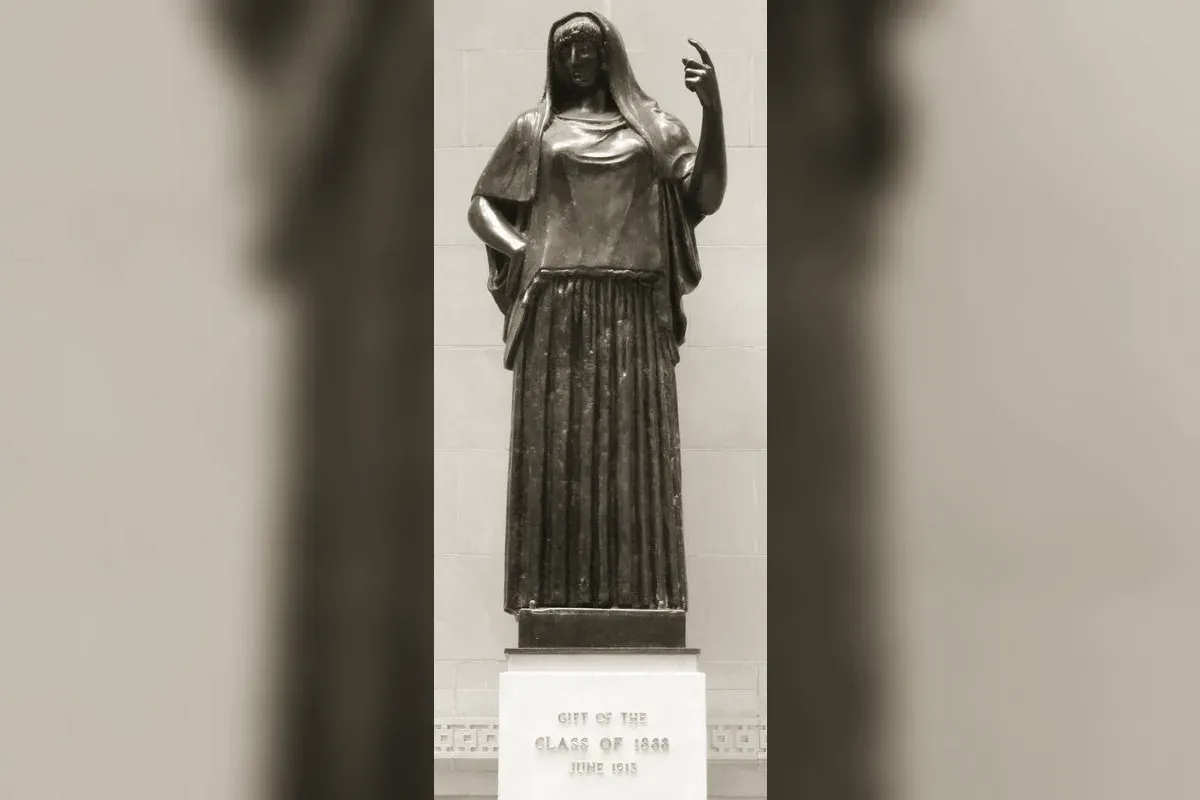
Who is Hestia?
Hestia is the Greek goddess of the domestic and civic hearth — the flame burning at the center of every home and every city. Eldest daughter of Cronus and Rhea, sister of Zeus, Hera, Poseidon, Hades, and Demeter, she occupies a unique place among the Olympians: no dramatic adventure narrative, no temple built around a monumental cult statue, yet invoked before every other god at every domestic sacrifice.
Role, nature, and domain
Hestia governs neither the sea, nor war, nor love: she guarantees stability itself. Every Greek household kept a central hearth where a fire was tended and never allowed to fully die out — that fire was Hestia, concretely present in the domestic space. At the level of the city-state, the civic equivalent was the hearth of the prytaneum, where the community’s public flame burned.
This dual dimension — private and civic — explains why the Greeks systematically invoked her at the opening and closing of every sacrifice, following the proverbial formula “Hestia first, Hestia last”: no rite could begin or end without her.
Birth and genealogy
Hestia is the eldest child of Cronus and Rhea — and thus the first swallowed by her father, who feared being overthrown, according to the myth reported by Hesiod in the Theogony. She is also, paradoxically, the last to be freed when Zeus forces Cronus to disgorge his children after the Titanomachy. This position — firstborn, last freed — feeds one of her ritual epithets, “the First and the Last.”
The vow of perpetual virginity
According to the Homeric Hymn to Aphrodite, both Apollo and Poseidon seek Hestia’s hand. She refuses both suitors and swears on Zeus’s head to remain a virgin forever. In exchange for this vow, Zeus grants her a unique honor: to receive the finest portion of every sacrifice offered to the gods, in every hearth and every temple across Greece. This bargain sums up her theological function: renouncing union and descent in order to embody permanence rather than lineage.
Hestia and the list of the twelve Olympians
Hestia’s membership among the twelve Olympians is the most disputed thing about her, and the dispute is usually framed the wrong way.
A story circulates that Hestia stepped down in favour of Dionysus to keep peace on Olympus. No ancient source records it. It is a modern explanation intended to supply a narrative reason for lists that simply do not agree with one another. Hesiod is often cited in support and says nothing of the kind: he gives no canonical roster of the Twelve at all, only a birth order in which Hestia comes first among the children of Cronus and Rhea (Theogony 453–455).
The real phenomenon is the instability of the lists. The “twelve gods” were a cultic and iconographic grouping before they were ever a doctrine, and their membership varies by city, by period, and by monument — some assemblies count Hestia, others Dionysus, others include figures a modern reader would not expect. There was never one fixed roster that Dionysus’s arrival forced anyone to amend.
One particularly explicit ancient passage sets Hestia apart from the rest, and it makes a different point. In Plato (Phaedrus 247a), when the procession of the gods sweeps out across the sky behind Zeus, “Hestia alone remains in the house of the gods.” She does not withdraw; she does not move, because not moving is what she is. The hearth is what stays when everything else is in motion.
Cult and civic rites
Hestia’s cult almost never produced narrative iconography or monumental sanctuaries comparable to those of Zeus or Athena — a logical coherence for a goddess whose cult was lived first in the intimacy of the home. Diodorus Siculus (Library of History 5.68.1) supplies an aetiology for exactly that: Hestia discovered how to build houses, and in return for this benefaction nearly all people set up her shrine in their own dwellings. The goddess is attached not to a temple but to the house as an institution.
Her most significant rite remained the transmission of fire: when a Greek city founded a colony, the settlers carried a flame taken from the mother city’s public hearth to light the new city’s hearth, symbolically sealing their filiation.
What ancient sources say
Hesiod’s Theogony (8th–7th century BC, lines 453–455) puts her first among the children of Cronus and Rhea — a birth order, not a roster of the Twelve. The Homeric Hymn to Aphrodite (no. 5, lines 21–32) reports her vow of virginity, her double refusal of Apollo and Poseidon, and the compensation Zeus grants her. The Homeric Hymn to Hestia (no. 29), brief but explicit, closely associates her with Hermes and celebrates her presence in every human dwelling. Plato (Phaedrus 247a) leaves her at home while the other gods ride across the sky. Diodorus Siculus (5.68.1) grounds her domestic cult in the invention of the house.
None of these texts mentions a traded seat with Dionysus: that story does not belong to the ancient corpus.
Further reading
For the Olympian siblings whose eldest Hestia is, see the pages on Zeus, Hera, and Poseidon. For the god she is wrongly said to have made way for, see the page on Dionysus. To place Hestia within Greek cosmogony, read the myth of the Titanomachy.
Ancient sources
- Hesiod, Theogony, lines 453-455
- Homeric Hymn to Aphrodite (no. 5), lines 21-32
- Homeric Hymn to Hestia (no. 29)
- Plato, Phaedrus, 247a
- Diodorus Siculus, Library of History, 5.68.1
See also
Frequently asked questions
Why doesn't Hestia have a famous myth like other Olympians?
Because her very nature demands it: Hestia is the goddess of stability and sacred stillness. Unlike Zeus or Aphrodite, she does not travel, quarrel, or take a consort. Ancient authors describe her less through adventure narratives than through her constant ritual role — invoked first and last at every sacrifice, but rarely cast as a character in a plot.
Did Hestia give up her seat among the twelve Olympians to Dionysus?
No surviving ancient text tells that story. It is a modern explanation proposed to reconcile lists that disagree, not an attested Greek myth. What is genuine is the variation itself: the membership of the 'twelve gods' shifts from city to city and from monument to monument, some groupings including Hestia and others Dionysus. One particularly explicit ancient passage is Plato (Phaedrus 247a), where the gods ride out across the heavens and 'Hestia alone remains in the house of the gods' — she stays because she is immobile by definition, not because she resigned anything.
What was the public hearth Hestia guarded?
Every Greek city-state kept a perpetual fire burning in its prytaneum, the civic building dedicated to Hestia. This fire was never allowed to go out: it symbolized the community's continuity. When settlers founded a new city, they carried a flame taken from the mother city's hearth to light the colony's own hearth — a ritual gesture binding the new city symbolically to its origin.