Greek mythology · Gods & goddesses
Rhea, mother of Zeus and the Olympians in Greek mythology
In brief
Rhea, Titaness mother of the Olympians: the swaddled stone she gave Cronus, the armed dancers who hid Zeus, and the rock still oiled at Delphi.
- divine motherhood
- fertility
- continuity of generations
- lionesses
- +2
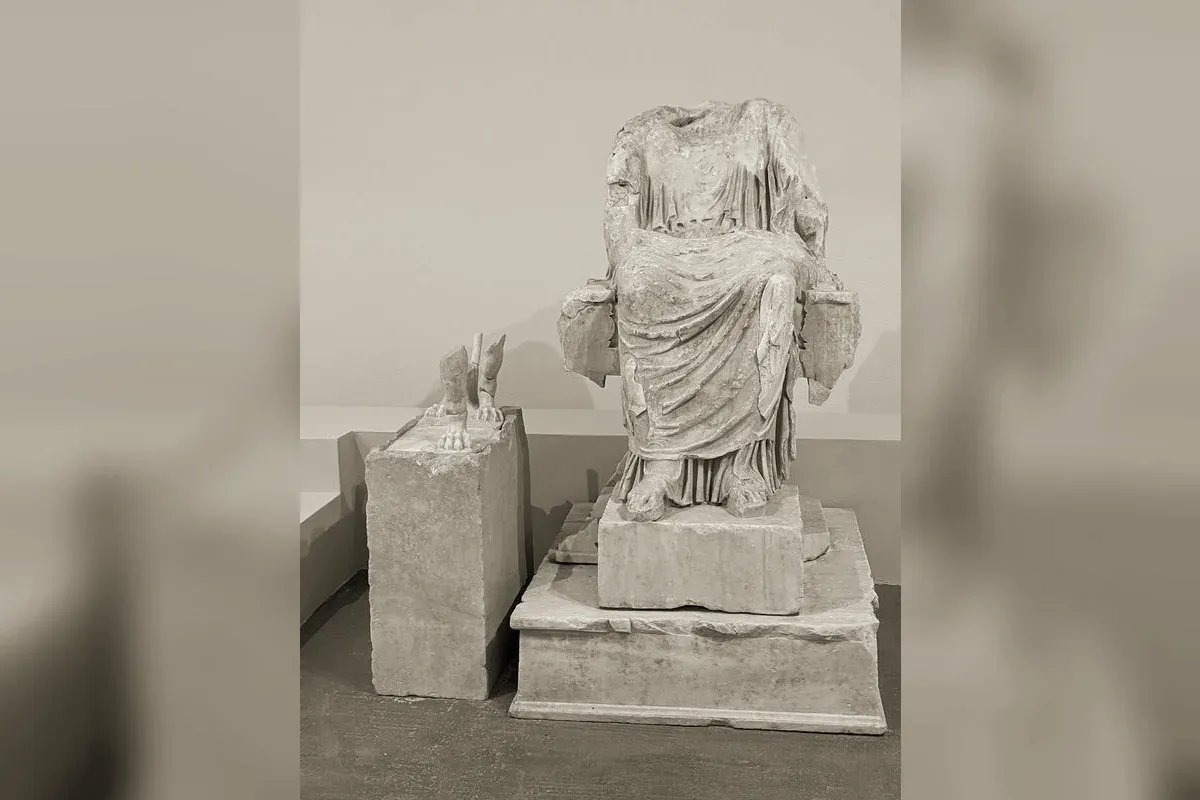
Rhea is the Titaness who ends the first divine dynasty by hiding a baby. Daughter of Uranus and Gaia, sister and wife of Cronus, she is the mother of the six eldest Olympians — and the only figure in the succession myth who defeats a tyrant without violence.
Six children, five swallowed
Warned by his parents that one of his own sons will unseat him as he unseated his father, Cronus adopts the simplest possible countermeasure: he takes each newborn from Rhea and swallows it whole. Hestia, Demeter, Hera, Hades and Poseidon disappear in that order.
Hesiod’s phrasing is worth noticing. Cronus does not kill them — they are alive inside him, which is why they can later be recovered intact, and which makes his solution a containment rather than an execution. What he is doing is refusing to let time proceed.
Pregnant with her sixth, Rhea goes to Uranus and Gaia for advice and is sent to Crete. She gives birth in a cave on Mount Aegaeum — or Ida, or Dicte, depending on the source — hands the infant to Gaia to conceal, and returns with a stone the right size, wrapped in swaddling bands. Cronus swallows it without examining it.
The noise on the mountain
The child cannot be allowed to cry, and Greek tradition supplies a specific and very strange solution: the Curetes, armed young men who dance around the cave, clashing their spears against their shields to drown the sound of an infant.
This is one of the clearest cases in Greek myth of a story built to explain a rite. Armed dances performed by bands of young men were a real feature of Cretan religion and initiation, and the Curetes were a real cult association. The myth explains why they dance; the practice almost certainly came first.
Rhea’s method, throughout, is concealment and substitution rather than force. Gaia arms Cronus with a sickle and tells him to attack. Rhea gives Cronus a stone and says nothing.
The stone at Delphi
When Zeus is grown, Cronus is made to disgorge — by an emetic Metis prepares in some versions — and brings up the swallowed children in reverse order, the stone first.
Zeus sets that stone at Delphi as a marker, and it stayed there. Pausanias, visiting in the second century CE, records seeing it: a stone of no great size, over which the Delphians poured oil every day and laid unspun wool at festivals. A myth about a mother deceiving a cannibal husband ends with an actual object in an actual sanctuary, receiving daily maintenance eight hundred years later.
The Great Mother
From at least the fifth century BCE, Greeks identified Rhea with Cybele, the Phrygian mountain mother, and the two are largely inseparable thereafter. That is where the lions, the frame drum and the ecstatic mountain worship come from; strip them away and Hesiod’s Rhea has almost no iconography of her own.
The merger tells us something about how she was actually used. Rhea does very little in narrative after the Titanomachy — she appears occasionally as a mediator among the gods, and otherwise recedes. What survives is her function: the mother in whom the generations continue despite a father determined to stop them, which is exactly the office Anatolian mother-goddesses already held.
Ancient sources
- Hesiod, Theogony, 453-506 and 617-735
- Apollodorus, Library, 1.1.5-1.2.1
- Pausanias, Description of Greece (10.24.6) for the stone
- Callimachus, Hymn to Zeus
See also
Related entries
- Uranus, the primordial Sky in Greek mythology
- Gaia, the primordial Earth and mother of the Greek gods
- Zeus, king of the gods in Greek mythology
- Poseidon, god of the sea in Greek mythology
- Hades, god of the Underworld in Greek mythology
- Hera, queen of the gods and goddess of marriage
- Demeter, goddess of the harvest and agriculture
- Hestia, Greek goddess of the hearth and home
- Cronus, king of the Titans and father of Zeus in Greek mythology
Stories featuring this entity
Frequently asked questions
Who were the Curetes?
Armed young men who danced around the Cretan cave, clashing spears against shields to drown the cries of the infant Zeus. It is one of the clearest cases in Greek myth of a story built to explain a rite: armed dances performed by bands of young men were a real feature of Cretan religion and initiation, and the Curetes were a real cult association. The myth explains why they dance; the practice came first.
Why is Rhea identified with Cybele?
From at least the fifth century BCE the Greeks merged them, and the two became largely inseparable thereafter. That is where the lions, the frame drum and the ecstatic mountain worship come from — strip them away and Hesiod's Rhea has almost no iconography of her own. The merger tells us how she was used: her function is to be the mother through whom the generations continue despite a father determined to stop them.